This is the final part of Lucas Carroll’s interview with D. C. Schindler. You can access the other parts here: Part I, Part II, and Part III.
DCS: I think we can see something of how authority can be represented, by reference to a beautiful description in Schiller’s Letters on the Aesthetic Education of Man. As we have talked about, I closely link authority to beauty. It has its noetic dimension in virtue of its being intrinsically aesthetic. There is a particular quote from Schiller’s text which I find illustrative:
This genial and aesthetically free treatment of everyday actuality is, when we come across it, the sign of a noble soul. In general, a nature may be called noble which possesses the gift of transforming, by its method of handling it, even the most limited matter and the pettiest object into an infinite one. Every form may be termed noble which impresses the stamp of self-dependence upon something which by its nature merely subserves some purpose (is merely a means). A noble spirit is not satisfied with being itself free; it must set free everything around it, even what is lifeless. But Beauty is the only possible expression of freedom in phenomena.
Being a noble soul, Schiller is saying, means that you want to give dignity to the world around you. To dignify means to show something as not being a mere instrument—to show that the dignified thing has a value in itself. It is to reveal that something is, is true, in an ontological sense. There is a connection between dignifying and allowing something to stand forth into the True. This very concrete, aesthetic sense of authority is, I take it, what allows us to think properly—in a free way. Schiller will also note that there is a certain playfulness to this, a certain humor which attends to it. Not everything depends upon our being able to persuade someone as to a certain conclusion. The quality of the conversation is essentially affirmative and celebratory, allowing things to really be themselves, which, ultimately is what play is. This connects to the noetic dimension of symbolic authority, in that representing that something is true is inseparable from having an ultimately disinterested perspective. I don’t need something to mean a particular thing, my livelihood or my standing doesn’t depend on it. I have a certain nobility, I don’t need to prove myself by making things mean something I need them to mean. I can very peacefully and happily let them be, even if it is contrary to me in some sense. The office itself gives people a kind of freedom to detach even from their own individuality, their personhood.
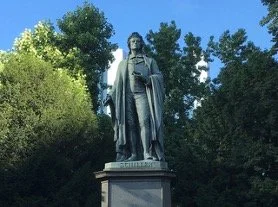
Johannes Dielmann, Friedrich Schiller Monument (Frankfurt am Main), 1859
LBC: Our contemporary imbroglio, though, is one in which the question of the existence of authority as you describe it, has become itself in a way politicized: ‘so, you’re trying to work yourself into an apparent position of disinterestedness… I.e., you are interested in that appearance, in some fashion.’
DCS: Our sense of authority has so radically atrophied that our attempts to reinstall something of a kind authority will tend to have something of a ‘power move’ character to it. But this is why you can’t fix it technologically. It has to be a recovery of something which is already given.
LBC: So far, in our discussion of the noetic effects of symbolic authority, we have spoken the language of phenomenology or hermeneutics – of a horizon of manifestation, etc. – although, also, this has shown itself to be present, too, in the ever-rich thinking of our mutual friend Plato. I am wondering, if we were to countenance this thinking of authority from within what might be considered a differently ‘classical’ epistemology or perhaps ‘metaphysics of knowledge,’ of, say, a Thomistic stripe – wherein there is an order of operations that leads you from your sensible experience with things through abstractive concept-formation and the judgment of existence into a capacity for discursive rationality about these same things – I suppose I am wondering how you would understand the function of a ‘horizon,’ i.e., the precise point at which symbolic authority would intervene in the knowing process. How would you think through the connection of these theoretical frameworks?
DCS: This doesn’t seem to be something Aquinas thought about directly. I can’t help but be very influenced by Ferdinand Ulrich on these matters. It is striking, though—the Thomistic epistemology properly begins from the ens primum cogitum, that being is that which is first to fall into the intellect. Some people will reduce this to our having, perhaps, a concept of being – with the attendant question of how this then relates to other concepts, etc. – but, the ‘being’ first known doesn’t seem to have the quality of a concept. Ulrich really interprets it as the light of reason, distinct from the objects which reason illuminates, as the enabling dimension of the intellect. To say that it is first in the intellect is not to say that the intellect circumscribes it, but rather that this marks, in fact, the opening up of a truly singular horizon, allowing us to think about things as such. Here you can see the Platonic language of the light of the Good. This brings us to another, very intriguing point – one which I do not recall seeing anyone, as of yet, unfold – which is that Aquinas also says that all knowledge in some manner arrives through the senses. So, what is the relation between the initial experience of ‘being’ which opens up the world, and our sense experience? We seem to face a dilemma, insofar as sense experience concerns appearance, which is (apparently!) other than being itself. This, I would be inclined to say, is where beauty comes in. Beauty just is the appearance of being. It is the presence within sense experience of that which transcends mere sense experience, as Plato already saw. It is the invitation of the sensible to grasp things in their being, and not just in their sensible accidents.
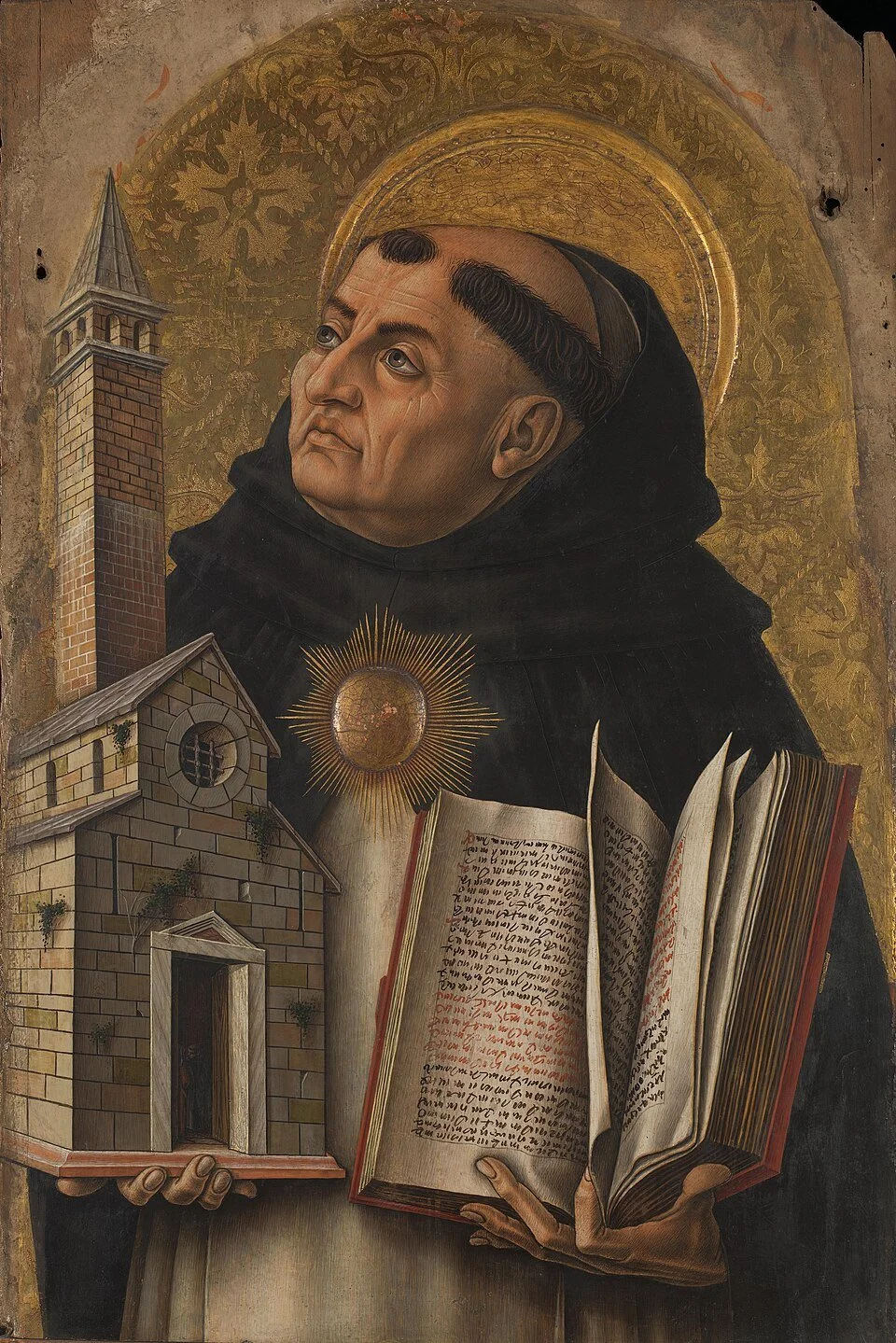
Carlo Crivelli, “Saint Thomas Aquinas,” 1476
LBC: If we say that what symbolic authority does is to recall that aspect of seeing within the context of being, seeing as-being, or, under the aspect of being – and if there were an aberrant, perverse horizon, which the nature of our fallenness frequently imposes upon us, wherein we are inclined to see the thing primarily as an object of use or domination, such as in accordance exclusively with the animal need of consumption, etc., or perhaps in more lofty but still distorted political-polemical contexts, such as ‘what I need in the seeing and saying of this is for it to be expressed in a certain definite way towards my own interests and toward the destruction of my opponents and the confirmation of my friends, etc.,’ – then, what it is that authority is doing is making possible the more adequate judgment of existence with respect to the thing. That is, by opening the thing up in a certain kind of way.
DCS: The political authority recapitulates this fundamental experience. There is a way in which the family is the deepest expression of this in human life, and another in which the political is the paradigm. It is interesting to think through the relation. There is something of a sacramental dimension to authority—its independent validity, irrespective of the quality of its instantiation: ex opere operato, as they say. There is a certain guarantee, in light of its simple being there. Even limited and distorted instances can be recognized as such, against the background of the objectivity of the office they are supposed to represent.
LBC: So, authority helps to return us to what is most proper in our noetic life. We are essentially beings in possession of logos – or, in scholastic language: our substantial form itself is the intellect, defined by the ens primum cogitum –; authority, then, precisely in its noetic dimension is something uniquely humanizing. It returns us into ourselves quahuman, redeeming us from its privative forms, liberating us from being merely interested persons, political actors, etc. It is a sensible reminder of the vocation of man.
DCS: Yes, and this in both form and content. The very reality of authority is to be such a sensible reminder of that which transcends the senses. It is perfectly human in the sense that, what is distinctive about man is to be embodied spirit, transcendent intellect nevertheless incarnated in this particular place and time, accompanied by my given limitations. Political authority represents that to us—reminds us of this transcendence within the immanent. And, if we consider the condition – about which we spoke before – of the absence of authority, of its recapitulating reminder, there is something about thinking that becomes airy. It doesn’t have a weight and substance that sticks to things and allows us to patiently take something in, contemplate it, and think it through, recognizing a certain claim that it has on us. That capacity to attend to something is only possible if reality makes a kind of claim—and, a claim is a kind of analogous expression of authority. Our thinking becomes rootless, arbitrary, and uncertain. There is confusion as a result…
There is a connection between the loss of authority and the rise of ideology as a sort of forma mentis, in the way Augusto Del Noce describes. We can see how certain habits of mind—conspiracy thinking, anti-intellectualism, and so forth—emerge as implications of this loss of authority. So, how does it come back? As you have already indicated, there are very ordinary ways—beauty I think is essential. A teacher who really radiates a love of the truth, that can have some really profound effects upon a person’s capacity to think. – I mean, probably, ultimately, I think this is where the Church has failed in all sorts of tragic ways. There is a sort of ground-up dimension, and there is a top-down dimension. The Church is the ultimate guardian of authority. What is crucial is that there be an authority in the Church who is genuinely dignified, and, who recognizes the office—who isn’t trying to, in a way, reinterpret himself through the categories of power imposed by the world, and trying to minimize the proper radiance of authority. Without an authentic representation of ultimate authority, you end up creating additional confusion. You need someone to make authority real– and, again, the first act of authority is not to teach, or to command, but to be –. I think that kind of recollection, at every level of society would be helpful.
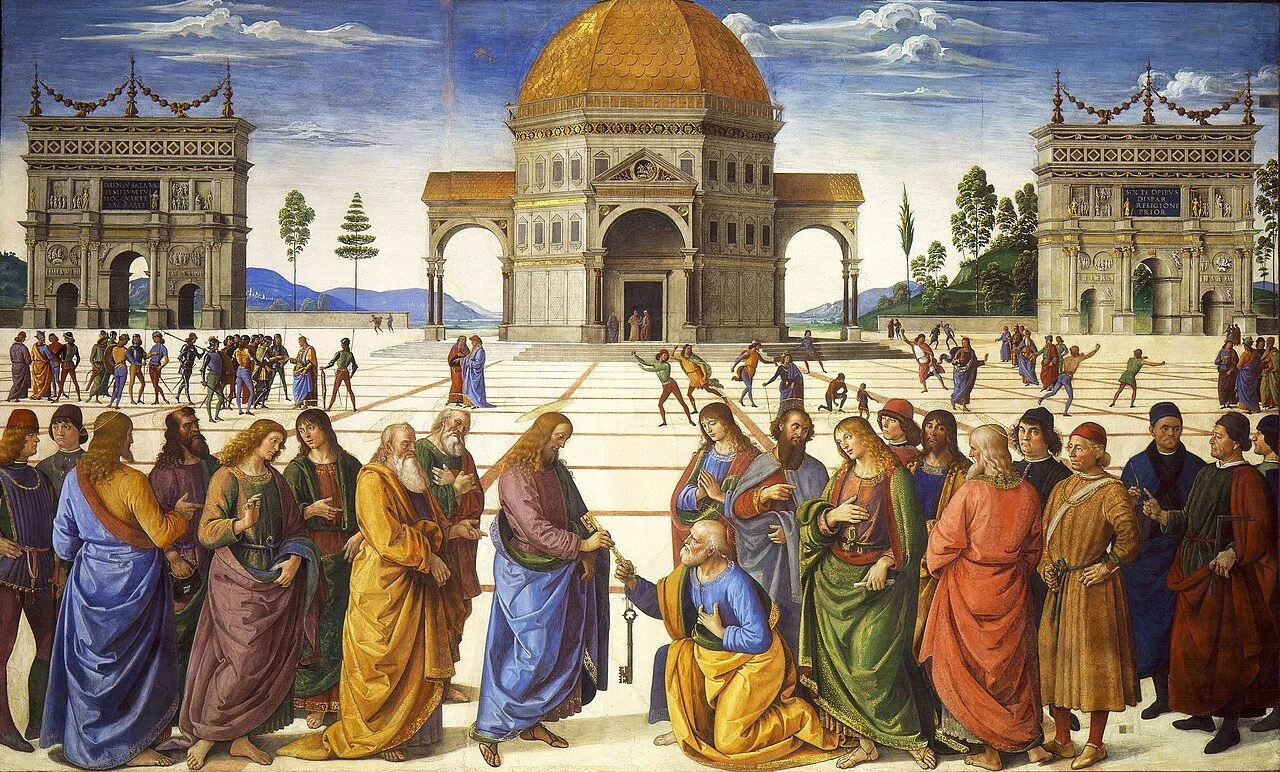
Pietro Perugino, “Christ Giving the Keys to Saint Peter,” 1481-1482
LBC: I want to close by asking after a somewhat elusive, but I take to be very important, third figure, who has come up in our discussion. I think I have some sense of the relation between the Pontif and King, Church and State—and, we mentioned briefly the role of the Prophet. You said that the Prophet bears witness to the transcendent. And, it seemed to me, though I am not sure if you said it in so many words, that the Prophet is in a way necessarily clad in camel fur and living in the desert, and is not a part of the institutional order. Can you help me to understand the topology of these three a little more?
DCS: With the prophet, I just think of a symbolic representation of the fact that authority transcends the office. It is beyond the reach of the office, but, speaks to it. When I say “prophet,” I have in mind a triad that Nietzsche spoke about in his early essay on education – the Philosopher, the Artist, and the Saint. These figures all have a duty, as part of their principal vocation, to call the King, or in other words the office of authority, to account in line with the transcendental over which they keep vigilance: the True, the Beautiful, and the Good. That’s what this triptych represents, in my opinion. They are in a sense symbolic manifestations of the ultimate meaning of being, beyond the political office. In other words, they are symbols of the Prophet, each in his own way. In the properly authoritative realm, the Philosopher, the Artist, and the Saint carry authority—and it is an authority that has to be recognized by, respected by, the King, as it were. If the King fails to recognize it, he severs his authority from its transcendent source, which means he reduces it to mere power once again.
The prophet also speaks on behalf of nature—physis in its distinction from nomos, there are many ways we could characterize it. But, really it all comes back to what we were talking about earlier: in their arising from beyond the explicit office of authority, they represent the ‘other,’ and so introduce the trial to determine whether the ‘other’ is repelled as other – which then reduces the office to an expression of mere power – or, the other reminds the authority of the source which transcends even him, and so calls on a deeper procurement of the origin of authority.
LBC: This has been a wonderful conversation. I want to thank you, Dr. Schindler, for your time, and for your considerable care in outlining these matters in advance of the appearance of Authority and its Counterfeits.
DCS: Thank you, too, Lucas. It is always a joy to speak with someone who seems to understand what you are saying even better than you do! I found our conversation quite inspiring.