This is the third part of Lucas Carroll’s interview with D. C. Schindler. The first part can be found here and the second part can be found here.
DCS: I actually think there is a connection between “the forgetfulness of authority” and “the forgetfulness of Being,” that Heidegger sees—and “the forgetfulness of beauty” that Balthasar talked about. I think all these things go together in really fascinating ways.
LBC: If we are living today in this crisis, in this kind of tendency towards absenting of authority, or else tendency towards being unable to find it, forgetfulness, etc., and, if this tendency were to persist and perhaps intensify, in the inexistence of any counter-movement, then, what is the situation, what is the contrary, the absence, if the restoration of authority is not forthcoming? Which is another way of saying, to put it in grandiose-apocalyptic terms: if your book wasn’t written, what would happen? Where would things be going, if what we are attempting manfully to avoid were allowed instead to come to pass?
DCS: I would say that the whole “transhumanist” movement is ultimately an expression of the disappearance of authority. There is a profound connection between authority and human nature. One might say—and, I am inclined to say this—that, ultimately, it is impossible to destroy human nature. This was a point my father and I—there were few things we would actually get into huge arguments about—he thought it was possible. For some reason, I don’t know that it is possible for human nature finally to be altogether excised from consciousness.
LBC: It is because he was a good dad!
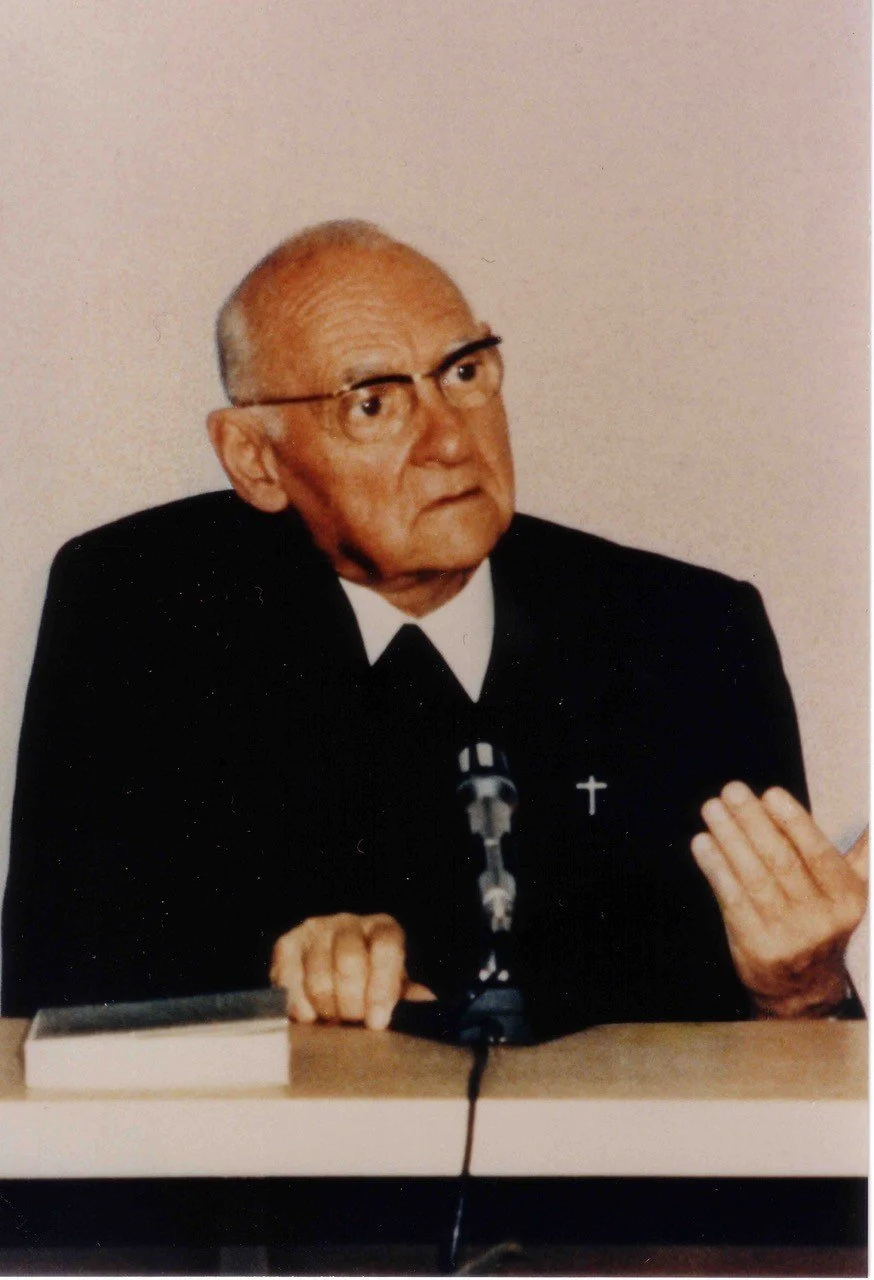
Hans Urs von Balthasar at a conference, CC 4.0
DCS: Yeah! Well, I have always thought there is no way to eliminate human nature except by destroying all human beings, but, it seems to me that inasmuch as there remains any human nature at all, the experience of authority will just keep popping up—maybe in unsuspected places. Even just, I close the current draft of the book—which may end up being edited out—with Balthasar’s reflection on the mother’s smile. The child is born, and the mother radiates her love through the symbol of her smile. That’s kind of an act of authority in this proper sense. The child, just naturally, is augmented by it. The child recognizes in this implicit way a goodness of hierarchy and so forth. So no matter how cynical—the baby is too young to be cynical—eventually reasons for cynicism inevitably occur. Nevertheless, it’s always going to be a second moment, and never most fundamental. So, in a way there is always going to be hope. But, that being said, we can go a really long way to dampening that possibility. We can destroy family structure. We can produce children in labs, such that they never have a mother in any proper sense, or a family. There are all kinds of things we can do. We can so radically reinterpret experience for people so that they never realize—they never remember—their original experience of the world. I think there are a lot of things that are set in motion…But, I find it pretty fascinating, and, I feel this might always be the case, that, despite how dire things become, this tends to prompt even more surprising acts of humanity in reaction. And that remains the hope for the preservation of authority.
LBC: This feels to me closely connected with another question I had for you. That is: if there are noetic effects to the absence of authority, and, if we are in the situation we are in, where we are undergoing something of this absence, or, we are at least living today in a moment of a kind of crisis wherein the ability to even hold a thought, adjudicate it in terms of its evidence, and pursue it to its end, for the sake of arriving at a true account is becoming a real rarity on earth, and is perhaps on its way toward—I worry about—its total extinction, then, are we not trapped in a sort of malicious feedback loop? There are cognitive prerequisites of being able to acquiesce to, see the value of, discern the notion of authority. And, authority has for its consequence the enrichment of, the development of, precisely those same cognitive faculties that are, today, so on the decline. I know that the hope is not one where we are in a situation where things have gotten so bad in terms of people’s ability to take up their existence within judgment, such that they would be incapable of engaging in the difficult process of a renovatio of the notion of authority—but, we’re certainly on the way towards such an irreversibly terminal dissipation. I take it that the answer to this, what breaks the feedback loop, will be something of the primary positivity of the beautiful, of the aesthetics of glory, that we have been talking about.
DCS: I haven’t said much about the noetic effects of this. That is something worth dwelling on. When we do our thinking about things, we always do so against the background of a certain “horizon”—something like what Heidegger will call “World” or “Clearing”—there is a horizon that is established that allows things to appear in a particular way. Certain aspects of things will be set into relief, while others fade into the background. This is a normal fact concerning the way humans see and, indeed, think. What I want to suggest is that what, fundamentally, sets the ultimate horizon is the authority. This is what it means to think of authority in the symbolic sort of way. Symbols radiate significance, illuminating other things. The most basic symbol is the authority. In that regard, the political authority most decisively sets the horizon within which we think. It is not just that it instructs us, or commands us, to think about some particular thing or other, but rather in its very mode of being allows us to think about things as a whole in a particular way. I think this is in a sense what Plato means by the Allegory of the Cave. The Cave represents a horizon within which we think. Leaving the Cave is shifting to a new horizon, such that the same ‘“objects,” the same realities, are now able to be seen from within a different horizon. The most important role of the authority is, actually, to make truth possible and accessible to everyone. To allow things to stand out not only in their particular usefulness in this or that way, but indeed to show themselves as they are, to allow them to stand forth most fundamentally in their being. This is why I associate authority so directly with beauty. It has a disclosive dimension. There is a kind of disinterestedness that characterizes the experience of beauty. Thinking of authority within the aesthetic register involves opening up that disinterested horizon that allows us to appreciate things as realities in themselves and to see beyond the merely utilitarian register.
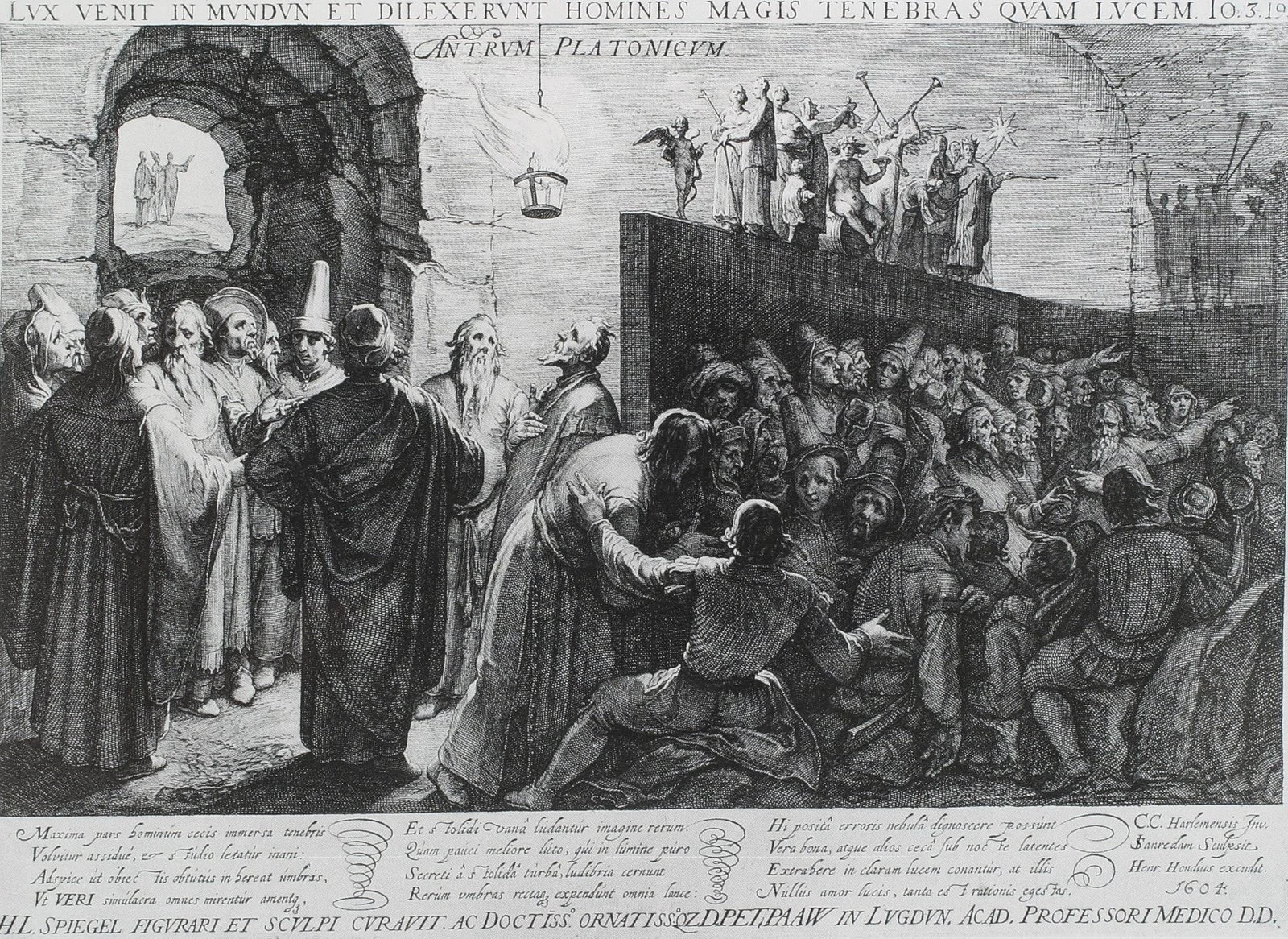
Jan Pietersz Saenredam, after Cornelis Cornelisz van Haarlem, “Antrum Platonicum” (The Cave of Plato), 1604
LBC: I can hear a counterfeit of authority rendering what you have just said as the claim that the function of authority is to pronounce the basic axioms for a community—to be a Hobbesian Sovereign whose role it is in the last instance to determine the meaning of words. Speaking in the Platonic fashion, this would be the confinement within the dianoetic-hypothetical stance: constriction to reasoning on the basis of theorems that are set down, given over to you from “above,” and are unable to be returned back upon as-axioms as such. They give you the horizon, the frame—but, they give you a frame of captivation. I am wondering about the kind of horizon authority is, authentically, to give. How do you see this differentiated from the dianoetic perspective, in which one is enslaved to he who unilaterally determines what counts as unquestionable, as axiomatic?
DCS: There are many things to say about this. Maybe it is best right now to say that I don’t see the authority in the first place as pronouncing, as making propositions—at least, not in the first place. The role of the authority is to simply be the authority, not yet as commanding or defining. What the authority does is to stand in for, to make present, the transcendent principle. Simply being the authority invites, thereby, a certain freedom. It is not primarily a putting on of constraints. This may seem paradoxical, but it is precisely because the supreme authority is not chosen—is not politically determined—that it enables this kind of freedom. The authority transcends “politics” in a way, represents something beyond political division, and so opens up the free possibility for debate and discussion that may not have been able to exist otherwise. There is something about the nature of the authoritative office that recognizes it is not supposed to be partisan, and this recognition transforms one’s living of the role.
LBC: Where the non-transcendence of political division means that all speech is ultimately polemical, where what is posited as being the case is not just in virtue of the putative object of truth, but always as well of “owning” the other side (i.e., of defeating them in some imminent contest)…That there would be anyone in an institutionally authorized position who is not therein subject in what they are saying and representing to such a rule of political interest, preserves the possibility of a different order of even political discourse.
DCS: Yes. In our political system, the president, for instance, always belongs to a political party, and it is on some level supposed that he will represent the interests of that party. This differs from what I mean by political authority’s genuine nature, as representing something transcendent, which means truly otherwise than the merely political. In this case, assimilation to a particular party would mean abandoning authority.
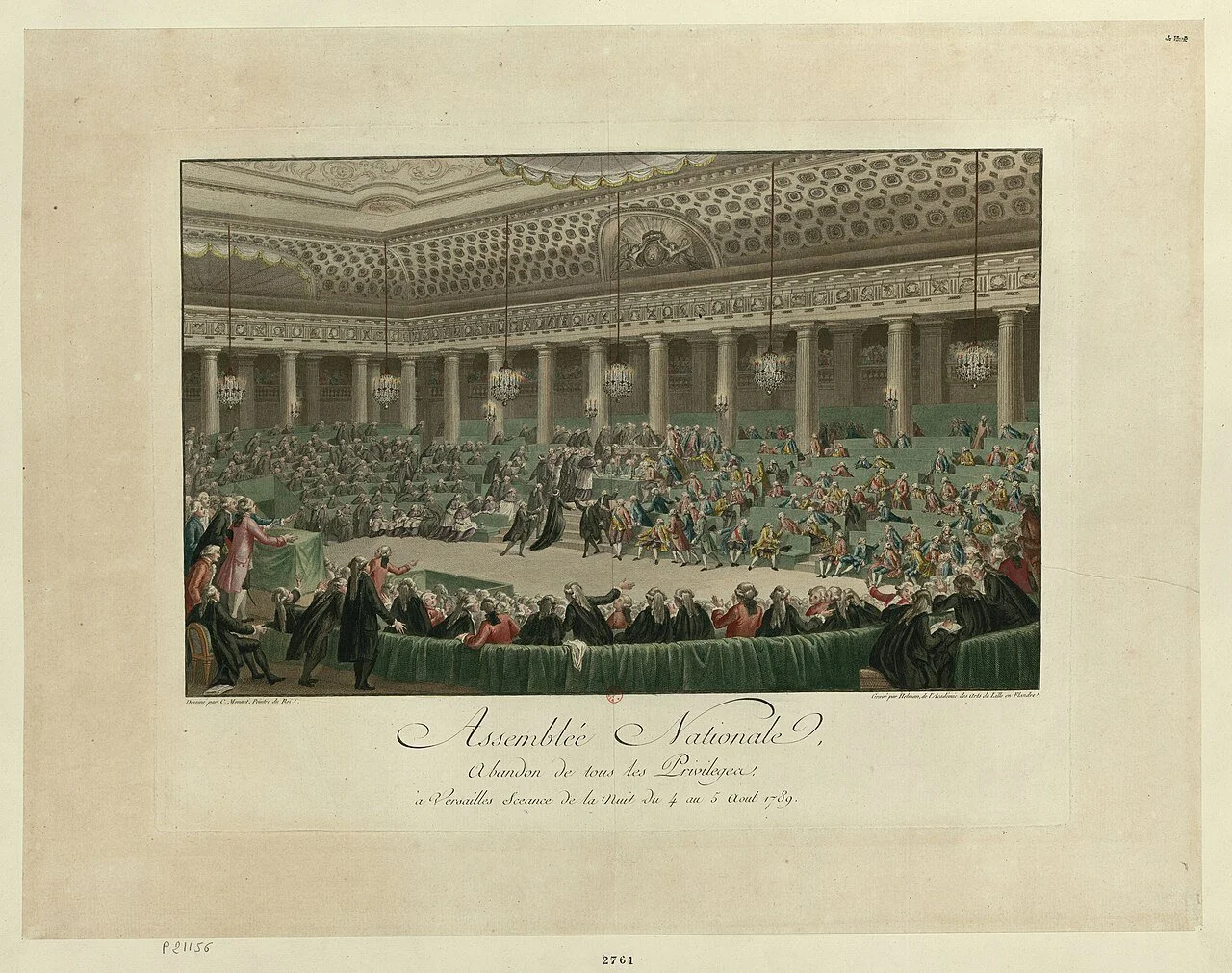
Charles Monnet, The National Assembly Relinquishes All Privileges, 1790
LBC: On some level, the members of the distinct political parties also understand themselves to be speaking not from a merely particularistic perspective. They, too, believe themselves to be able to say, “I, the Truth, speak.” The background supposition, then, is that there exists an order that is more ultimate than that which the politician qua politician, the political qua political, can contain. The authority would be marked as the representative of such an order by standing for that which, by its nature, has no particularistic opposite.
DCS: Yes, right. From within the horizon of the merely political, it is impossible that one speak as a party member even in one’s, perhaps sincere, aspiration to the Truth. Think of Plato’s designation of the Good as “the anhypothetical first principle,” and, think of the Philosopher King as representing the Good in precisely that respect. Notice: that is not yet a decision as to what things are good. What the Philosopher King represents is that there exists such a thing as Goodness itself, which will allow us to deliberate—it does not exclude, even, a democratic element of common deliberation—but, the horizon is of an ultimate Good, Truth, and Beauty. The whole point is to install and preserve this horizon itself, so that we can go forward in deliberation, proper. In response to the objection raised before, this representing the anhypothetical first principle, this “letting in” of the light of the good, is very different from pronouncing “this is good.”
LBC: That is a good distinction. Authority is not the univocal positing of a certain particular content as true, in virtue of the fact that I hold the scepter. It is, in the first instance, not the pronouncement of any given determination against which there exists a true opposite. But rather, the representation through itself of the existence of the dimension of Truth, per se.
DCS: And if that is the case, then, if one has an objection, the authority is in a way obligated to listen. Think of how Socrates acts. He is dogged in the pursuit of the Truth, but he does not exclude any position a priori. “Ask me a question. Let’s talk this through. Correct me if I’m wrong.” That is an expression of authority, if authority means representing the anhypothetical Truth, then it belongs to authority to—
LBC: Authority is intrinsically dialogical.
DCS: —it is intrinsically dialogical. Even more than that, authority is what allows dialogue to take place in fact, in truth. Otherwise, it is not dialogue. It will instead be power plays and so forth. But, if you have an authority that says that there is Truth, that there is Goodness, then, it weights things in a certain way. It opens up dialogue by conserving a kind of responsibility for the things that you say in terms of a common measure of the True. So that, if you cut off dialogue, you are betraying your authority.
LBC: So, the dialogically unmediated “thus is so, there shall be no further question,” is the opposite of authority rather than this being its full expression.
DCS: Authority symbolizes, in the robust sense of that verb, the “non-negotiable” reality that there is truth and goodness, and that we are all responsible to it. But it is just this that allows us to “negotiate” everything else, in one respect or another. To refuse this would be to turn authority into power. But, saying this does not at all mean that there can be no statements of the authority as to what is good in particular. There will always be questions of prudence. As the authority, you are mediating between the eternal and time. The temporal aspect, history, is going to be crucial. It is inevitable that there will be points where specific decisions have to be made and followed up on. But, you come to see that this has its true sense in light of the common good—something very different from one’s having the sovereign right to make arbitrary decisions, to exercise coercive power, simply in virtue of one’s being “in charge,” which is not what is really meant by authority.
LBC: I am thinking of the previous reference you made to Arendt’s comment, about an authority being such that if it needed to justify itself, it would no longer be authority. One way to hear this is to say that authority is thus essentially unaccountable. But, now we are adding nuance to that. Inasmuch as it is the first act of authority to be the representation of Truth, this need not justify itself, but this is not out of arbitrariness. Rather, the one who asks the question of authority is participating in the dimension it makes possible, already.
DCS: Right. It is not that the authority is unaccountable in the sense of refusing to give an account. It is not a question of justifying oneself or not, and the authority simply chooses not to. The authority represents that which precedes, that which is the ground of justification. And the authority’s role is just to be that. Then, discussion can occur. The objector in making their objection, in determinately signifying, supposes the dimension of Truth to exist, and that we are inside it. But, very often the objector doesn’t admit this. Socrates is so fascinated with the problem that arises here. He typically will articulate the objector’s objections for them, because they do not yet mean it seriously enough. It is not about a priori dismissing objections. It is about allowing all substantive objections. It is showing a mutual obligation to and for an order of Truth, for which the authority is uniquely responsible, but to which we are all bound.
LBC: It is almost as if in order thus to become a true objector, one must fail to be a true objector. Still though, the dimension of authority can wane. It is factically contingent at the same time that it is logically irrefutable.
DCS: This is why authority must continue to be faithfully represented.