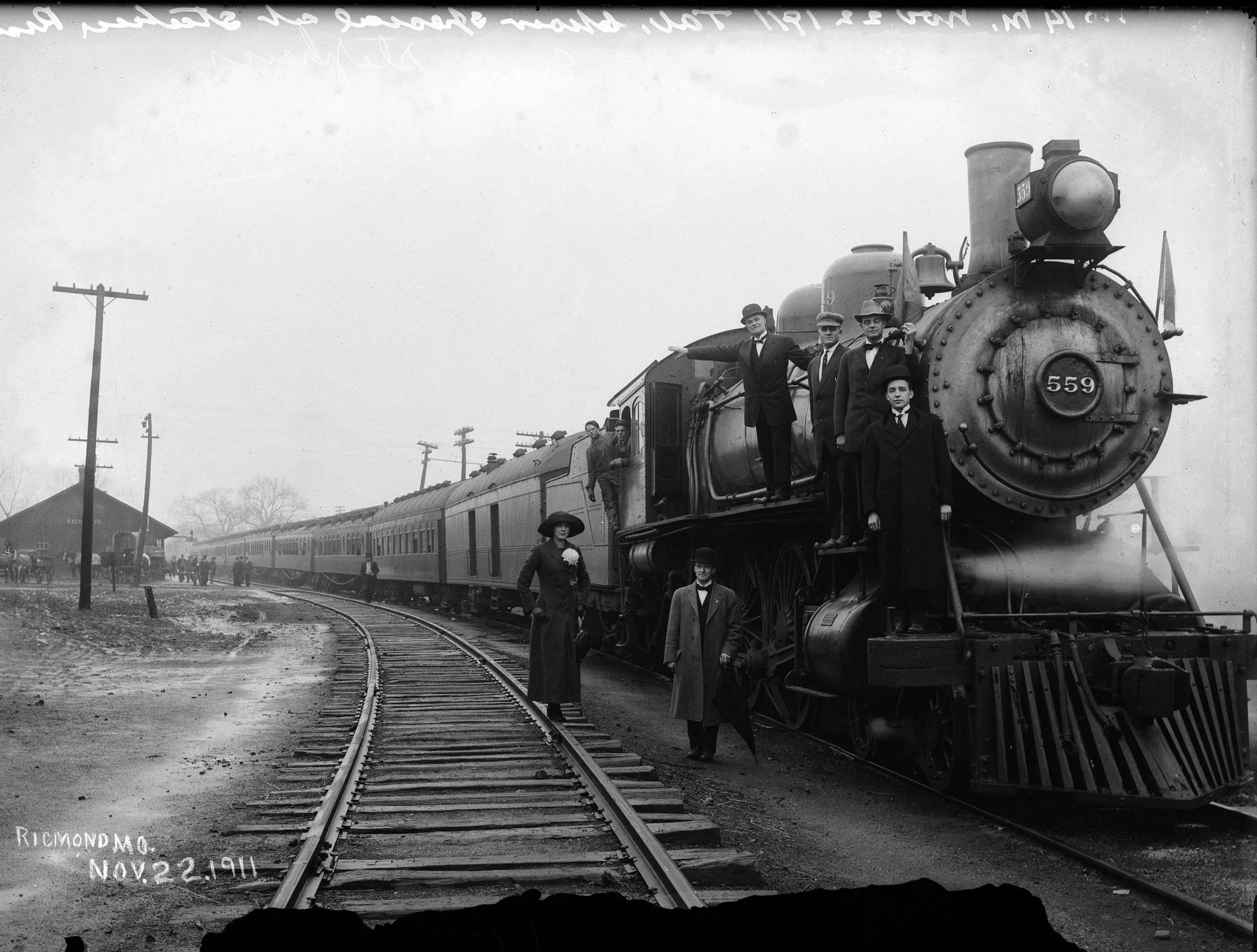
George Edward Anderson, Photograph of the L. D. S. Tabernacle Choir Special Train. Richmond, MO, 1911.
Railroads seem to epitomize modernity. Their abilities for faster travel and connection of far-flung regions were utilized by nineteenth- and early twentieth-century political leaders to craft a national, or even international, market and culture. These leaders intended to spread what they deemed as civilized to places not yet enlightened. Included in this package were notions of progress, of light casting out darkness, of disenchantment. Regionalism was supposed to fall away in favor of the unity of the nation-state and global capitalism, in word and in steel. Leaders, such as Porfirio Díaz and Gilded Age capitalists, changed provinces’ relation to space in an effort to make an individualist nation—what they considered to be progress. However, even the movement of the railway could not escape enchantment, a term I take to mean an openness to experience beyond the immanent or material. In the examples of Mexico, the United States, and China, I will show how passengers and commentators took a more-than-material look at this technology and its effects. Not all railroads had their intended effects of bringing about what national elites considered progress, both materially and rhetorically, in the minds of citizens. Even the practitioners of progress could not disenchant the railroads.
One way early riders came to terms with the consequences of railways was in relation to the world of the supernatural. We can see this in a pro-railroad corrido (ballad) in the Mexican case. The corrido restates railway critics’ arguments:
What foreign devils! / says a nasally old lady…For there is no doubt, / says another of ninety, / it’s the devil himself…Well, of course, it is the devil / who pulls those train cars along, by damn! / These days, Doña Charo, / everything is electric
While this one-sided perspective straw mans its opponents as superstitious and anti-progress, the corrido here acts as a chronicle of resistance, even when written by opponents. The corrido, in one way, tries to write off those opposing the railroad, but the multiple voices speaking here illustrate that enchanted ideas complained too loudly to ignore completely. Painting railway detractors as hysterical old women left an incomplete picture of who took an enchanted viewpoint and why, as we will see later.
The corrido above cast train technology as part of a Mexican project and did not mention the U.S. or Europe; this was not a universal for anti-railway activism that referenced the supernatural. In China, the Boxer Rebellion was an anti-foreign conflict in 1900. One of their common placards says:
When [foreign] martial and magic techniques / Are all learned by each one of you, / Suppressing the Foreign Devils / Will not be a tough thing to do. // Rip up the railroad tracks! / Pull down the telegraph lines! / Quickly! Hurry up! Smash them.
The Boxers connected Western-style material progress with Christianity, considered heretical. Like the supposedly nasal detractors of Mexican railways, the boundary between iron and spirit was not impenetrable. Even foreign ways of fighting connected to magic loyal and patriotic Chinese could harness. Unlike the writers of the corrido, the Boxers did not see railroad progress as inevitable. The appeal to urgency in the Boxer poem infuses its message with youthfulness and vigorousness, contrasting with how Mexican boosters saw their opponents: decrepit and disposable.
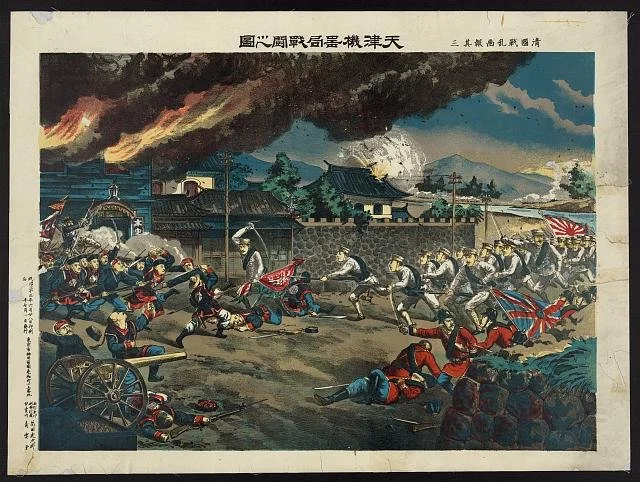
Torajirō Kasai, Tenshin Kikikyoku sentō no zu, 1900. Kasai depicts British and Japanese troops engaging Boxer forces at Tianjin, China.
However, anti-foreign sentiment and enchantment, considered separately or together, were not limited to those in complete opposition to railways. Mexicanist Michael Matthews examines an 1884 corrido celebrating the Zacatecas completion of the major Mexican Central Railroad. While not referencing the supernatural or criticizing technology, the corrido considers where the technology came from:
the passenger, / can hear the hum of the foreign machine […some Mexicans] welcomed the whiteys / wearing pocket watches and long jackets…They mocked us, / the gringo salamanders, / because we were struck dumb / by looking at such a wondrous engine.
The corrido author attempts to argue a both/and: railroads are good because they awaken wonder, and US influence hurts Mexicans. Mexicans could be struck dumb, arrested by something so powerful, whether that was foreign technology or foreign people. Additionally, the corrido illuminates a diversity of Mexican opinions on Americans—to be welcomed or to be shunned for their disenchanting intentions. Railway expansion and disenchantment, to some Mexicans, did not come across as an all or nothing endeavor. Enchantment was not totally separated from technological nationalism, from a desire to remain truly Mexican in the face of foreign influence.
Some rail promoters noted a Romantic-like sublimity to their work, especially in the early days of the medium. Historian Mark Fiege cites journalist William Gaylord Clark, writing in 1838:
This great chain of communication will yet be made, with links of iron…The granite mountain will melt before the hand of enterprise; valleys will be raised, and the unwearying fire-steed will spout his hot, white breath where silence has reigned since the morning hymn of young creation was pealed over mountain, flood, and field.
Playing into the stereotype of virgin western lands, Clark’s technological Romanticism sees nature as perfected by human intervention. Clark does not portray the spread of the tracks as the cold hand of scientific Progress extending across vast territories. Instead, he uses a literary voice that finds its artistic equivalent in the Hudson River School. Enchantment does not equal a countercultural stance; it can be used for the ends of those in power, those yearning for Apollonian progress.
The most striking matters surrounding those of the “iron horse” and enchantment concern rail’s relation to death. The Mexican case illustrates this best. Poets used the modern technology of railroads to discuss what was almost as old as humanity itself—people dying. Quoted in Matthews, “Tren Expreso” lamented that:
After this fleeting existence, / When the two of us, like the train, reach / The last station of our lives… / Goodbye, goodbye! As I deliriously speak, / I don’t know how to say what I want to say! / The only thing I know of myself is that I’m crying, / That I’m suffering, that I loved you, and that I’m dying!
The change that the trains brought about were more than political. In one way, this poem reaches for the supernatural from the other end—from a meditation on the implicit question of what comes after the “last station,” not that the railroads themselves would unleash demonic forces as shown in the Boxers and as feared by aforementioned Mexican proponents of progress. Railroading became a new metaphor for coming to terms with perennial problems, though not in the way the champions of progress intended.
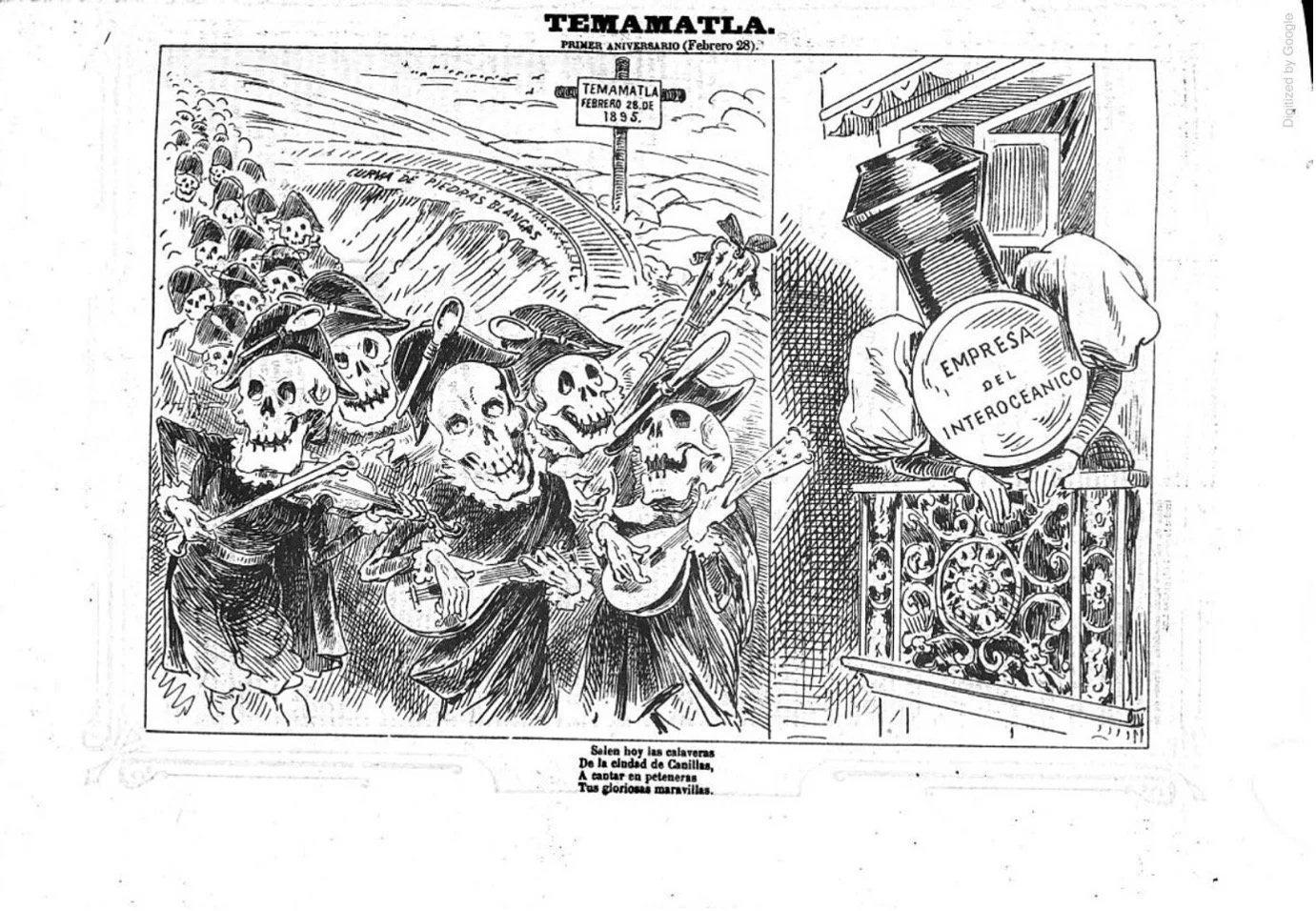
Cartoon responding to the Temamatla train crash one year later, in the Mexican newspaper El Hijo del Ahuizote, 1896.
Mass casualty railroad accidents put the focus on death into an even firmer view. In 1895, Matthews tells us, over 100 were killed in a wreck near Temamatla, mostly lower-class passengers. Unlike the poem above, the end of life took on a more-than-personal dimension. One year later, the anti-government, anti-clerical, and pro-Mexican nationalism newspaper El Hijo del Ahuizote created a cartoon memorializing the victims. Like materialized ghosts, skeletons parade near the place of their death, the infamous White Stone Curve, sing and play songs of praise with bones to a swooning representation of the train that killed them. Instead of a pile of corpses, the skeletons enchantedly cry for remembrance. The scene reminds one of Día de los Muertos (Day of the Dead, November 2—All Souls Day), a yearly commemoration of the departed. In one regard, El Hijo del Ahuizote’s image has political valence. The railroad industry, and by extension, the regime and the United States, fall under critique—implicitly here and more explicit earlier in the newspaper issue. Though another Temamatla-sized disaster had not happened in the past year, the newspaper still blames the charioteers of the iron horse for derailments, remaining the “arch-killer industry.” However, the image has a meditative aspect—it does not play the blame game, instead taking a moment to keep the songs of memory playing. Its resurrectionary hints show a modern tragedy processed through more-than-modern means, through a refusal to reduce Temamatla to an insurance claim or other immanent trappings.
If it is true that we are now disenchanted and have been wrapped up in that process since at least the nineteenth century, then the rhetoric of railway progress probably played a role in that. In this view, the enchanted sentiments analyzed above contain meaning only vestigially, as nasal old ladies waiting to be pushed aside by the iron cowcatcher. We can achieve progress discursively, by thinking modernly, in addition to building modernly. I think these sources mean more than that. They show us how the introduction of something new can spawn a wide range of reactions, that the users of a technology are not merely passive receivers of it. They show us how something arresting can catalyze the creations of new concepts of identity, new relations between nations. And they show us how grappling with ever more modern developments does not necessarily indicate a one-way street towards disenchantment, that new horizons open to we know not what and yet central realities stay constant.