This is the second part of Lucas Carroll’s interview with D. C. Schindler. The first part can be found here.

Portrait of Elizabeth II, 1958
DCS: I had an interesting experience when Queen Elizabeth died. It was quite a moving moment, and gave me much to think about with respect to the meaning of authority. I was at a dinner party at a restaurant in Rome, as a matter of fact, and, there were a couple of people at the table who were English. Our dinner conversation was interrupted by messages they received on their phones that the queen had died. We naturally spent the rest of the evening talking about that. One of the things that struck me most was the comments from an American at the table who had a kind of native contempt for the very notion of a monarch. He spontaneously interpreted the queen in this cynical way as one of “these aristocrats” with “their power,” “trying to suppress” and so forth. The English people there had a radically different experience of the matter. They said that the queen naturally transcended the differences between the left and the right, between the Labor party and the Torries, and so forth. They were saying, basically, that it would be fatal if the monarch took a side. Because that is the whole point. True authority by definition transcends class divisions and party lines. The role of the queen is to belong to all of England. It seems to me that this point reveals something of the essential nature of authority (even if the English monarch, in another respect, fails to represent authority insofar as he or she has been reduced to something like what we call a “mere figurehead”).
LBC: We’re talking now about a much more classical view of “nation,” and so of what founds the tradition and continuity of “a people” through the both symbolic and real presence of the monarch.
DCS: Yes. And, when we start to talk about the English monarch, who is head of the Church rather than subordinate to the head, this raises a much more fundamental question of the relation between the King and the Church, and, specifically, the theological question, which, I think is really crucial.
LBC: Great, yes. I’d like to move into this theme by asking for your thoughts on the historical emergence of the crisis of authority. In your writing on this topic, in some of your previous interviews, and in our discussion so far today, you have connected the presence of authority with religious transcendence, and have connected it as well—inasmuch as these things are perhaps associated intrinsically—with metaphysics, as a discourse, as a dimension of the human being. So, how do you think about the modern crisis of authority in association to the sociological phenomenon of secularization on the one hand, or else in relation to the historical event of the “end of metaphysics?” And how do you think about these things as being involved in our current crisis of authority?
DCS: Yeah—there is so much that can be said about that. Let me start with a comment. I came across this passage by Francis Oakley, a great historian who has written a lot on monarchy. I’m not sure I would agree with his final assessment of things, but I have learned a great deal from him. At the end of one book, he quoted a passage from, of all people, Albert Camus, on the execution of the king—regicide and its implications. It is fascinating. Camus himself says that the king represents symbolically the meaning of the whole cosmos. The king was the paradigmatic, the culminating symbol of creation. So, whether you can affirm the symbolic, and therefore the sacramental sense of the created order of the world, depends on the king—it literally lives or dies with him. If the highest instance of symbolic reality fails, it all fails. It is a kind of test case, if you will. When the king was killed, this was really a symbolic act representing the elimination of the ancien régime, of the old world order. This changed our physics, it changed the sense of the natural meaning of things. Regicide entails the disenchantment of the world generally. There is in other words a connection between the elimination of authority in this high, symbolic sense, and the loss of a sense of the sacred generally, which is to say the rise of what we call secularism. Though this is compelling to me, historically speaking, I don’t think we have to see it beginning simply with the French Revolution. It seems to me that one can—especially one who knows Church history better than I do—point to other moments. A recent historian, echoing earlier work, has pointed to the Investiture Controversy as the birth of the modern world, the official establishment of the logic of liberalism (which this historian is entirely in favor of, by the way!). There are a lot of Christian thinkers who would actually defend some version of this secularization. It is often said, for example, that Christianity introduced a distinction between the religious and the secular, between Church and State. In the pagan world, it was all mixed up, the king was high priest, etc. Christianity separated the king and the priest. The king had a worldly authority but he didn’t have any theological significance. But, that’s just false, historically speaking. That’s not what Christianity did. For most of the history of the Church, there was a kind of a recognition of the political order as being a sacral order of its own, while distinct from the ecclesial order, properly speaking, but, it was not secular. Andrew Willard Jones is outstanding—
LBC: He is so good.
DCS: —on this point. Yes. The world was just a part of the Church, and, the king had a theological role. So, the Church made a distinction without a separation. It is really not until the late Middle Ages that you get a real fragmentation, around the time of William of Ockham and, also, Marsilius of Padua. This fragmentation between the theological and the political cuts right to the heart of what authority is all about. Because there is no authority that does not represent the transcendent, authority is inseparable from ultimacy. Thus, if political authority is not recognized as an ultimate authority, then, ultimately, the political authority isn’t really an authority in a proper sense, but becomes mere power. If you separate the Church and the State in this fragmentary way, as two separate parts with different jurisdictions, and you say that the State is a penultimate authority and the Church is the ultimate authority, it seems to me that you have undermined the principle of authority in the state. And because the “king” remains the paradigmatic symbol of authority, all authority, even that within the Church, gets reinterpreted as mere power. There has to be a way to distinguish between Church and State even while maintaining that the political ruler truly represents what is ultimate, which means he retains a theological significance. It follows that political authority has to be grasped as theological in nature, even if it is theological in a way that is distinct from the direct theological significance of the Church herself. These matters quickly get very technical, but I think that they are also quite crucial to explaining the historical loss of the sense of authority.
LBC: I am really interested in this move of going back to the Investiture Controversies as the genesis of the modern crisis of authority. So much of what was going on in that period didn’t enter into the history of philosophy, proper. So much of it belonged to the writings of jurists, and in discussions of canon law. Few are equipped to tackle these issues competently, today—but, your gesturing in this direction seems to suggest such an investigation to be a worthy project.
DCS: Yes, it is. Though I am no historian—not even an intellectual historian…I am scarcely an intellectual!
LBC Ha!
DCS: The Investiture Controversy arises at the same time that the first seeds of nominalism are being introduced, and, this also seems to coincide with the first real engagement between Christianity and Islam. I am thinking of the work of St. Anselm here, which the great medieval historian W.J. Courtenay has suggested contains the seeds of nominalism. It seems to me that these seeds are engendered, not necessarily because of Islam per se, but because, in facing Muslim thinkers, Christianity is now encountering something other than the Judeo-Christian tradition. Obviously, the presence of the Jews in Christendom entailed an encounter with the “other” in some sense, but there is another sense in which the Jews can be understood to have a place in the Christian story, and in any event they share a tradition. Islam represents something more radically other. I am interested in the coincidence of this particular encounter with the rise of nominalist logic and the emergence of a non-theological world.
LBC: I am now thinking about how, in any affirmation, you always have simultaneously the exclusion and denial of the contrary. I’m a good Hegelian—determinate negation all the way down. So, as I see it, there is something to saying, that, in the period prior to the experiential exposure to this alternative kind of claim and theoretical framework of considering what constitutes the delivering-over of authority—within this theological context, in the exposure to Islam—that the, maybe, “excluded” contrary was not so pronounced, in some fashion. And this seems like a way in which authority, authoritative claims, generally speaking tend to be, not refuted, but instead dissolved, by the exhibition of an apparently simply diverse alternative. I think that is why it is that, in a basically liberal culture, a culture which has in some measure embraced dethroning authority as its fundamental gesture and maybe its raison d'être, the move so often seems to be the affirmation of difference for its own sake, the putative making-to-appear-arbitrary of authoritative claims through the insistence of their being read against the background of an “and, and, and.” There is something that is critical, or maybe better, subversive, about the sheer demonstratio of some ‘other’ something. It’s a kind of mocking “subsume that into your formula.” The petulant ability to be able to introduce—or else to fabricate—novel categories and instances becomes a furtive tactic, not of refutation, but of dissolution—relativizing your claim, by casting it as just one among a flat weave of ostensive “others.”
DCS: That’s right. I recall a faculty meeting in which a colleague objected to the language of “the tradition,” insisting instead on making it plural. It occurred to me that, by putting the “s” there, really, the whole point was to undermine authority. If you have “the tradition,” you have an actual expression of authority. As soon as there are two (or more) traditions, you no longer have authority. The “s” kind of neutralizes the meaning of “tradition,” precisely just by pluralizing it. Or, it does so apparently: one inevitably smuggles some kind of ultimate tradition and ultimate authority back in. The question is only what form this takes.
This is what I would say the introduction of the apparently unassimilable “other” presents. The presence of the other becomes a trial, in Ulrich’s words, a temptation [Versuchung], a-tempt, that reveals the difference between mere power and authority. Because mere power in a way is precisely undermined by opposition—as we saw, authority generates otherness in some respect: augere. I have come to see that authority is thus essentially analogical, and I think of the analogy of authority not just in terms of the King or of the Priest, but also of the Prophet. The Prophet symbolizes, in a way, precisely the excess beyond office, beyond the reach of office; he in a way provides the test case. If the authority is generally bearing witness to something other than himself, and, bearing witness to a transcendent order, and if it is genuinely a transcendent order, then, there is nothing which can come from the “outside” that cannot be properly celebrated and that cannot find its proper place, even if this changes the arrangement, so to speak. It might not be immediately obvious how that happens. But if it is genuine authority, then, there is room. If the other provokes, instead, a kind of rejection, then, that very action is going to be a reduction of authority to mere power. So, in a way, the challenge calls forth, in the authority himself, the capacity to recognize the transcendence of his own office, the transcendent source of his own office, which then allows him to not impose an order, but, to amplify an order which is already given—even in the novel other who approaches.
LBC: And, that is the criterion of absoluteness, isn’t it? True non-exteriority.
DCS: We are definitely moving into your territory here.
LBC: I love it.
DCS: Recapping somewhat, I take the first step in the historical becoming of the crisis of authority to be a real division between the political and the theological order. And then the elimination, or at least, the transformation of the highest symbols in the French revolution, the symbolic regicide.
LBC: I see it now, but, I never before thought of the directness of the connection between the political reality of the French Revolution and Nietzsche’s proclamation of “the death of God.” “God is Dead,” and, by that I mean to say, “We Can Kill Kings Now.”
DCS: Killing the king is the death of God in the world. So, now, God can only live in the Church, which is henceforth set apart from the world, in a way. You eliminate the symbolic presence of God in the world when you kill the king. Let me be clear that this does not mean that we need to have a king, in the univocal sense. But what we do need to have is a sense of political authority that includes a metaphysical-theological dimension, and whatever form that might take in the future…So, some people might read what I am suggesting as “we just need to go back to the Middle Ages and just reduplicate that order,” but, of course, that’s absurd. Whatever we should have now is going to be different; you can’t duplicate an order that has passed. But it does mean we can learn something from the pre-regicidal reality, we can give it an analogical expression that is appropriate for our age—that might be radically different in all sorts of ways.
LBC: This connects with a question I have been meaning to ask you. That is, what intervention do you understand your work, this project, this book, to be affecting in the present? I had one thought about this, which I wonder if you’d endorse.
DCS: Please.
LBC: Okay. I am wondering if I am hearing—and, this of course accords with this being an interview for Genealogies of Modernity—something like, maybe one way to construe what it is that you’re attempting, is to retrieve the concept of authority by providing it with its historical genealogy, by means of which we would be able to distinguish between true and false instances in the present. And, then, the somewhat “speculative,” “practical, question which follows—which I acknowledge may or may not be worked out just yet—is: once we are in possession of this genealogy, which your work Authority and its Counterfeits is going to provide for us, is going to describe for us, I am wondering about what analogous sense of this authority you imagine to be able to become present for us, in the world today? And, what kinds of false claimants to authority do you see as being put out of play by this genealogy?
DCS: That’s really helpful and well put. In terms of the fundamental intervention, that is something I am still thinking about myself, and, I want to continue thinking about it, and, to open up conversation about it, to see what emerges. I don’t have a program—certainly not a political program—that I am hoping will be set in motion, in any sense. But, as you said—you put it really well—one of the contributions, I suppose, that I would hope this kind of project would introduce and enable is precisely a recalling of the criterion that would allow us to distinguish true authority from a false one. I think that when one hears that we have lost a sense of authority, I think we can be led to immediately think, “heads need to start rolling”—
LBC: Yeah.
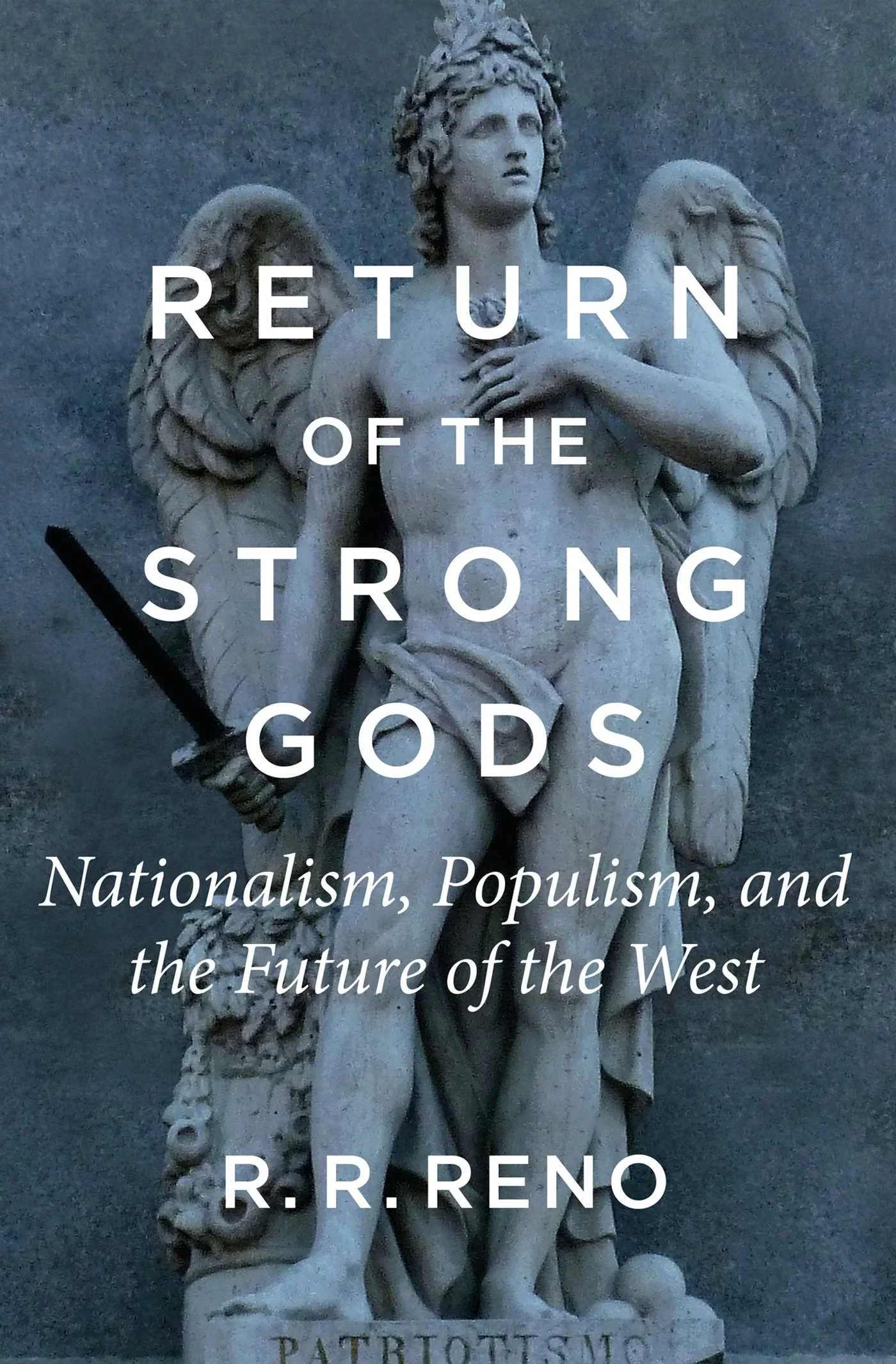
Cover of Reno’s book, 2019
DCS: —that we would need to have these “strong men,” a Return of the Strong Gods, as Rusty Reno flags for us. People seem desperate for more forceful people in positions of power, and so forth. That’s not what I mean by authority at all. It seems to me that’s kind of a caricature. There is in this precisely an instance of this reinterpretation of the meaning of authority in terms of power. You come to think of authority as just an unabashed self-assertion. Precisely because it conceives of itself as justified in itself, it becomes a kind of unrestrained exercise of power.
There would be two points I’d want to make in this context. First, recognizing the history we’ve been discussing, this genealogy, the relationship with the theological order, implies a kind of chastening that we don’t often notice. I don’t know if you are familiar with Bertrand de Jouvenel, a French political philosopher who wrote around WWII, and his book On Power: The Natural History of its Growth. He makes an observation that is hard for us to grasp as liberals: we tend to think of the Christian monarchs of old as instances of “the divine right of kings,” but, in fact, those were opposed to each other. Royal anointing and rule by divine right are fundamentally different concepts. The divine right of kings has it that the king acts and speaks for God independently—that there is nothing on earth to which his power is relative. It is a kind of pure license for anything. One of the reasons that notion was asserted is precisely because the more traditional notion of the anointing of the king by the pope was humbling. The king, in being anointed, was inserted into a greater tradition, into an actual history, into a transcendent order—which in a way preceded and made a claim on him, as much as he made a claim on anyone else. And so it was precisely a natural constraint on his exercise, in this tradition. The very thing that gave him supreme glory constrained him and placed on him an extraordinary burden, a demanding context of limitation. That seems to me something we need to recover—in historical terms, to recover the tradition of political authority, or in other words an authority that is part of a tradition and so constrained by that tradition.
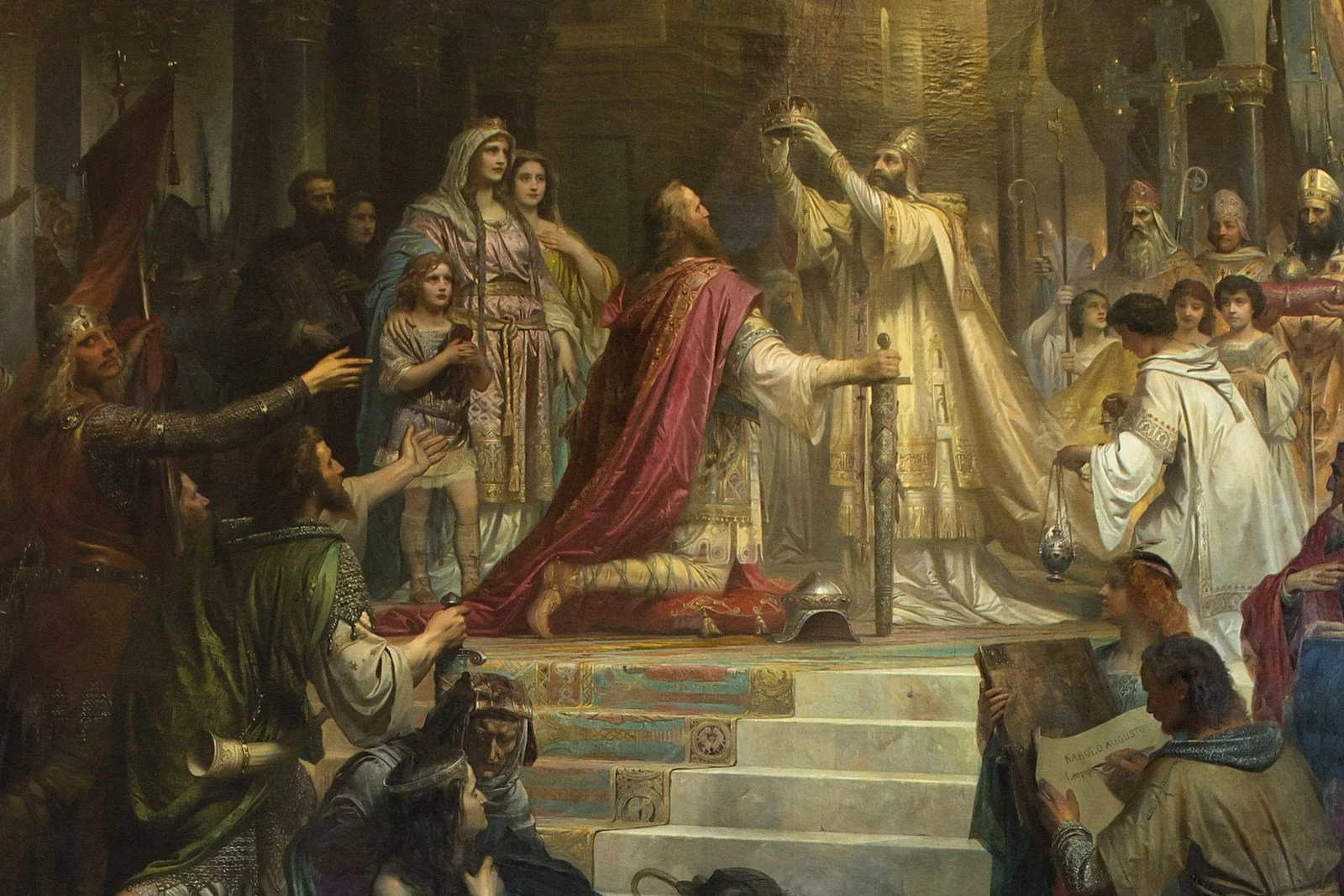
Friedrich Kaulbach, The Coronation of Charlemagne, 1861
The second point is that I would really want to stress the analogical sense of authority. On the one hand, it’s not univocal. There’s not a single sense. Instead, authority, as augmentative, is essentially self-differentiating. It has built into it a kind of subsidiarity. There is no authority that is not always-already and—this is part of the argument I make in the forthcoming book—distributed, in sort of a basic way. A single authority that is genuinely authoritative in the world, is divided between a Priest, a King, and a Prophet, and, these are symbolic for various sources—and no one of them has authority, unless all three of them have it. I mean, it’s Trinitarian is what it is. One authority in three dimensions, I suppose you could say. And, built into that then is this recognition that you possess authority yourself most fundamentally by always-already having given it away. So, I have authority over my children: my authority increases to the extent that they become independent and stand on their own. And, the other aspect of analogy is that authority can take very surprising forms. So, it’s not just the “final decision maker,” as Carl Schmitt would say, in the political order, but, it resonates through the whole, including throughout the cultural order.
So, one of the things that I have to say, is that, if one were to find this line of thinking compelling, then, what I would hope to see is not in the first place any sort of enthusiasm for strong men of power or something like that, but principally and fundamentally in the more ordinary aspects of life. We are all authorities, first of all, in the words we speak—“author” of course is connected to “authority”—which means we ought attend carefully to the words we speak; we ought to speak with fidelity and dignity, by analogy to the hosting of a dinner party, to refer to the earlier example. In other words, we should all try to work, within the sphere of our own existence, to foster an ethos of authority, to restore a culture of authority. These extremely concrete things can help, in a participatory way, to amplify the authority that, eventually, we hope, the people who govern will take on and respect, in a responsive way.
LBC: I love that. It’s almost like a kind of ethics of gravitas—to reintroduce a sense of weight into one’s living, speaking, and doing. I like as well the distinction you’re able to draw, in this way, from out of this much richer and more historically grounded conception of authority, which allows you to avoid what is really a—as I think you’ve just noted—what is an implication of the crisis of authority itself, that is, a Spenglerian “Ceasarism,” that says “well, you know what we need to do, in the tumult of life: we need to find some plot of land; put down a flag; and establish a totalizing univocal order with respect to it, against the sea of change.” There’s something compelling about this prima facie—
DCS: Right, it seems like a redemption from the chaos, like a way out.
LBC: But, as we were talking about earlier it looks like it, at the same time, then contributes to—it has as its effect, then—by reifying its other as other, by hypostasizing its enemy as enemy, it then contributes to and participates in precisely that order of “War, the Father of All,” to mention our old friend Heraclitus.
DCS: Ironically, the moment you do that, you forfeit authority and reduce it to power. You’re actually reinforcing the “forgetfulness of authority” [Autoritätsvergessenheit]—to use a kind of Heideggerian term.
LBC: As one must.