If our present bears within itself any traditional inheritance, this would seem inextricably to include the legacy of authority’s pluriform crisis, as issued forth from the same indeterminate cluster of singular points germinating both the original becoming and problematic passage of what is called ‘modernity.’ Pursuing this topic, of such immediate and poignant interest to the project of Genealogies of Modernity, I sat down with the eminent philosopher and political theorist D.C. Schindler to discuss the meaning of ‘authority,’ its political and theological dimensions, its symbolic effects, its aesthetic manifestation, its historical dislodging and ultimate ambiguation, the disastrously resounding consequences of the latter, and the contemporary gift and task of its retrieval and restoration (the complex weave of which themes to be elaborated in further loving detail in his forthcoming volume, Authority and its Counterfeits). The following four-part presentation represents, in serial form, the stirring results of a single, ongoing Conversation.
Lucas B. Carroll: A good place to start, when having a discussion on a thing, is maybe just to ask, ‘what is that thing?’. So, with that in mind, how do you understand ‘authority,’ and, this with respect to a maybe alternative claimant, something like ‘legitimate power?’
David C. Schindler: In a nutshell, authority is that which makes effectively present a principle of order. But authority does this in a distinctive way, one that we have tended to lose any real sense of. Today, we generally confuse authority and power, or, if we make a distinction – for example, specifying authority as a legitimate or justified use of power – we still take our bearings from within the domain of power. I first was struck by the question of the nature of authority when I began to suspect the difference between authority and power was more radical than we generally suppose. I am by no means original in this. But my thinking has followed a certain path: the more I have thought about the nature of the distinction the clearer it has become to me that authority is concerned with a sphere of existence that far exceeds the merely pragmatic order. It ultimately includes the order of thought, and, ultimately, the order of being simply. And that introduces a radically different way of thinking. So, what precisely is this difference? – Actually, feel free to break in, because I feel it might be helpful to work this out in response to your questions as they arise.
LBC: Fine with me. Is it that at least part of what is going to be distinctive of authority is that it doesn’t just have to do with a coercive management of bodies, or something like this, as some people may think of what power does, but that the symbolic dimension really is what is—
DCS: Crucial.
LBC: Yes, crucial. One thought on this, related to some of your previous discussions (New Polity, Spe Salve), is that there is a kind of problem involved in the way that some people like to talk about the ‘legitimation’ of power, as they try to give an alternative account of what they take to be the same as ‘authority.’ The alternative proposed by some has it that the sources of legitimacy are the ‘people’ or some such. So, one question might be: is authority essentially aristocratic, or hierarchical in some way, such that when, if somebody tries to use the language of power’s legitimation from out of the consent or the will of the people, this is missing it, because authority is prior rather than posterior, it comes from above rather than below?
DCS: One way to think about this is that, if we try to distinguish authority simply by calling it legitimate power, we are still thinking about it legitimizing itself somehow in relation to power, that is, we are still thinking of it, as you said, in terms of the management of bodies. Maybe a more general way we could think of what power is, is that it is the capacity to introduce a change—in the philosophical sense of change: power is the capacity to make something happen. Aristotle might add, “also to enable something to happen,” but, in any event, power has essentially to do with change. Authority I think is of a radically different nature. Rather than being about making something happen, it is instead, in the very first case, disclosive, manifestive, it’s about opening a horizon. And this helps us understand why it is inadequate to define authority simply as legitimized power. Hannah Arendt—a classic figure in this discussion, and quite illuminating—explains that authority is something that in a certain sense doesn’t legitimate itself. It doesn’t have to! Authority always has the character of givenness. It’s already evident. There’s a kind of pre-givenness to authority, which is recognized before all thinking and doing. Arendt says that if a person has to legitimate himself, has to prove himself, he has already lost authority. Now, if we say that authority is “pre-given,” we naturally have to ask, “pre-given by what?” The very notion of givenness implies a kind of reception from another. So, then you ask, what’s the source of the givenness of authority? And here, I think, it is inevitable that – you can look at this historically, but I think also from the intrinsic logic – it has to have some kind of transcendent origin. Otherwise, it’s going to cash out eventually into some sort of power. Authority cannot exist as distinct from power unless it bears witness to and thus communicates in some sense an order that transcends it.
LBC: I like the language you are using, of authority’s being – as you say in one of your interviews – ‘martyrological.’ So, I wanted to ask you to follow up a little on that, about the sense in which this is a bearing witness. And, I wanted to ask this in comparison to something that seems to be similar, which I have not seen addressed in this sort of discourse. The Greek practice of theoria, in its original sense, of the theoros leaving the immanent, practical, political dimension – really passing beyond the walls of the city – for something otherwise than trade/warmaking, for the sake of going and bearing witness to a sacred spectacle, for the purpose of returning, and relaying this, essentially, in theoretical speech, in logos apophantikos. There is something interesting there. I was thinking about your denoting the crisis of authority while reading Plutarch, in his talking about “the disappearance of Oracles,” with this going along at the same time with the decay of the Panhellenic self-conception. I was curious if you thought the martyrological moment, and this kind of original cultural practice of theoria, if you think these are connected.
DCS: That is precisely right. The transcendent indicates an analogy of being. There has to be an order of being that is beyond, what you might say beyond the walls of the city, so when you move toward the higher order you transcend certain limits. But, in doing that, you’re witnessing, you are a spectator of that higher order of being, which you receive through this theoria, through contemplation, and which you then allow to bear fruit through the return to the city. This transcending also implies a kind of return to the city.
I just mentioned bearing fruit. This is crucial. Whenever you think properly about authority you’re going to be led to these organic metaphors. The word itself implies ‘growth’ and augmentation: auctoritas ultimately from augere. In authority, there is a taking what is given and amplifying it, augmenting it, allowing it to grow beyond itself and fructify. A very simple image is the gardener. This is the original meaning of ‘dominion.’ The kind of authority in creation—the world is good, and man’s relationship to the world is not just to change it, to introduce something novel. That would be dominion simply according to the model of power. Authority first receives the world as given, and then amplifies its goodness. Authority allows it to actually grow, and be greater. You can’t do that simply by originating an order from yourself in isolation and imposing it on the other. As a genuine authority, you are in a way, to speak in plain language, ‘tapping into’ a source that exceeds you and that exceeds the thing over which you have responsibility. But that ‘tapping in’ allows the original, creative actuality – energeia – to enliven, enhance, amplify something other than itself.
There is a further thing I want to add here about theoria: the connection with contemplation. Remaining within the limits of the language of power and the coercion that accompanies it excludes propitious space for contemplation. If, by contrast, we interpret authority as fundamentally disclosive, it naturally opens up the contemplative dimension. This is something that has especially struck me in reflecting on contemplation, and I think it is a fruitful path worth exploring further. The first act of authority is a letting-be, it’s a kind of allowing things to be fully themselves. And, that precisely opens up the horizon of, the possibility for, the spirit of contemplation, it fosters a contemplative disposition. This is, in my opinion, one of the things that most clearly distinguishes authority from mere power.
LBC: That’s really good. This letting be, or affirming a being into itself—I like that way of talking about it. I am hearing in this—there is so much Plato, there is so much Balthasar, there is so much Ulrich. It is terrific.
DCS: Well, those are the waters I tend to swim in. You know, I take it that thinking along these lines allows one to have a very different interpretation of, for instance, the Philosopher King and the Cave. There is this concern about the philosopher entering the cave, that this is a kind of legitimating a sort of manipulation from above, ‘for your own good,’ but it is still effectively coercive. That is not at all what the philosopher does in the cave in Plato’s depiction. Arguably, what the Philosopher King is doing is trying to let in the sun, let in the light of the sun. So, it’s more fundamentally opening up an ontological horizon where things actually can stand forth in their being, and not simply in their utility. It liberates things in their very in-it-selfness, in their—
LBC: –integrity, their integral being.
DCS: Yes, their being-themselves. It allows us to relate to these things as realities in themselves, rather than mere objects of use, objects of thought, objects of some form. They are also objects, of course, and they are good for us, not just in themselves, but this is secondary, an implication of their intrinsic goodness. They become proper objects of use and of thought and so forth because we see them as they are, because their essential being is allowed to be and allowed to manifest itself.
LBC: The question, I guess, to speak crudely of the ‘mechanics’ of how it is that authority brings about these symbolic effects is something I want to return to. But, first, while we are on the theme of Plato—just looking at the title of your Communio essay, ‘The Crisis of Authority,’ as well as the title of your forthcoming book, Authority and its Counterfeits, again, I hear this Platonic ring, inasmuch as so much of Plato has to do with discerning judgment, a krinein, between reality and appearance, between authentic appearance and its simulacral double. My question on that front is whether it is that you see the contemporary crisis of authority as one of authority’s simple absence, or else as a kind of inability to distinguish between true and false claimants to the title—and, I suppose how you are conceiving of the crisis, within those kinds of Platonic categories.
DCS: The problem for Plato is always the relation between being and appearance, though we don’t ever grasp things outside of appearances in a crass sense. We only ever are dealing with appearances in some respect. So, if we can’t set appearances aside and get to being directly and without mediation, we have to ask, are there certain appearances that can afford, in the sort of technical sense of that word, a glimpse of being itself. And, I actually think that this is precisely what authority is, what it represents in a kind of paradigmatic way. It is also, I think, one of the best ways to interpret what beauty means. Beauty is – I think you can draw some really great insights from the German Idealist tradition, and from von Balthasar – though, it is missing in Ulrich, he doesn’t talk much about beauty, which I find that kind of interesting—
LBC: But it is there, though, he doesn’t use the word—the explicatio, the externalization of essence in the manifold of accidental appearance…
DCS: Yes, right—beauty is the manifestation of being. This means that, in genuine beauty, you can actually have an appearance that effectively communicates reality. I can anticipate all sorts of objections – ‘how do you know that beauty is real and not just a deception?’ and so forth – and that is a whole different conversation. But, taking for granted at least that some of the greatest thinkers in history have interpreted beauty along these lines, it is worth exploring the connection between beauty and authority. The role of authority in a way is to represent in the world something that transcends the world. This is an appearance, or in other words, an outward, effective manifestation, of being. Seeing authority in this way was for me a huge epiphany. It is not adequate to think of authority simply in terms of the pragmatic sphere, that would connect it to the transcendental of goodness—it also has an intellectual component, and so that it is connected the transcendental of truth. In wondering about how these dimensions can be integrated, it finally just dawned on me: the fundamental transcendental connected to authority is beauty. As soon as you see that, you see how this resonates with the appearance of authority throughout all of history. This is why the pageantry of authority and so forth has been absolutely essential to the offices of authority. One can give a kind of cynical interpretation of the way this functions, but, I think that, for all of the possibilities of abuse, you can’t abandon it, because to deny this aspect is to lose the disclosive role of authority, and to return to the limitations of mere power. An authority represents in his person, you might say, this perfect coincidence of being and appearance, a coincidence that effectively opens up this horizon in which, you might say, the light of the transcendent can therefore illuminate everything else, everything lying within that designated sphere. Only then can we say that authority opens up a metaphysical dimension to everything.
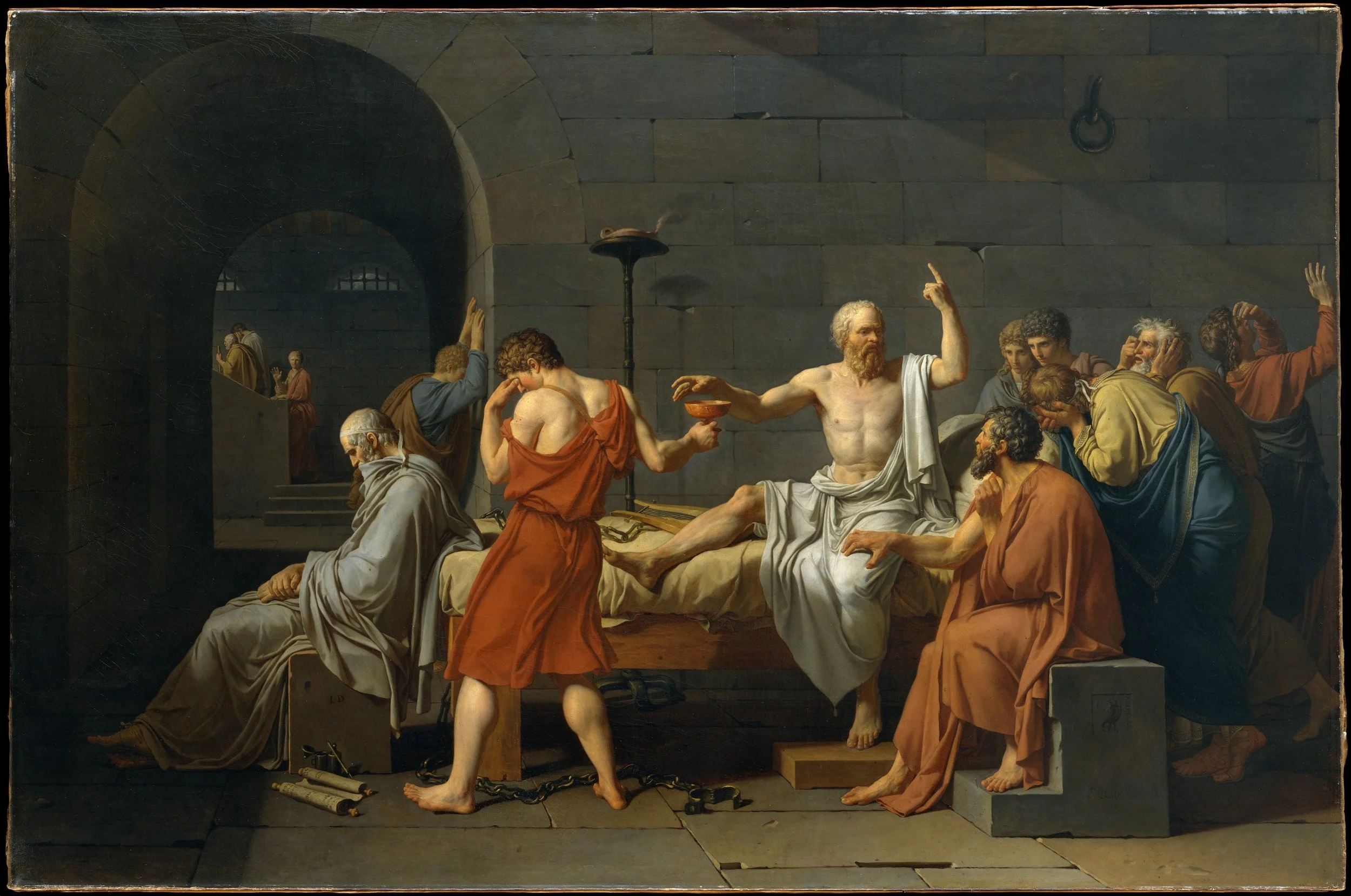
Jacques-Louis David, The Death of Socrates, 1787
So, the first act of the authority is not to command, or to teach, though, these are of course fundamental. Instead, its first act is simply to be—and to radiate being. And then, within that first act, teaching and command actually make sense. We all have the experience, for instance, of a really good football coach, who inspires the players. He doesn’t just yell at them, or tell them what to do. But, in a decisive moment, through a kind of authoritative presence, an inspiring presence, the player finds himself able to do something he didn’t think himself able to do. We might say that the coach, as authority, augments the abilities of the player, elevating his activity beyond its normal scope, both by orchestrating its connections with the activities of others, and by improving it in itself.
Similarly, there is a kind of an analogy with the light of faith. The tradition has always recognized the centrality of authority in faith, and people typically interpret this as a kind of substitute for rationality: you can’t understand, so you should just believe what you are told, perhaps because the one speaking has certain credentials, etc. The matter looks quite different if we privilege the disclosive, mediating, and amplifying role of authority. In this case, it is what allows our reason to see the truth, so to speak, beyond reason’s native capacities. More generally, with authoritative teaching, there is something being communicated in and with the specific content of the teaching, that elevates the mind to be able to see its truth—to be able to see it as true, not only as a proposition, a claim, a hypothesis, but to be able to see it as being true. And, that is what beauty does. It is an experience that elevates, enraptures, the person experiencing it, in a way that enables the proper exercise of the intellect and will.
LBC: I hear this and I think about the aesthetics of glory. The authority excels, as a symbol of that which is excellent in itself. I hear the kind of metaphysical dimension, in the sense of saying, through the authority’s being, and their being this, and so allowing that which excels them to appear through their actions, through their accidents, this establishes – as you say – a ‘horizon’ wherein those who are in the proximity of this authoritative emanation are able to be set free into their own selves, and are able to come into a higher coordination one with another, and a greater communion with their own nature. I think to your point, vis-à-vis the contrast with power, this would not be in the imposition of a new teleology, but in the furtherance, the intensification of the natural teleology already present—the striving that people already have, in one respect or another, for the good.
DCS: That’s right. There are many sorts of everyday illustrations that I think are really revealing. I think one could write them off just as that, as everyday experiences that don’t have to do with the meaning of reality generally. That they are just fun things to do here and there. To take a simple example: just think about the difference of attending a dinner party, hosted by somebody who really understands how to entertain. By contrast, you can just go to a place where they throw out the pizza boxes, everybody just grabs what they want on a paper plate and we just sort of walk around the room. – Okay, to be honest, we all love that too.
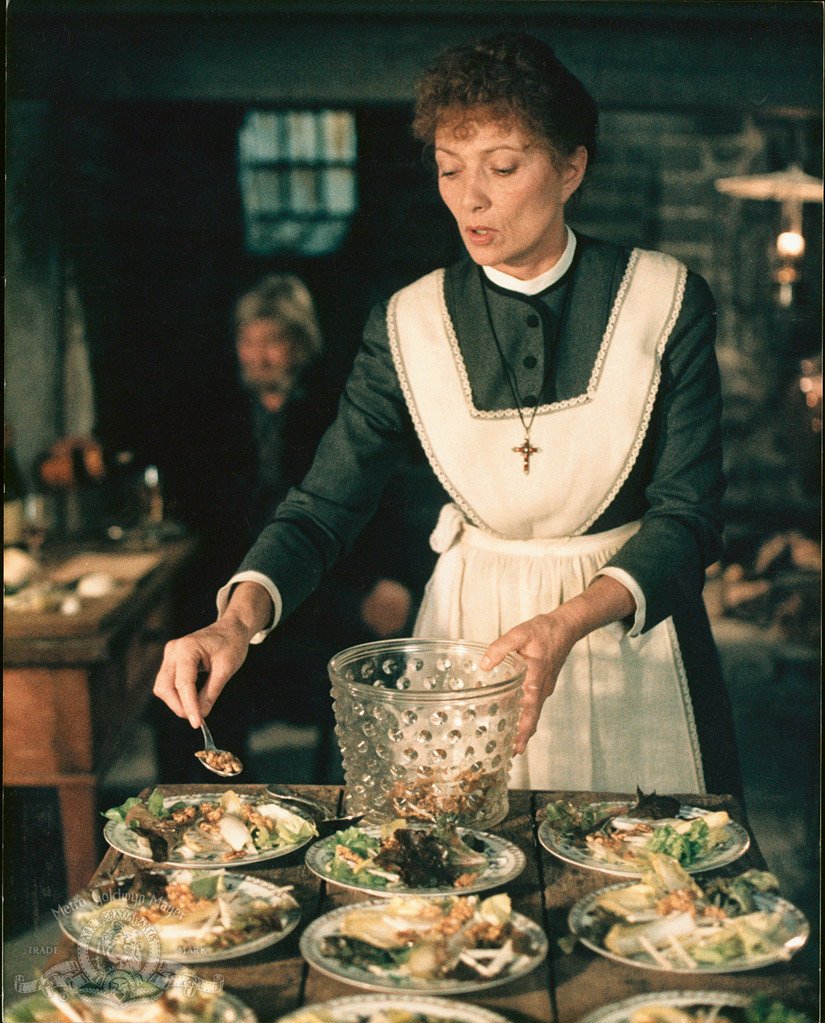
Still from Babette’s Feast, directed by Gabriel Axel, 1987
LBC: It’s great.
DCS: Yes, but, there is something about the experience when you’re invited by somebody who knows how to host. A particular wine has been chosen, the table is set in an elegant fashion, and perhaps even the seating has been planned. Babette’s Feast is such a beautiful instance of this. There is so much attention that has been brought. You are sitting in a beautiful room. There is real silverware; it is heavy. Candles are lit. There is a dignity to the setting. Some people might say that is stuffy. I don’t know. It seems to me that it might be stuffy until the second bottle of wine gets passed around—
LBC: That’s right.
DCS: —but, you find some sampling of the Babbette’s Feast experience: everyone in such a situation is just elevated, and in the best cases you end up talking about deeper and more interesting things. It just brings out the best in the people in attendance. You feel ennobled—by what you’re eating, how you’re eating it, by your company. It can be a truly memorable event. It seems to me that this is what political existence ought be, that the political order ought to ennoble us in an analogous way. We actually can’t live without this dignity, so we are always trying to find ways to compensate for its absence, but they never work out very well. And, because we don’t have a sense of the meaning of authority generally, we tend to cynically reduce the solemn and ritualized dimension of political activity to manipulative rhetoric and so forth, and these are forms of coercion that are being exercised, etc. But, it seems to me that a healthier way to think about it, a more traditional sense, is by analogy to the example just talked about: just like a beautiful dinner setting brings out the best in everyone there, a properly authoritative political order brings out the best in everyone. It implies a sense of a kind of dignity, and thus elevates us all.
LBC: This reminds me of the way that Simone Weil will talk about the complex of vital needs of equality, honor, and hierarchy, in The Need for Roots, and how a proper political order will be one in which there will be a recognition of distinction in vocation, but which will also permit due and adequate respect to a person who works in the mines alongside the clergy, the academic, etc. while also recognizing the reality of hierarchy, their proximity to the unifying center of the social order—but, it is also not the case that the person who works in the mines feels themselves to be degraded in light of that, because, in a way, they participate in an order wherein the virtues that are proper to the laborer are able to appear and be celebrated, and, that they are ennobled through their participation in this greater whole.

Portrait of Simone Weil, 1942
DCS: You’re absolutely right. I have been reading a really interesting book, by Gordon Wood, on the American Founding. Everything he has written is fascinating, but the one I’m reading now is Friends Divided, on the relationship between Thomas Jefferson and John Adams. Adams was very concerned, always, about the aristocracy, and he thought that the inequality of aristocracy was a perennial problem. There is no human political order that doesn’t have aristocrats of some sort. The idea that we are all born equal is an illusion. This is a thing that he disagreed with Jefferson on, obviously, even though Jefferson was much more naturally aristocratic. What is so fascinating is that Adams can’t but think of aristocrats as holders of power. He clearly thinks within the horizon of mere power. What it means to be aristocratic is thus to have money and power. And, of course, money is just a form of power. And if they have money, that means we don’t have money. And so as their money and influence and power increases, ours decreases, which means we’ve got to come up with a system that somehow neutralizes as far as possible these various advantages… But, I think, exactly as you’re saying, in an authoritative order, the authority that the people ‘higher up’ in the hierarchy possess is not opposed to those ‘lower down.’ Competition is built into power; that is its essence. This is really important. Mere power always brings about a zero-sum game. Where one has power, the other has less power. Whereas authority is exactly the opposite. If authority means augmentation, then, the more authority I have, the more independent those around me become, the more authority they have—and they then, in a way, spill it over. So, as you say, of the worker in the mine, in a genuinely authoritative order, they would look at the king and – in a way – feel, ‘that is me,’ ‘he represents me,’ ‘the grandeur is something I share in.’ And that’s why the laborer wants to defend the king. He has a sense that what the king represents belongs to him, and that it ennobles him by ennobling the land to which he belongs. Symbols tend to function in that way.