This is the second essay in a three-part series. Read Part I here.
Unitarian-isms: Capitalism, Theism, Liberalism, and Optimism
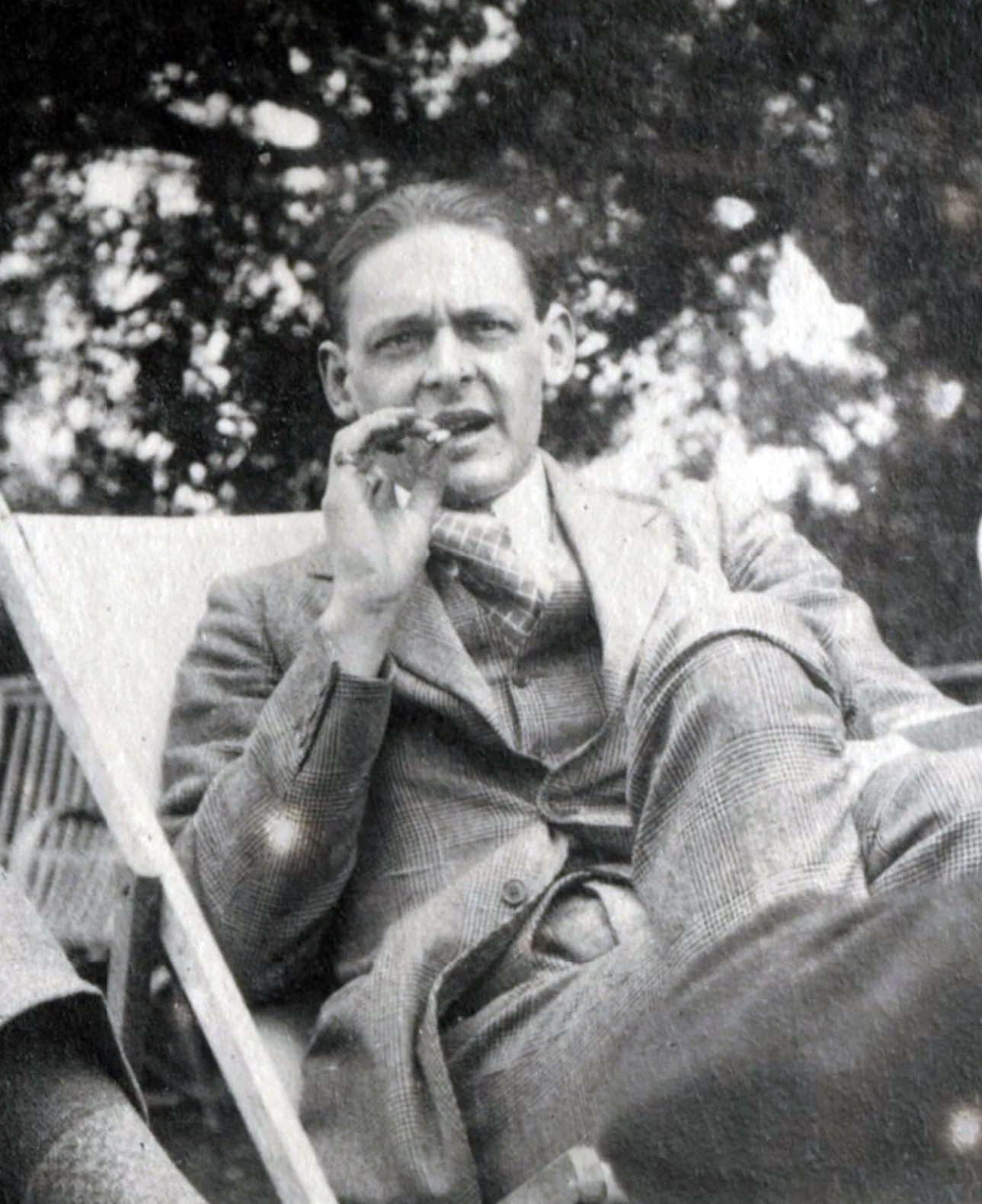
Photograph of T. S. Eliot by Lady Ottoline Morrell, 1923
T. S. Eliot was born into a prominent Unitarian family, or as he liked to joke, “the Borgias of Unitarianism.” His grandfather, the Rev. William Greenleaf Eliot, was the first Unitarian minister to arrive in St. Louis, Missouri, in 1834. He became an influential figure there, one of the movers and shakers who guided St. Louis in its evolution from a small town into a metropolis.
Having emerged from a liberalized version of Calvinism in North America, Unitarianism is fully exemplary of the logic of liberal Christianity. Since the sixteenth century, Calvinist denominations had taken the loose organizational form of Congregationalism, but by the early nineteenth century, the more liberal Congregationalists had sloughed off the core Calvinist tenets of predestination and human depravity. (“Liberal” in these contexts meant “broad-minded” and “non-sectarian.”) In the first decade of the nineteenth century, this group of liberals had not yet claimed the term “Unitarian,” which was initially a pejorative hurled at them by the orthodox Calvinists. In the 1810s, they still considered themselves Congregationalists, though on the liberal side of the reformed tradition. After several decades of controversy with their Calvinist opponents, however, doctrinal distinctions and denominational status solidified, particularly the doctrine of the Unity of God. In their eventual claiming of the term “Unitarian,” the liberals seemed to concede that their primary disagreement with the orthodox Calvinists involved the nature of God. Unitarians staked their claim in a strict monotheism, a godhead only of the Father, with the son as a prophet and perhaps nearly divine, but not God himself: Christ was a “sort of superior Emerson.”
In spite of the moniker derived from the Unity of God, the more significant difference between Unitarians and Calvinists stemmed from their opposing views of human nature. The ethos and temperament of Unitarianism, as it developed away from Calvinism, became increasingly rational and dependent on human will. In the early nineteenth century, the charismatic William Ellery Channing, pastor of Federal Street Church, asserted that Unitarianism valued “reason, individuality, and progress” as opposed to orthodoxy, doctrinal statements, hierarchical structures, and authoritative teaching. Although firmly rooted in Christianity, early Unitarianism was just as committed to the free-thinking tradition of the Enlightenment. What was unique about the religion was that its leaders collectively chose not to police even the beliefs they shared. This individualism is what makes Unitarianism exemplary of the Protestant impulse, in a way that was not characteristic of any other denomination. Other Protestant sects paradoxically believed in freedom of individual conscience yet vigilantly guarded their theological borders. Unitarianism, by contrast, followed through on the logic of freedom of conscience. It urged its adherents to pursue truth in their individual lives, but no leader or preacher took it upon themselves to identify that truth for others, only to gesture in the direction of the Bible. The Unitarian impulse boldly (or rashly) jettisoned the problem of competing Scriptural interpretations by positing reason as always sufficient. Unitarians also took for granted that teleological progress was the Scriptural view of history. The Unitarian theologian James Freeman Clarke optimistically hymned progress as essential to his religion: “the continuity of human development in all worlds, or, the progress of mankind onward and upward forever.” It did not occur to them that notions of an inexorable process leading to improved material conditions might instead have been imported from progressivist ideology, Enlightenment philosophy, colonialist expansionism, and imperial–industrial culture.
A consequence of the Unitarians’ historical blindness and psychological naivete is that they believed that the doctrines they had hammered together at the beginning of the nineteenth century—a curious mixture of Enlightenment principles, German idealism, free-thinking skepticism, and Biblical-sans-ecclesial authority—would simply take care of itself. Rational and optimistic, they believed their precarious formulation was not precarious at all, that it was an uncovered truth, “essential and indestructible” in Rev. John Snyder’s view, and that therefore it would never become corrupted from the form they had created. This innocence would soon unravel Unitarian Christianity.
In the short run, forging a space between liberal Calvinism and agnosticism solved a number of theological and cultural problems for a segment of Christian-minded, well-educated Americans at the beginning of the nineteenth century. Daniel Walker Howe has argued that in their various resolutions to modern problems, early Unitarians, in spite of their tiny size, were actually more representative of the modern period than any other group, particularly their “commitments to capitalism, theism, liberalism, and optimism.” While these social commitments provided a temporary cohesion, the theological ground on which Unitarians stood had become treacherously narrow. Having declared theological debates about the liturgy, the sacraments, grace and free will, and biblical hermeneutics “bigotry,” what was left then was the rather sterile ground of ethics, which they dressed up as cheerful duty. Only tenuously related to metaphysical assumptions, the “inculcation of right principles of conduct” formed the ethical basis of Unitarianism. Then, in 1886, at a Western Unitarian Conference meeting, the historical relationship of Unitarianism with Christianity was finally severedwhen the only theological resolution to pass was one stating that there would be “no dogmatic tests,” and that the principles of “Truth, Righteousness and Love” would instead be the grounds of their association. Only Enlightenment principles were invoked, not Scripture—the last bulwark of Unitarian Christianity. While early Unitarianism had successfully catered to the capitalistic, theistic, liberal, and optimistic predilections of its followers, its long game was a losing one. Early Unitarians might have been committed to the authority of Scripture, but without the guardrails of doctrine, it was inevitable that Christianity and free-thinking would fall afoul of one another.
Peter Ackroyd has memorably described the late-century religion of T. S. Eliot’s childhood as “Puritanism drained of its theology,” which nicely describes the ethos and temperament of Unitarianism. However, its theology might more accurately be described as deism with a vague nostalgia for Scripture. In spite of this lingering nostalgia, the tide was turning away from Scriptural authority and towards the only other authority Unitarianism recognized: reason. A few decades after the 1886 split, history would shred all the commitments that had held the early Unitarians together. In the smoldering wreckage of World War I, T. S. Eliot and others would find modernity’s trust in capitalism destructive, its theism shallow, its liberalism ungrounded, and its optimism unwarranted. Resilient and flexible, however, Unitarianism would survive, evolved into a different form, one unshackled by Christian Scripture, more robustly dedicated to skepticism and free thinking, and more attuned to the relativism of the twentieth century.
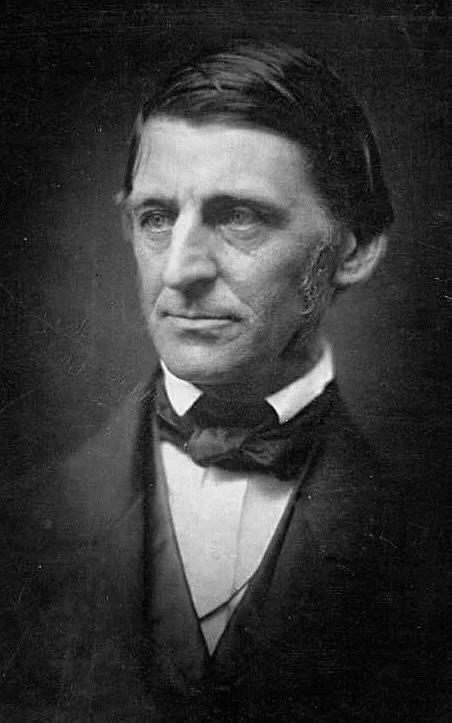
Ralph Waldo Emerson, c. 1857
Unitarianism and Transcendentalism in Eliot’s Poems
Ever since Ralph Waldo Emerson theatrically renounced his position as Unitarian minister, literary critics have tended to categorize Emerson and his peers as Transcendentalists rather than Unitarians. Regarding its flourishing literary culture, scholars have preferred to understand Transcendentalism as an aesthetic movement. But this relationship between Transcendentalism and the arts has been overdrawn, as if the movement were merely a salon of like-minded artists. More recent scholarship, by contrast, inclines to understand Transcendentalism as primarily a religion, and one descended from Unitarianism rather than in opposition to it.
While Transcendentalism did reject some aspects of Unitarianism, its disavowal belied strong continuities. Unitarianism exalted the individual (a Transcendental virtue also), but unlike Transcendentalism, it looked askance at effusions of religious emotion, distinguishing itself from the revivalist movements that were gaining ground in America. If Unitarianism had emerged in response to the “papal Protestantism” of Calvinism—its rigid institutionalism and imposed creeds—then Transcendentalism emerged in response to the restrained mode of Unitarian worship. Both Unitarianism and Transcendentalism were fed by the same German idealism, both trusted in human goodness and intuition. But in Unitarianism there was something too cool and rational for the Transcendentalists. Emerson had witheringly described Unitarianism as “corpse-cold.” Ultimately, Unitarianism aimed for respectability and promoted a bourgeois moral ethic—modes that irked the Transcendentalists.
Decades later, when Unitarianism and Transcendentalism were no longer understood as brash rejections of institutional orthodoxy, but as the exact opposite—the status quo, staid “guardians of the faith”—a young and rebellious T. S. Eliot would cast a pox on both their houses with four poems written in the spring of 1915. In the first poem, “The ‘Boston Evening Transcript,’” the speaker satirizes the eponymous newspaper and its readers. With a fondness for genealogies, Boston Evening Transcript was a high-toned daily aimed at the city’s elite, its Waspy and Unitarian readership. In an era of upper-class condescension toward mass culture, it offered news in a deliberately stodgy style that aimed to distinguish itself from other, more sensational evening papers. Eliot’s poem suggests that these readers do not think for themselves, swaying “in the wind like a field of ripe corn.” Emerson’s complaint about “corpse-cold” Unitarians describes them perfectly: they have no appetite for life, only for monotonous routine and for the safety of a newspaper that will not challenge them. As the speaker wearily mounts the stairs to greet his family, newspaper in hand, he acknowledges the imaginary presence of La Rochefoucauld. Praised elsewhere by Eliot as “hard” though not cynical, the presence of this “implacable moralist” signals the author’s sympathy with the French aristocrat’s searing judgment.
In the second poem, “Cousin Nancy,” a “modern” force, in the form of a liberated woman, disrupts the solemn rounds and barren lives of New England patricians. According to the poet, Cousin Nancy’s last name, Ellicott, was a conflation of Eliot and Endicott, suggesting that ancestral ties were at stake: John Endecott was the first Governor of the Massachusetts Bay Colony. In the third poem, “Aunt Helen,” the disruptive force is death itself, ushering in a modern set of values. First, however, Miss Helen Slingsby must be dispensed with. Off she is sent to heaven, where the speaker relates: “Now when she died there was silence in heaven / And silence at her end of the street.” No angelic chorus greets her, only a grim, Unitarian reserve. Likewise, Aunt Helen’s earthly heirs maintain a decorous quiet rather than mournful wailing. Her death is met not as l’ultimo momento or grand translation, but as a material embarrassment, to be veiled by the discrete manners of drawing shutters and wiping feet. Facing death, the oily undertaker—in the poet’s mock understatement—was “aware that this sort of thing had occurred before.” Writing to his brother, Eliot claimed of their shared religious inheritance: “Unitarianism is a bad preparation for brass tacks like birth, copulation, death, hell, heaven and insanity: they all fall within the classification of Bad Form.” “Aunt Helen” is a blistering critique of a religious ideology that has reduced the ultimate concerns of life and death to matters of social decorum.
The fourth poem, “Mr. Apollinax,” also focuses on a disruptive force, a lacerating sensualist—based on Bertrand Russell—who unnerves a polite gathering of Harvard academics, including one Mrs. Phlaccus (flaccus, Latin for “flaccid”) and a Professor Channing-Cheetah. After Mr. Apollinax departs, the confused guests debrief among themselves. Overcome with l’esprit de l’escalier, one of them bleats pathetically: “There was something he said that I might have challenged.”
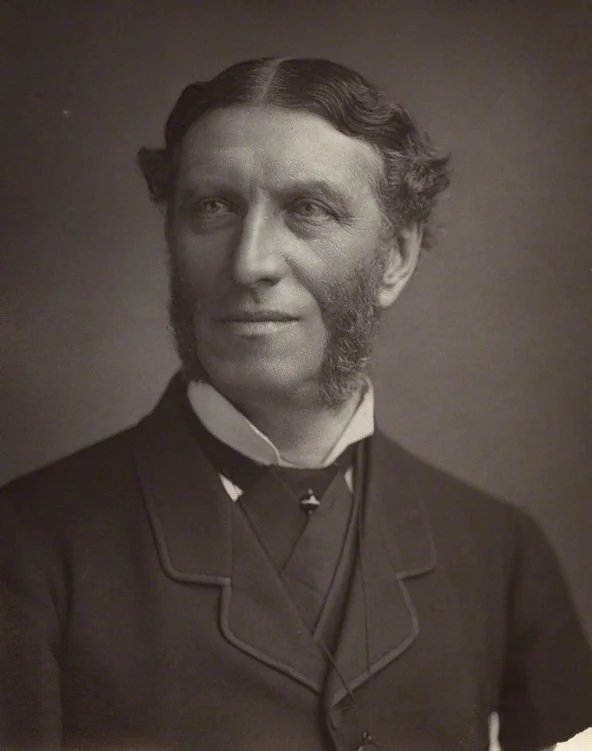
Matthew Arnold, c. 1883
Eliot’s targets in these four poems are identifiable though not directly named, the obliquity mirroring the fussy deference that the poems lambast: “Channing-Cheetah” rather than William Ellery Channing; “Matthew” rather than Arnold; “Waldo” rather than Emerson; and “Ellicott” rather than the Eliots, Endicotts, Lowells, and Adamses—the entire New England heritage the poet was both proud of and oppressed by:
Upon the glazen shelves kept watch
Matthew and Waldo, guardians of the faith,
The army of unalterable law.
The “pale negations” of Unitarianism (Emerson’s complaint), the stern judgments of Transcendental orthodoxy are detectable in those judging eyes, domineering and inflexible, provoking the young Eliot to his own counter judgments. Eliot’s earliest poems had revealed a penchant for satirical critique and a savage rejection of gentility, but until these four poems were drafted in 1915, he had kept the most vicious compositions in the privacy of a notebook. In these four published poems—written in England as he contemplates leaving America behind forever—he gives free rein to burn-it-to-the-ground satire.
This is the second essay in a three-part series. Read Part III here.