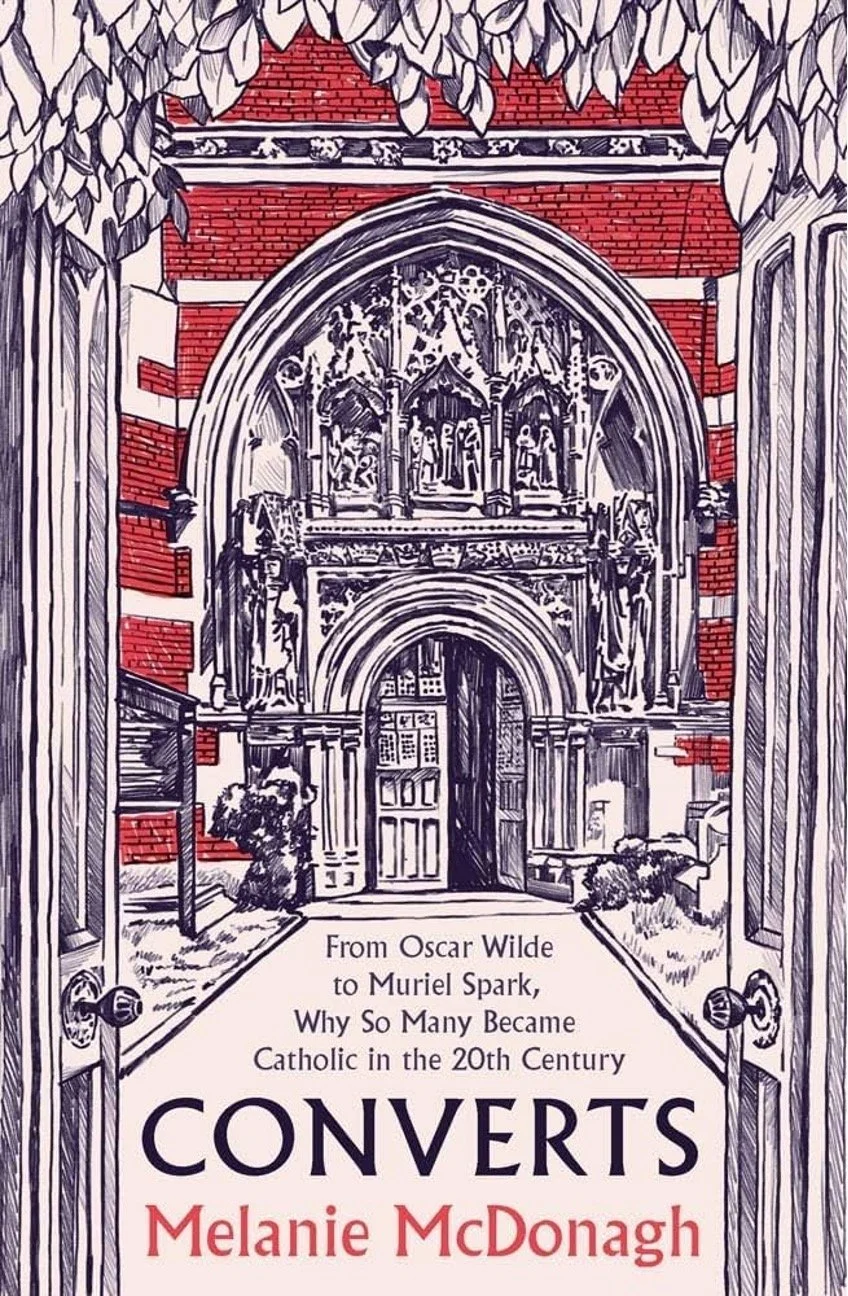
The cover of Melanie McDonagh’s new book
“When will men understand that between what is Catholic and what is anything else, there is a great gulf fixed?” Thus wrote the English Jesuit and convert Fr. Cyril Martindale in a bit of triumphalist exasperation. For Catholics in early-twentieth-century Britain, Martindale was summing up fellow feeling regarding thousands of conversions to Rome, a phenomenon that was setting the Church of England on edge. Since there is little data regarding working-class conversions, the scholarly emphasis has been on artists and intellectuals who wrote about their experiences of crossing the Tiber. Modernist artists converted for different reasons and from different starting places, though a surprising number followed John Henry Newman’s short leap from Anglo-Catholicism. Melanie McDonagh estimates over half a million conversions to Roman Catholicism in England and Wales between 1910 and 1960. While it is tricky to generalize about this generation of converts, the sheer volume suggests that something was in the air, more than personal searches for truth or salvation. McDonagh’s interesting new book, Converts: From Oscar Wilde to Muriel Spark, Why So Many Became Catholic in the 20th Century (Yale, 2026), provides an opportunity to revisit this remarkable phenomenon. Using her book as a point of departure, this three-part essay proposes to approach the circumstances of modernist conversion from a slightly wider angle: Orthodox Christianity instead of only Roman Catholicism. And using the test case of T. S. Eliot—a convert from Unitarianism to High Church Anglicanism—it considers such conversions from the opposite direction: what liberal Protestantism could not offer instead of what Orthodox Christianity could.
It was the decadents in the late nineteenth century who set the ball rolling, cementing the idea of Roman Catholicism as a refuge for serious artists. It is extraordinary to count the number of Oscar Wilde’s circle and acquaintance who converted: Wilde himself, Robbie Ross, Lord Alfred Douglas (“Bosie”), Sybil and Edith Douglas (Bosie’s mother and sister), Aubrey Beardsley, Lionel Johnson, Ernest Dowson, John Gray (a model for Dorian Gray), Henry Harland, and Wilde’s son Vyvyan Holland. To this list, McDonagh tentatively adds John Douglas, the horrid Marquess of Queensberry and proximate cause of Wilde’s downfall, who was given conditional absolution on his deathbed by his brother, a Catholic priest. McDonagh credulously relays the Very Reverend Canon Lord Archibald Douglas’s account: that his brother Queensberry had “confessed his sins, renounced his atheism and professed his love for and faith in Jesus Christ.” While noting that Lord Queensberry had been a pugnacious atheist his entire life, McDonagh does not point out that he died in a state of mental confusion after a stroke. That Fr. Douglas felt compelled to offer conditional absolution rather undermines his claim that his brother made a full confession and declaration of faith. If Queensberry had done so, conditional absolution would not have been necessary. The pious Christian can certainly hope that Queensberry died in a state of grace, but the scholar should be suspicious that a dazed stroke victim and lifelong crank could summon such lucidity and humility in his final moments.
In any case, for many decadent artists, their turns to a bedrock of faith was effected within a small sub-culture of religious feeling and sexual dissidence. As Ellis Hanson has argued, Catholicism offered decadent artists a language and a form to relate queer desire to religious impulse: “For [Wilde’s] dandyism and his aestheticism, there was beautiful ritual and passionate faith. For his taste for scandal, there was a discourse of sin. And for his aesthetic and sexual martyrdom, there was the language of penitence and hagiography.”
Nevertheless, the decadent conversions did not inspire a larger-scale resettlement in Catholic pews. Among many interesting insights is McDonagh’s claim that conversions were not on the rise in the late nineteenth century. Rather, the flood of conversions in the twentieth century was a marked and sudden reversal of a lowering tide. The real tsunami started in 1910 with the modernists themselves who went over to Rome: David Jones, Graham Greene, Robert Hugh Benson, Eric Gill, Edith Sitwell, Radclyffe Hall, Gwen John, Maurice Baring, Siegfried Sassoon, Muriel Spark, Evelyn Waugh, G. K. Chesterton, and Elizabeth Anscombe. McDonagh provides lively biographies focused on the conversions of many of these artists and intellectuals, as well as some chapters devoted to contextual history. McDonagh’s emphasis on individual biographies does not obscure—as it might have—the sociological and data-driven aspects of her argument.
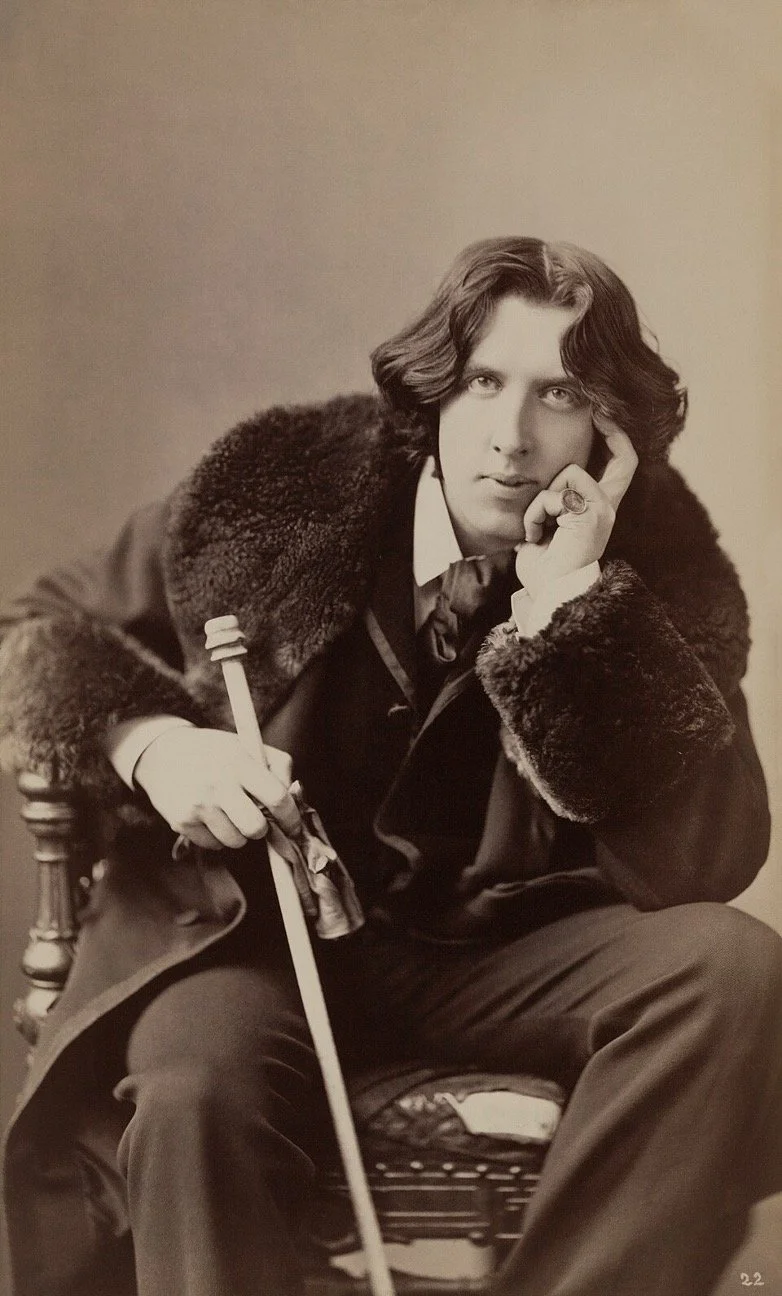
Photo of Oscar Wilde by Napoleon Sarony, 1882
Another canard that McDonagh puts to rest is the idea that most of these artists were attracted to Catholicism by the beauty of its liturgies and church buildings. She notes that such reasoning is not often articulated in these converts’ memoirs and autobiographies. She contrasts the Catholic Church—poor and detested by middle- and upper-class Brits—with High Church Anglicanism that could amply provide its members with the “merely aesthetic.” In England, “Catholic churches tended in fact to be repositories of hideous taste in religious trappings,” McDonagh remarks. “Many convert accounts emphasise that the reality of the faith emerged even in the most unprepossessing buildings and despite markedly unimpressive clergy.” McDonagh also notes that focusing on artists and intellectuals highlights the problem of class in conversion narratives. In the British landscape of the early twentieth century, Catholics were considered vulgar and uneducated. From the reaches of the established church, conversion to Rome was a crime against taste: artists who converted should have known better.
In places, McDonagh is repetitive or uncritical. Given the book’s focus, it is not surprising that one of Wilde’s conquests in Italy is framed as an intersection of queerness and Catholicism. This was a poor seminarian about whom Wilde had bragged to Robbie Ross: “every day I kissed him behind the High Altar.” That the boy was fifteen years old does not seem to be a particular concern for McDonagh—naming Wilde’s behavior as abuse would undermine the triumphalist narrative. Only when we stop relaying such stories uncritically can we move past the hoary narrative of Wilde as queer martyr and see him as an altogether more complex individual, that his tragedy was partly due to the intolerance of his age and partly of his own making. And although McDonagh tries to be evenhanded about the failings of the Catholic Church and its members, one never quite escapes the feeling of being dragged into a sectarian polemic: cheering all those wins for Mother Church.
Nevertheless, hail to McDonagh for digging up all kinds of interesting data, including illuminating anecdotes and quotations from unpublished material in the archives. I was especially struck by the Martindale observation that appears in the introduction and that is implicit throughout: “When will men understand that between what is Catholic and what is anything else, there is a great gulf fixed?” In considering what Catholicism calls “the fullness of truth” and what it believes to be its trump card in the apostolic succession, such a claim about a theological gulf may be true for the individual soul. But as a sociohistorical question, what if the more interesting divide is not between Catholicism and the rest of the world, but between sacramental Christianity and the rest of the world? The gulf, in this case, is not determined by the brand name of a religion, but by the differences between orthodox Christianity and liberal Protestantism, between sacramental and non-sacramental worldviews. Given that Christian denominations delineate themselves along multiple spectrums, the dividing line is not a bright, clear one in the way that conversion to a specific faith is. For example, the same baptismal formulary is used across the board of Christian denominations, but what it means differs widely: a “sacrament” to some, an “ordinance” to others. And even those churches that call baptism a sacrament do not agree on what baptism effects or what constitutes its sacramental nature.
Despite such difficulties, reframing the question includes more orthodox-leaning Christians. The churches that I would identify as sacramental and orthodox—in a loose, sociological sense rather than a strictly theological sense—are the High Church wing of Anglicanism, including Anglo-Catholicism, Roman Catholicism and its Eastern rite cousins, Oriental Orthodox (Coptic, Syriac, Armenian, etc.), and the Eastern Orthodox (Greek, Romanian, Slavic, etc.). By sacramental, I mean a theology holding that sacramental actions (especially baptism and the Eucharist) convey the immanent presence of God rather than being symbolic ordinances. Further distinctions might be drawn, but the above is sufficient for the purpose of this argument.
To get a handle on the religious tenor of the age—and to be fair to McDonagh, that is not the quarry she is pursuing—it would be counterproductive to limit the discussion to Roman Catholicism. Nor is it helpful only to consider conversions. Is not reversion to the faith of one’s childhood just as religiously and sociologically significant as a conversion? Widening the field significantly, it brings into the discussion such major modernists as T. S. Eliot (who converted to Anglicanism and settled in its Anglo-Catholic wing), W. H. Auden (who returned to High Church Anglicanism), C. S. Lewis (who moved over to the Church of England and held High Church views of Eucharist and confession and Broad Church views in other matters), Paul Claudel and Charles Péguy (who both returned to the Catholicism of their youth), Igor Stravinsky (who returned to Russian Orthodoxy), Willa Cather (who became a High Church Episcopalian, with strong leanings toward Catholicism), and even Simone Weil (who never converted, though she loved the Catholic faith, feeling called instead to stand on the periphery of the institutional church). Even though the focus on conversions is understandable—they are dramatic, public, and illuminative—for the fullest view, we might also add those modernists who remained firmly High Anglican, Catholic, or Orthodox all their lives: Dorothy Sayers, J. R. R. Tolkien, Georges Bernanos, and Hilaire Belloc. Remaining in one’s faith is itself a choice, a reaction to the anxious era in which they lived.
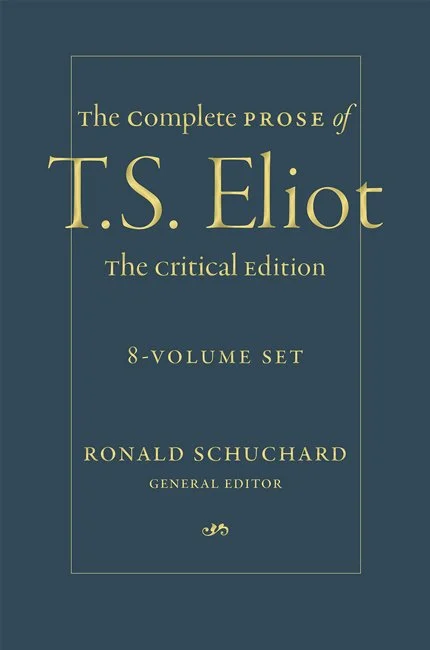
The 8-volume set of The Complete Prose of T. S. Eliot: The Critical Edition, published from 2014 to 2019 under the guidance of General Editor, Ronald Schuchard
Rather than present a full sociological sketch with the coordinates readjusted as described above, I propose instead to zoom in on a detail in the next installment of this series: T. S. Eliot’s rejection of his family’s religion. As I explain, Unitarianism, more than any other Christian denomination, is fully exemplary of the liberal Protestant impulse. And T. S. Eliot, because he explored multiple faiths with extreme skepticism, and because he became so theologically literate, provides an ideal model for a convert describing the circumstances of his search. This study is further aided by an explosion of new materials: since 2009, 21 new volumes of Eliot’s poems, letters, and prose have appeared. As a consequence, a much clearer view of Eliot’s biographical and historical contexts has become available thanks to the T. S. Eliot Editorial Project.
This is the first essay in a three-part series. Read Part II here.