The “Ascension” from Facticity
What follows is taken from my recent book In Heidegger's Vineyard: Reflections and Mystical Vignettes. It is one of several meditations in the book that remind us that, no matter our circumstances in life, we are called to lift up our hearts in thanks and praise.
It is evident from Heidegger’s manifold published and unpublished texts, lecture courses, and other talks and writings composed after Being and Time and until his death (almost 50 years of work) that only faint traces of his early notion of “facticity” are to be found. Perhaps not surprisingly, this is often overlooked (or ignored) by many contemporary commentators who insist that Being and Time is definitive of his thinking. For these commentators, Heidegger’s early notion of “facticity” and “thrownness”—the indelible imprint of all circumstances of our individual and collective existence—define our radical and unremitting finitude from which there is no release. Accordingly, for these readers, our existential task is to come to terms resolutely with our contingent, random, and broken existence—and also to help relieve the plight of the “facticity” of others.
Admittedly, there is merit to this kind of (narrow) reading of Heidegger. After all, there is no existential “escape” from our facticity, and we all have to come to terms with it. Yet by no means does this represent Heidegger’s final or complete understanding of the matter. In my most recent book, Heidegger’s Being: The Shimmering Unfolding, I offer a more balanced perspective.
And here let us take another “leap” in thinking, which, again, moves us beyond the late Heidegger’s thinking but keeps us in its orbit, I believe.
Why did Heidegger move past his early emphasis on facticity? There are no doubt many reasons, but one consideration is very simply that “facticity” is a younger person’s preoccupation. In the first half of life, we come to recognize how all the circumstances of our existence have formed and shaped who we “are.” Our gradual awareness of our “facticity” and “thrownness,” and of how we have been subsumed in the “They-Self” (das Man), most certainly knocks us off balance, alarms and angers us, and fills us with “anxiety” (Angst). How accidental and contingent—and unfair—it all is!
Heidegger’s Being and Time confronts our “facticity” head on, and it offers the solution of “resolution.” That is, our difficult finitude needs to be taken up with a form “resoluteness” (Entschlossenheit)—an existential remedy that is similar to Nietzsche’s or Camus’s. And there is no question that such a message resonates most powerfully with those in the early stages of life who are dealing with—and very often struggling with—the “facticity” of their existence.
Yet in the second half of life, and especially in the latter quarter of life, the particularities of our factical existence begin to recede or fall away as we have stronger intimations (not formal reasons or arguments) of the “infinite” or the “eternal” (“Being is everlasting,” observes the later Heidegger; see my Heidegger’s Being: The Shimmering Unfolding, Part I, Chapter 6). The later Heidegger moved on from “facticity” to other core themes and concerns with a very different inflection. He moved on to the themes of “homecoming” (Heimkunft) in relation to Being, our gentle “releasement” (Galassenheit) and “openness” to all that is, our grateful reception of the “gift” of Being. We remain factical beings, of course, but this is no longer the leitmotif of our meditations—not for Heidegger and not for any human being who has traveled a good part of the way along the path of life.
I title this reflection “ascension” from facticity for a reason. I have in mind a magnificent stained glass window by Edward Burne-Jones installed in the Birmingham Cathedral in England in 1885. The window depicts the Ascension of Jesus. Here is an image of the window:
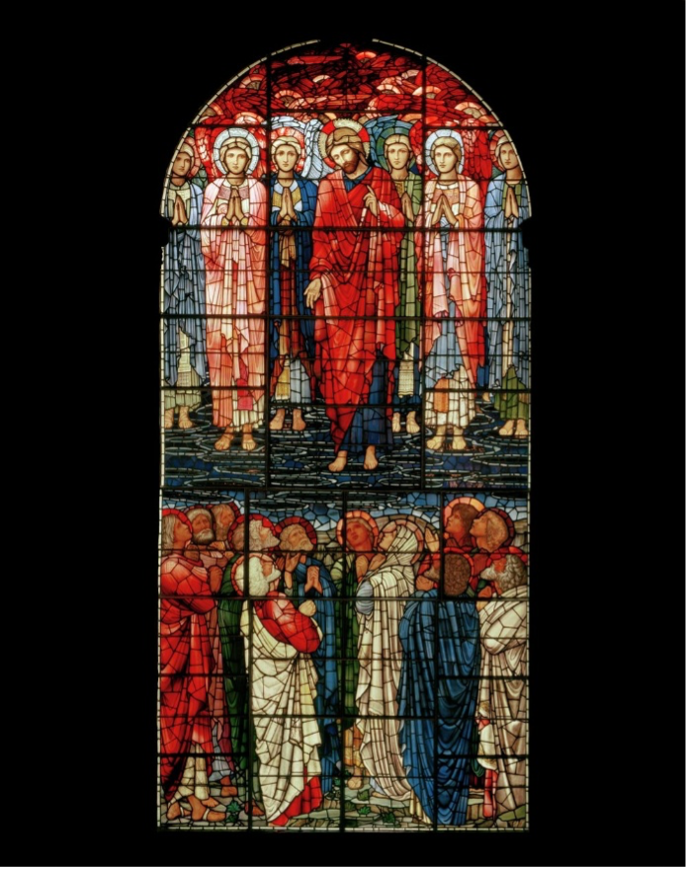
Edward Burne-Jones, Ascension, 1885
The image does not do justice to the clarity and splendor of the colors of the stained glass (which was crafted in the studio of William Morris, Burne-Jones’s life-long friend and collaborator). Even so, one can still discern the exceptional balance and elegance of the design and the vibrancy of the colors. Simply as a masterwork of art and craftsmanship, this stained glass window deserves our attention.
Yet what I highlight here is the message of the window, which we need not read in any “orthodox” manner. The figure of Jesus in the center is surrounded by serene angelic figures, and he looks down tenderly and lovingly toward the mortals of the world. With his right hand he gestures toward them, and with his left hand, he blesses, affirms, and reassures. What is this reassurance that comforts those “below,” that comforts the mortals? It is this: that all that is finite and factical “ascends” to the eternal. The figure of Jesus in this glorious stained glass window bridges the finite and the infinite, and reminds us that all that is finite is drawn up to the infinite without negating the finite. And notice how the mortals “below” look up in hope and wonder and awe at this great promise and mystery that no matter the heartache of the finite and factical, all—everything—will “ascend” to the eternal and infinite. The window beautifully conveys the message of the movement of all things “ascending.”
In the narrow reading of Heidegger’s Being and Time, and in our contemporary age in general, such a message is missed, or worse, dismissed as “inauthentic,” a “betrayal of facticity,” an “imaginary construct,” or mere “wish-fulfillment.” But what if we released ourselves to the message of this image? What if we opened ourselves to receive the gift of this work of art? Is it possible that if we did so, our facticity would not be denied or betrayed—but rather transformed and transfigured? And we would clasp hands, just like the mortals in the bottom half of this shimmering stained glass window, not with despair, but with abiding thanks and praise.