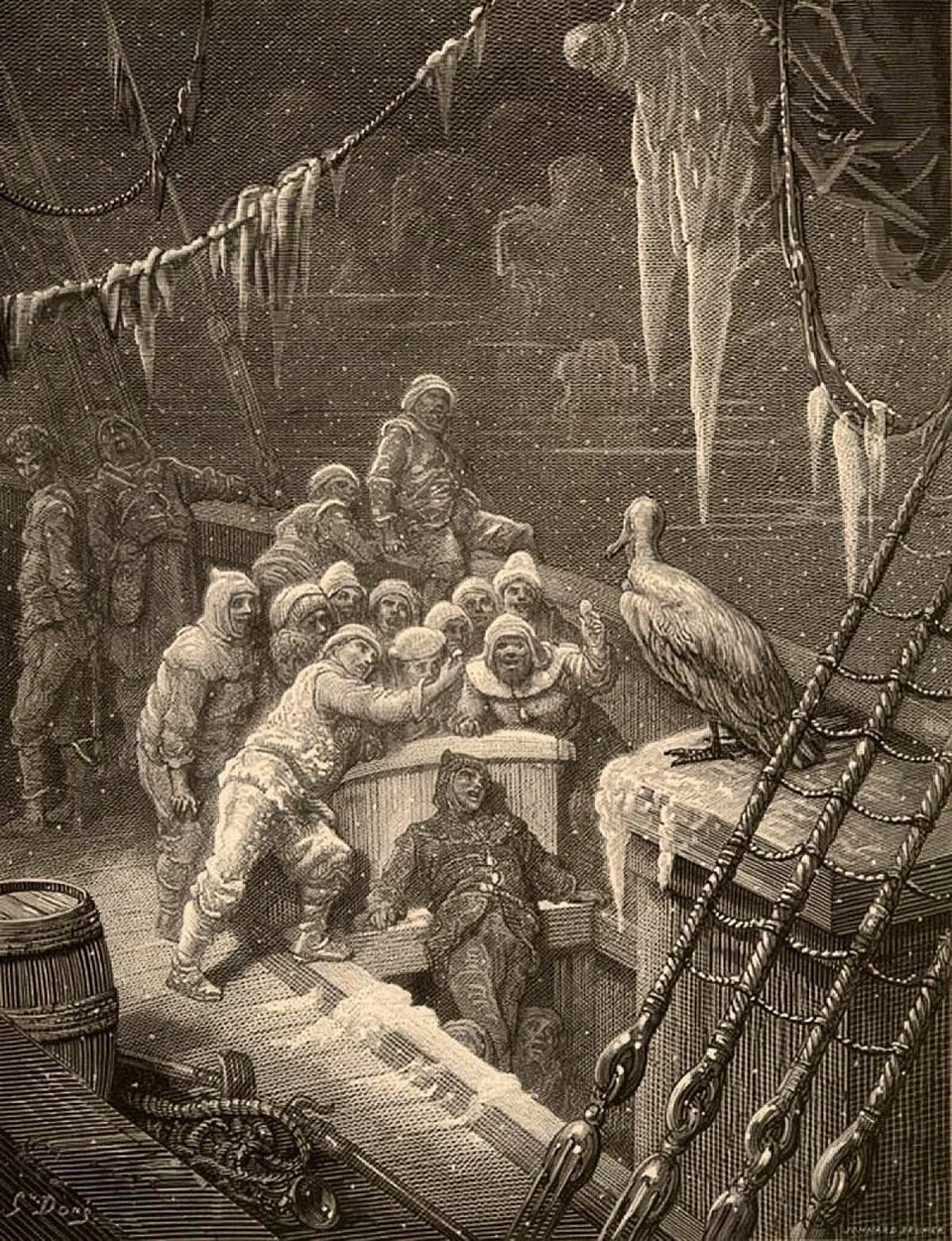
Gustave Doré, “The Albatross,” engraving for an 1876 edition of the Rime
“There is fantasy in this poem so long as we exclude altogether from fantasy anything in the nature of whimsy.” So writes the poet David Jones in his 1964 introduction to Samuel Taylor Coleridge’s Rime of the Ancient Mariner. On first glance, this observation is obvious. The Rime, with its vengeful spirits, ghost ships, and reanimated corpses, more than meets our contemporary expectations of a fantastical narrative. But as Jones’s qualification attests, the word “fantasy” can be slippery and suspect, suggesting frivolity rather than literary seriousness.
The Oxford English Dictionary records fifteen distinct definitions of the noun “fantasy,” many of which date back to the fourteenth century. The word can refer to perception, to imagination, to hallucination, to an apparition, or to caprice. Only in 1949 was it first used to name “a genre of literary compositions,” appearing in the title of the newly founded Magazine of Fantasy and Science Fiction. That label for short fiction would not become a firmly established novelistic genre until The Lord of the Rings’ popularity exploded in America in 1965, the year after Jones wrote his introduction to the Rime.
But by 1964, a hint of disreputability already clung to fantasy. We can see this in early responses to The Lord of the Rings. When W. H. Auden reviewed The Return of the King in 1956, he noted, “Nobody seems to have a moderate opinion: either, like myself, people find it a masterpiece of its genre or they cannot abide it.” He further suggests that those who dislike the book might object to it on principle as “light ‘escapist’ reading.” In 1961, when C. S. Lewis nominated Tolkien for the Nobel Prize, the committee dismissed his work, saying that it “has not in any way measured up to storytelling of the highest quality.” These incidents illustrate a common assumption, still in evidence in many literary and scholarly circles today: that narratives with fantastical or supernatural elements are less serious or less prestigious than fiction that restricts itself to the mundane. This explains Jones’s remark on the fantastical elements of the Rime: he fears that the label of “fantasy” will mark it as whimsical and therefore unworthy of serious attention.
This exclusion of the fantastical from “real” literature is a distinctly modern phenomenon. We can trace the divide between the “truly” literary and the fantastic at least as far back as Don Quixote, wherein the reading of romances, fantasy’s forebear, leads the protagonist to noble ruin. Eighteenth- and nineteenth-century anxieties about Gothic novels—suspected of exciting the desires and distorting the perceptions of impressionable female readers, and most famously satirised in Jane Austen’s Northanger Abbey—reflect this same divide. But earlier texts make no such distinction. As the science fiction writer Adam Roberts points out in Fantasy: A Short History, “fantasy … is the default mode of human storytelling. Mimetic, or more narrowly realist, fiction is a recent and … still relatively small-scale cultural development.” From Homer to Spenser, from Sophocles to Shakespeare, the fantastical is ever present. Only modern readers are likely to be surprised or displeased to meet witches, fairies, and prophecies in our literature. Any distinction between mimetic and fantastic literature would be incoherent to pre-modern readers.
In spite of this new divide, the supernatural lingers in modern literature—and not just in those texts shelved in the “Fantasy” section of the bookstore. Samuel Taylor Coleridge and David Jones are perfect examples, and their work reveals something about the trajectory of modern culture. Whereas in the Rime, Coleridge depicts a world full of supernatural forces, which his readers may choose to accept as true or enjoy as pure fancy; in Jones’s poem of World War I, In Parenthesis, the fantastical elements can always be read as literary devices rather than as plot elements. This shift forecasts the emergence of the fantasy genre, which led to an explosion of creativity even as it made supernatural narrative elements increasingly marginal. Literary modernism is, in its way, a step towards the emergence of the fantasy genre, even as the modernist literary elite are the sort of readers prone to dismiss fantasy.
***
When Coleridge re-published the Rime in 1817, he appended a Latin epigraph from Thomas Burnet’s Archaeologiae philosophicae (1736). In part, that epigraph asserts:
I easily believe that in the universe the invisible Natures are more numerous than the visible ones … Meanwhile, I do not deny that it is from time to time useful mentally to picture … a larger and better world, so that our minds, preoccupied with trivial matters of everyday life, do not shrink excessively and subside entirely into petty ideas. We must however be careful about the truth and keep a sense of proportion, so that we may discriminate between the certain and uncertain, day from night.
The claims here have profound implications for how we read Coleridge’s poem. First, Burnet suggests that the world may be populated by “invisible Natures”—presumably spirits such as the ones the Mariner encounters on his voyage. Likewise, Burnet commends to his reader the exercise of imagining “a larger and better world,” full of possibilities beyond the mundane and visible. And yet this expansive vision should not overwhelm our judgment. Taken as a whole, the paragraph seems to be an apology for the conscious contemplation of uncertainties.
The poem that follows offers a glimpse of that “larger and better world,” one in which a bird can love and preserve a crew of sailors; in which an “invisible nature” avenges an act of senseless violence; and in which a man learns to bless God’s creatures even in the midst of suffering. The Mariner’s voyage is framed as a tale told to an impatient “Wedding-Guest” who interjects at pivotal moments of the narrative. With every interruption, we are reminded that we are listening to the same tale as that Wedding-Guest, and that we might be transformed as he is, emerging “sadder and … wiser.” But to experience that transformation, we have to discern the truth in the supernatural tale the Mariner relates. This is not mere fanciful entertainment. It places demands upon us, asking us to consider familiar and urgent spiritual questions—where evil and violence come from, what debts we owe our fellow creatures—alongside the fantastical speculations: whether the world may contain more than we can see. These modes of inquiry go hand in hand. Coleridge invites us, at least for half an hour, to suspend our disbelief and to imagine a more expansive universe.
More than a century after the Rime’s composition, David Jones found that it expressed truths central to his understanding of the world. Much of his lengthy introduction he devotes to the literary tradition of voyages, finding in the ship, with its cross-shaped mass, a metaphor for the progress of the soul and of the church through history, “secure because to the transomed stauros [i.e. cross] of the mast was made fast the Incarnate Word.” (Jones loved the Rime so much that he made ten copper engravings to go along with his edition of the text, which you can find on the Museum Wales site.)
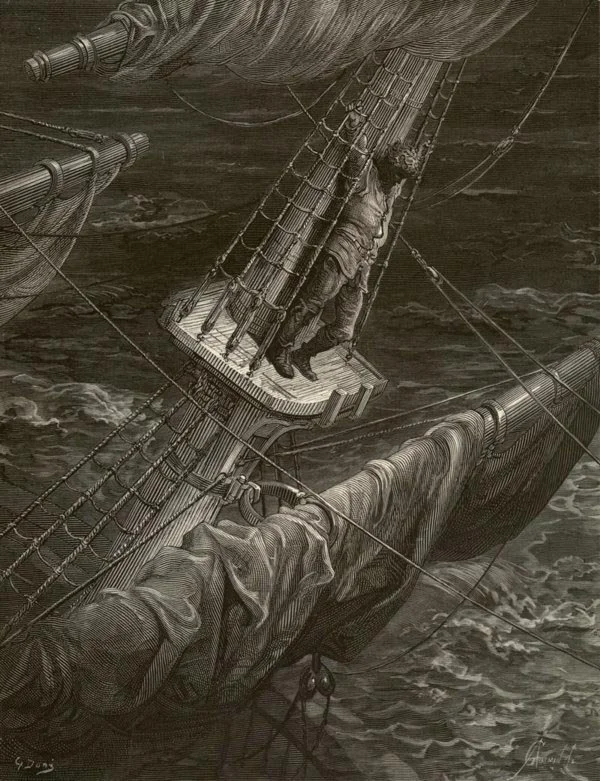
Gustave Doré, “I Had Done a Hellish Thing,” engraving for an 1876 edition of the Rime
It’s an incredibly powerful interpretation of Coleridge’s poem, one that reads metaphor and symbolism as the key to the Rime. Jones is fascinated by the typology of the voyage and the cross-shaped mass, but he does not seem particularly interested in the existence of Polar Spirits and ministering angels. His reading draws a clear line between the supernatural elements in which he believes (Christ and the church), and those that he enjoys as literary devices. Fantasy begins where belief ends—even when the two exist side by side.
This emphasis on metaphor and symbolism also characterizes Jones’s poetry, which abounds with supernatural images and allusions but never fully incorporates them into the plot, into its representation of the world. There is a sharp distinction between Coleridge’s imagined world, wherein we are invited to suppose that supernatural forces exist, and Jones’s, wherein we automatically accept the fantastical as a poetic effect. In Parenthesis, his book-length account of his time in the trenches of World War I feels at the start like a realist novel (albeit one without dialogue tags). In its opening scene, we see soldiers on parade, preparing to depart England for France. Novelistic conventions like quotation marks are missing, but we still find dialogue, characters, and a distinct plot. Gradually, the experience changes: the line breaks begin to tell us more about linguistic rhythm than about a shift in speaker or action; the plot becomes more difficult to follow; allusions and imagery abound. We realize that we are reading a poem.
And along with that shift from the novelistic to the poetic comes a profusion of supernatural elements. John Ball, the protagonist, looks to the sky on a night patrol and wonders if he has stumbled into the Arthurian waste land, if “dogs of Annwn glast this starving air.” But John Ball may well be dreaming. Dai Greatcoat, the purportedly undying “old soljer,” boasts of his presence at every mythic conflict, from the angels’ war against Lucifer, to Cain’s murder of Abel, to Arthur’s defeat at Camlann, to the crucifixion of Christ. But Dai may be spinning a yarn. At the end of the poem, when soldiers—British and German—lie dying in Mametz Wood, each receives a garland from the Queen of the Woods. But her ministrations may only be a wounded man’s hallucination.
Over and over in In Parenthesis, Jones offers these luminous, fantastical moments. They are central to the emotional experience of the poem. But they can always be read as metaphor, as symbol, as expressive of the poem’s thematic concerns rather than of the action of the plot. The world of Jones’s poetry is myth haunted. We are never asked to believe in those myths—but we are expected to take them seriously, as resonant symbols, as cultural fragments, as vehicles of meaning-making.
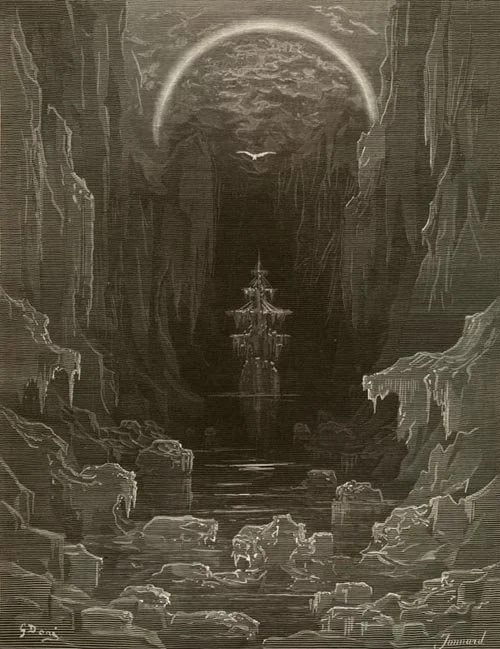
Gustave Doré, “The Ice Was All Around,” engraving for an 1876 edition of the Rime
Jones’s work anticipates fantasy’s further step away from the mimetic. His poem draws a line between realistic action and mythic resonance, never allowing the supernatural to become fully incorporated into the narrative. This is not to say that Jones rejects or denigrates the supernatural. Rather, he has a clear sense of what forms of the fantastical are acceptable within the literary circles of his day. Fantasy novels take a step further, incorporating the supernatural into the plot and thus portraying imaginary worlds, abandoning the mimetic. In so doing, they often also abandon literary respectability.
In Auden’s review of The Return of the King, he defends the novel from the charge of escapism by considering fiction’s capacity to depict the truth. Fantastical quests like that of Frodo Baggins, Auden asserts, resonate with our subjective experiences of time and choice, whereas more “naturalistic” narratives capture the social conditions we observe outside ourselves. “Both extremes,” he concludes, “falsify life.” Modern literature demonstrates an eagerness to divide these modes of truth telling. Coleridge and Jones, responding to the literary standards of their cultural moments, find ways to hold them together. In so doing, they illuminate the potential of fantasy writing, offering their readers glimpses of a larger and better world.