This is the fourth essay in our July–August 2026 forum on Personalism and the Catholic Worker.
During her visit to Australia in 1970, Dorothy Day began her talk at the University of Melbourne with an outline of her first encounter with Peter Maurin, who she characterized as “the founder” of the Catholic Worker. After recalling Maurin’s peasant background in the south of France, she pointed to another important influence on his life, namely his work in Paris for a French Catholic movement called Le Sillon (“The Furrow”) founded in 1893–1894 by Marc Sangnier. The Sillon did “very much the same kind of work that we are doing,” she noted.
This connection between an early twentieth-century French democratic movement, a wandering French–Canadian peasant philosopher, and the global network of Young Christian Workers (YCW) remains one of the least explored threads in the history of Catholic social action. To understand it, we must begin in the intellectual ferment of late nineteenth-century Paris.
Stanislas College, Léon Ollé-Laprune, and a college with a social conscience
The world that gave birth to Le Sillon was formed by the industrial revolution and the democratic revolution that emerged out of the French Revolution. These revolutions helped shape what the Jesuit church historian, John O’Malley, characterized as “the long nineteenth century,” the 150-odd year period from the French Revolution until the Second Vatican Council in which the Catholic Church struggled to come to terms with the challenges of the emerging, modern world. Indeed, it is not an accident that the Sillon’s methods drew heavily on the work of Frédéric Le Play and the thought of the philosopher and theologian, Alphonse Gratry, who were contemporaries at the elite École Polytechnique. A mining engineer and pioneering sociologist, Le Play was among the earliest to seek to apply modern inductive, scientific methods to the study of the social problems of the nineteenth century. Similarly, Gratry was among those who helped move the Catholic Church from its historic “deductive” model of seeking to translate Church doctrine into social action towards an “inductive” model based on “reading the signs of the times.” Members of the Sillon were thus at the forefront of these new developments.
For his part, Pope Leo XIII addressed the industrial revolution in his landmark 1891 encyclical Rerum Novarum (Of Revolutionary Change), which recognized the dignity and rights of workers, including the right to adequate pay and to organize in trade unions. Nine months later, on February 18, 1892, Leo issued another encyclical, Au milieu des sollicitudes (In the midst of our concerns), in which the pontiff called on French Catholics to abandon their dreams of restoring the monarchy and to accept and work with the Republican form of government.
These messages would resonate strongly among the students at Stanislas College, an elite Paris institution run by the Marianist Fathers with a strong tradition of encouraging social and charitable action among its students.
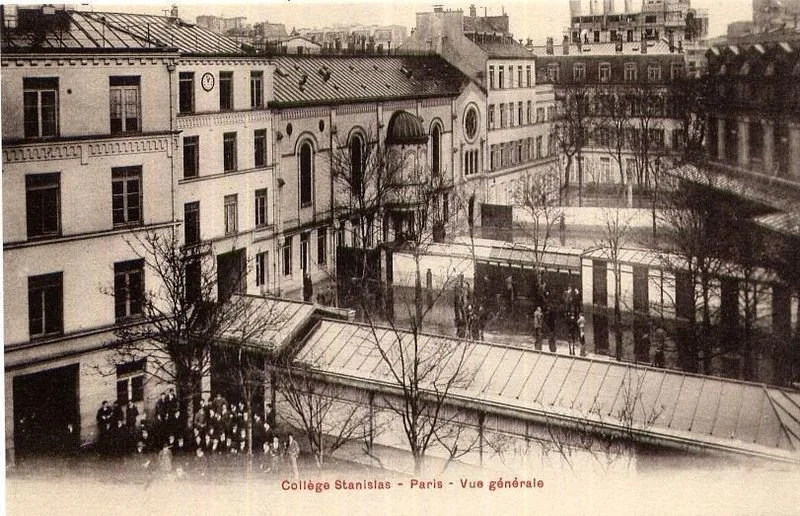
Stanislas College, early twentieth century
In 1893, the philosopher Léon Ollé-Laprune was invited to deliver the keynote address at the valedictory ceremony of Stanislas College. Ollé-Laprune challenged students to understand “the social question which convulses and torments your time” and to act upon it. “Life is action,” he declared, invoking Aristotle. “Everyone must apply themselves more than ever to courageously and faithfully consulting the principles and the facts in order to become more than ever capable of seeing clearly, of judging and of concluding.” His message found a receptive ear with Marc Sangnier (1873–1950), who together with Etienne Isabelle, Paul Renaudin, Augustin Léger, and others would launch a “study circle” at the college to examine and act upon the burning social issues of late nineteenth century France.
In 1893–1894, Sangnier and his friends established a study circle in a basement room at the college that they nicknamed “La Crypte,” (i.e., The Crypt). As Sangnier would later recall, “We wanted to sincerely look for answers. We firmly believed that the manifestations of Christ’s life in the world would evolve just as the world itself was evolving.” Among their first initiatives was the launch in January 1894 of a magazine called Le Sillon. Their goal was that young people “must themselves be their own educators, not remain a soft wax in the hands of their masters, but become hotbeds of life and action.” Echoing Ollé-Laprune, Sangnier articulated a three-step civic pedagogy for the Sillon study circles: “Every citizen must know the state of the country; when the situation is bad, must seek solutions; and having found solutions, must act.”
Making himself an evangelist for these study circles, Sangnier travelled the length and breadth of France and neighbouring countries. By 1905, those study circles had coalesced into a “movement”—perhaps the first Catholic network to so characterize itself—that took the name of the magazine, Le Sillon. Crucially, the Sillon’s approach to social study was not that of outside observers but of active participants. As the Marianist brother, Louis Cousin, who became the movement’s principal “counsellor,” explained in his 1905 book, Vie et Doctrine du Sillon (Life and Doctrine of the Sillon), in the Sillon method, “study ceases, so to speak, to be external observation” and “becomes consciousness.” For the Sillon, this method undergirded their vision of democracy, which they defined not merely as a system of government but as “the form of social organisation that tends to maximise the civic conscience and the responsibility of each person.”
Decades later, the Second Vatican Council, without using the word democracy, would echo this definition in its landmark Constitution on the Church in the World of Today, Gaudium et Spes (Joy and Hope), with its repeated emphasis on conscience (40 times) and responsibility (35 times).
For Sangnier, the Sillon was much more than a method or a conception of democracy. He often declared Le Sillon “est une vie” (a phrase difficult to translate directly but which suggests that the Sillon was a complete way of life) and “une amitié” (a friendship), in which its members sought the answers to life’s deepest questions. Hence, their slogan borrowed from Plato: “Il faut aller au vrai avec toute son âme:” “Seek the truth with your whole soul.”
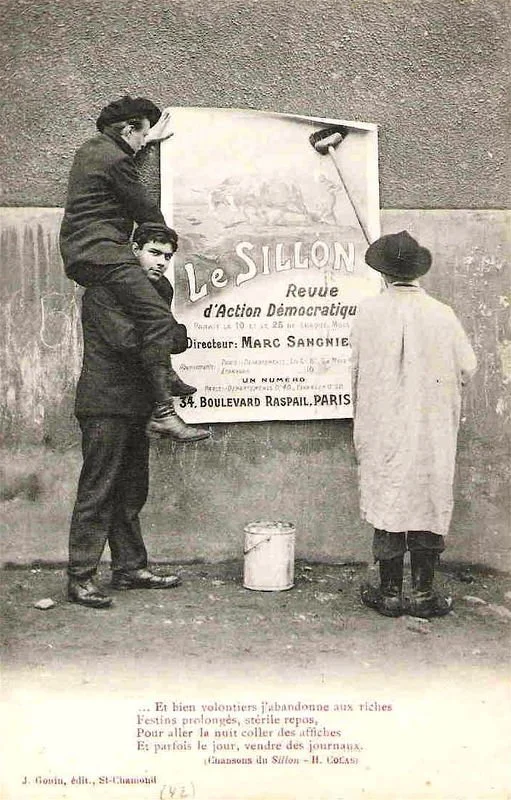
Le Sillon poster in Paris, early twentieth century
Peter Maurin and the Sillon
Such was the Sillon movement that attracted a young teacher, Pierre Maurin, who was born in the rural south of France in 1877 just four years after Marc Sangnier. In truth, we know few details of his involvement in the Sillon beyond the fact that he joined the movement in 1903 after leaving the Lasallian Christian Brothers.
Significantly, this was the year in which the Sillon first came to national attention, particularly through a public debate in the Mille Colonnes hall in Paris between Marc Sangnier and the anti-clerical former priest, Victor Charbonnel, and Henri Bérenger. It concluded with a riot in the streets of Paris in which Sillon leaders sought to keep the peace while under attack themselves. It is certain that these events were known to Pierre Maurin. It was around this time that he began to sell the Sillon newspaper, L’Eveil Démocratique (The Democratic Awakening) and threw himself into the movement’s work.
By 1907, however, the Sillon movement had spread so fast that it had begun to outgrow its early dimension as a movement of young men. In a shock to traditional Catholics, the Sillon had begun to open its membership to like-minded Protestants and others under the name “Le Plus Grand Sillon” or “Greater Sillon.” Meanwhile, Charles Maurras’ right-wing group, L’Action Française, whose orientation we would today characterize as a form of Christian nationalism, began to systematically attack the Sillon’s focus on promoting “democracy.” Church leaders, too, began to fear that the Sillon was becoming a political movement. These fears were not allayed by the fact that in a bid to have an influence in the political arena, Sangnier was preparing to stand as a candidate for the French National Assembly—a bid that proved unsuccessful.
What Maurin’s precise thoughts were about all this we do not know. His biographer, Jim Forest, however, notes that Maurin was concerned by the movement’s growing political character. And thus, he resigned before entering military service and eventually migrating to Canada.
Nevertheless, Maurin’s later career as the cofounder of the Catholic Worker movement with Dorothy Day, and as the author of his idiosyncratic “Easy Essays,” bears an unmistakable imprint of his Sillon formation. His emphasis on personal responsibility, manual labour, intellectual seriousness, and the transformation of society through small communities of practice echoes much of the Sillon’s methods and practice.
On the other hand, in “Easy Essay” 410, Maurin engaged directly with the Sillon’s legacy, quoting the Belgian priest Jacques Leclerq’s assessment that the movement “was full of enthusiasm and generosity but lacked deep thought.” In the second part of this article, we will turn to Pope Pius X’s response to Le Sillon and the movement’s influence not only on related youth movements like the Young Christian Workers but on the Second Vatican Council.