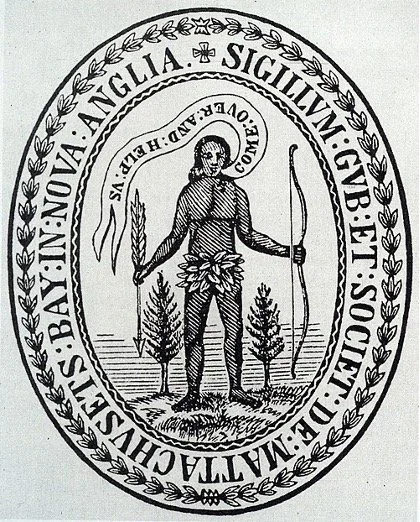
Massachusetts Bay Colony Seal, 1629
And a vision appeared to Paul in the night; There stood a man of Macedonia, and prayed him, saying, Come over into Macedonia, and help us.
- Acts 16:9, King James Version
As I write my dissertation on the Acts of the Apostles and its relationships with land, Judaism, and imperial spatiality in the Roman Mediterranean world around the turn of the second century, I find that many are surprised to learn about one of the most historically influential deployments of Acts in its modern reception. In Acts 16:8, the apostle Paul finds himself in the large port town of Troas in northwestern Asia Minor on the Aegean. There, Paul, whose missionary journeys had so far been limited to Cyprus, Syria, and Asia Minor, is visited by an anonymous Macedonian man in a vision. “Come over to Macedonia and help us,” the man asks of Paul (at least as rendered in King James English). In the following verse, Paul and his companions head to Macedonia—their first steps into Europe—to evangelize the people there, assured that their course of action was divinely guided.
A millenium and a half later, members of the Massachusetts Bay Colony reused the Macedonian man's words—strategically unmoored from the original geographical and narrative context—in their colonial seal. In the 1629 Charter of the Massachusetts Bay Colony, Charles I granted the Governor of the Massachusetts Bay Company a “Comon Seale,” in order to help enforce all written “Orders, Lawes, Statuts, and Ordinnces, Instruccons and Direccons” in the colony. The seal manifests the authority of Charles and the Company, but the design of the seal, the king stated, was up to them. And so the design chosen by the Puritan colonists stayed true to an explicit aim of the charter—that its people:
“may be soe religiously, peaceablie, and civilly governed, as their good Life and orderlie Conversacon, maie wynn and incite the Natives of Country, to the KnowIedg and Obedience of the onlie true God and Saulor of Mankinde, and the Christian Fayth, which in our Royall Intencon, and the Adventurers free Profession, is the principall Ende of this Plantacion.”
By incorporating Acts 16:9, the seal materialized, in a highly repeatable form carrying significant authority, the charter’s vision of “the good life” in the colony that would be so appealing to Native American peoples. Life in the colony was to be religiously defined so that biblical belief and practice were inseparable from English Christian conceptions of civility, and this is precisely what sets modern colonists apart from Indigenous peoples. The use of the passage in the colonial seal does what all reception of Scripture does: it represents the biblical text within a new context and transforms its meaning and function. But the process is exceptionally pointed in this case, demonstrating all sorts of transformations: Macedonia becomes the New World, the ventriloquized Macedonian becomes a ventriloquized Native American whose words, “Come over and help us,” rendered in a speech bubble, invites colonization, and the “help” requested looks less like evangelization and more like forced civilization.
What I want to suggest is that this seal is in and of itself a rather compact genealogy of modernity. The image is a discursive moment that actively constructs a sense of what it means to be modern, and it neatly highlights several important phenomena that cohere to underpin Western colonial modernity: seals/logos, the Bible, and the construction of “the Indian.” In line with Patrick Wolfe’s apt description of settler colonialism as not an event but rather a structure, we should expect this concise visual genealogy of modernity—and others like it—to not only speak to a single moment in the construction of what modernity is (i.e., seventeenth-century colonial Massachusetts), but to also point to what continues to define and represent the modern in the present Western world.
On Seals and Logos
The first observation I wish to make about this seal regards function. As a seal, this image functioned similarly to what we might call a logo, perhaps one of the most ubiquitous features of our modern capitalist world. While logos adorn just about everything—government buildings, laptops, notepads, clothing, and churches, to name a few—their omnipresence seems to render them and their effects invisible. They pass as automatic, natural elements of modern life.
This technology is, of course, not so new. Stamp and cylinder seals were used in the Ancient Near East for administrative and apotropaic functions. Ancient Roman manufacturers would stamp their names in their pipework or brickwork. Late medieval coats of arms differentiated opposing forces on the battlefield and class distinctions of the nobility, which developed into family crests and ecclesiastical heraldry. The seal of the Massachusetts Bay Colony certainly serves some of these same functions, primarily signaling imperial authority and property ownership, as seen above. Yet it also does more than this—it interpellates. That is, it calls the viewer in to adopt a particular identity.
In this case, there are three clear layers of interpellation: the Macedonian man calling Paul, the Native American man calling for the colony to be his savior, and the Native American man calling the viewer directly to assume the identity of the colony and its benevolent, divine mission. In a general way, this prefigures the way logos work on us today on multiple levels. They mark authority and ownership, signal class and wealth status, and create brand familiarity and recognition, while also, in conjunction with advertising, calling viewers to assume the moral stances and missions of the organizations they represent.
The seal, though, deftly leaves open the precise implication of the biblical passage; the first of these three layers of interpellation does not necessarily need to be understood for the messaging to be effective. Those who do recognize the reference to Acts could easily understand the invitation as wholly evangelical, seeing “helping” here as coterminous with the Great Commission—to disciple, baptize, and teach. Or it could be read purely as an invitation to civilize and assimilate the peoples indigenous to the lands of “Nova Anglia.” The seal’s ambiguity allows for both interpretations (of course, as seen in the charter above, these are not necessarily two separate commissions in the view of Christian colonists). Either way, the use of the Macedonian man’s words draws on and reinforces a paternalistic relationship with Indigenous peoples, an attitude and identity the colonist is encouraged to embody. The colonial seal, with its strikingly direct appeal to a mission and a set of assumptions about society, is perhaps one of the closest precursors to the phenomenon of logos we are inundated with today. The ancient and medieval seals indicated exclusivity, but this seal, like a logo, intends to call anyone into its mission.
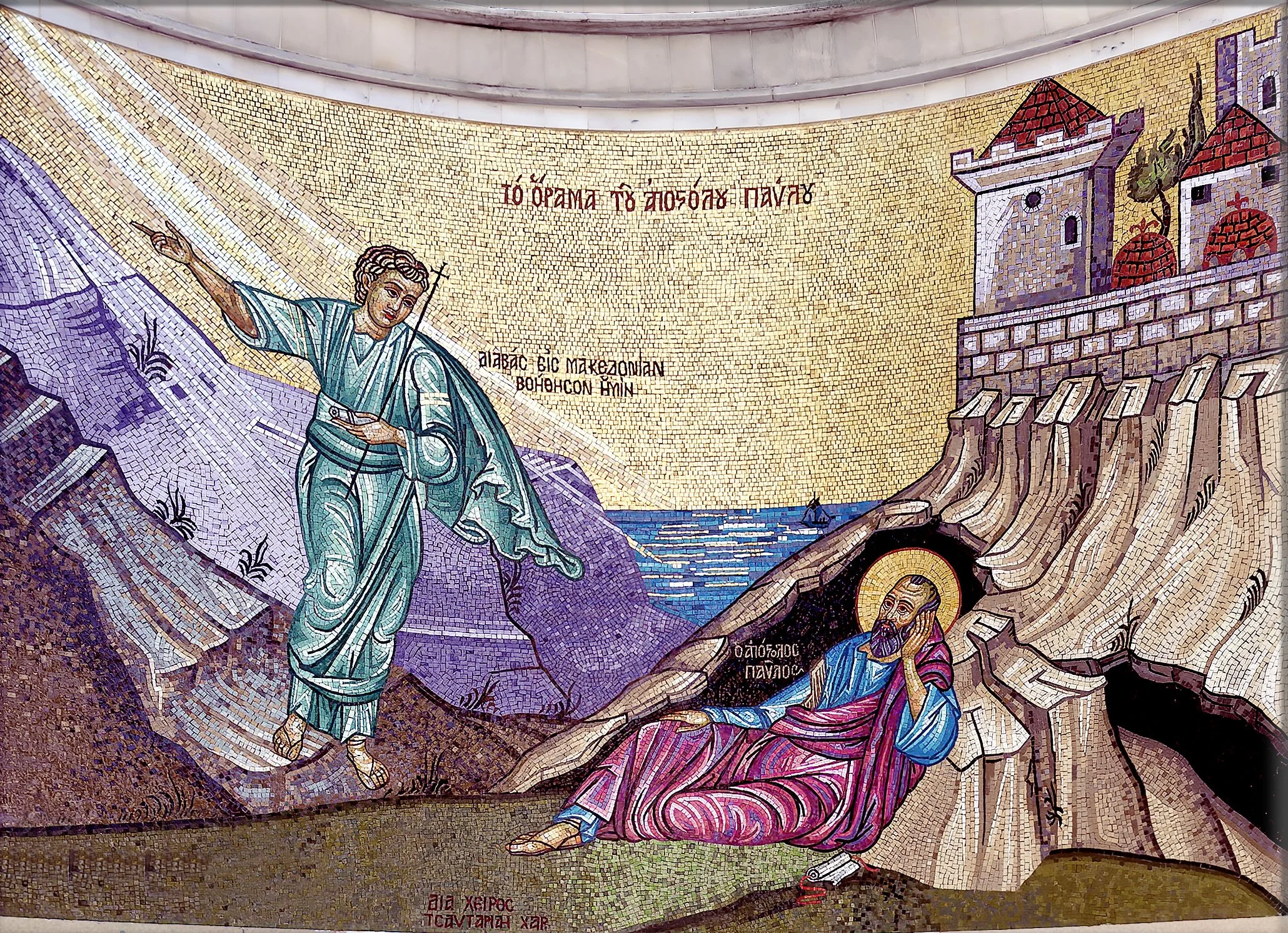
Mosaic of Paul receiving the Macedonian Call, Berea, Greece. Photo by Edgar Serrano, July 2022, CC 4.0.
The Construction of the Indian and the Modern
The second element worth analyzing is the depiction of the Native American man at the core of the seal. He stands with an Edenic shrub well positioned to preserve his modesty. His arrow points downward and his arms are outspread in a gesture of peace and invitation. He fits the ubiquitous presentation of the “noble savage”—he is passive, gentle, and he admirably recognizes his own need for European salvation. Wolfe rightly points out that the fundamental logic of settler colonialism is the elimination of the native, whose existence always represents a problem to the colonial mindset insofar as they carry a claim over the land the settler seeks. Yet in the seal, the native man persists, paradoxically, at the center of the colonists’ self-identity. This is exactly the utility of the ‘noble savage’ narrative, which desires to co-opt aspects of an idealized Native American society and personhood while simultaneously functioning to eliminate the populations and lifeways of real Indigenous peoples. As Philip Deloria argues in his masterful Playing Indian, Euro-Americans have sought, and still seek, essential qualities such as “aboriginal closeness” to the land and free spiritedness so as “to encounter the authentic amidst the anxiety of urban industrial and post-industrial life.” The Massachusetts Bay Colony seal constructs a specific image of the pre-modern man who is both helpless and possesses desirable qualities—a paradox that reinforces a particular paternalistic—and “modern” communal identity for a people negotiating the tension between the Old and the New Worlds. The colonist viewers want the freedom, antiquity, and open land of the Massachusett man, and are also reminded of their superiority over him. The self-identity of “modern” only really exists here in counter distinction to the “pre-modern” man, who is both incorporated and eliminated. In other words, the Massachusett man is superseded.
The Bible and the Modern
Thirdly, I want to suggest a conceptual parallel between the construction of the Indian and the use of the Bible in the seal. The Bible, like the Native American man, is also decidedly non-Western and boasts a far more ancient pedigree than the British colonists. The Bible had already, particularly at the moment of the production of the King James Version, undergone a similar process of incorporation. A set of otherwise temporally and culturally foreign texts were cemented into British self-identity, not simply translating the ancient text into English, but also helping to form and standardize the English language itself. A large part of the appeal of the King James Bible, both originally and perhaps even more so today, is its strange, archaizing language resulting from its attempt at a primarily literal translation. The text was both a fundamental part of the exporting of modern English identity in the colonial period, while yet always drawing its audience into a venerable and not-fully-graspable age. A claim to these narratives from the deep past provided a historical rootedness, cultural significance, and even divine claims to land to a people otherwise interested in the modernity of the New World.
The archaizing function of the Bible is admittedly hard to recognize in the seal of the Massachusetts Bay Colony, whose biblical reference is rather easy to overlook (although note that its Latin serves a similar, complementary archaizing function). It is clearer, though, in the original logo of Dartmouth College, which was produced nearly a century and half later. In the second part of this essay, I will turn to the 1769 Dartmouth logo to continue tracing this genealogy into the late eighteenth century—with greater implications for the visual reception of the Bible in Euro-American colonization.