
Dartmouth College logo (1769): Vox Clamantis In Deserto, “A Voice Crying out in the Wilderness.”
This is the second part of a two-part essay. You can find part I here.
Dartmouth College was opened with the explicit aim of forming Native American missionaries through education in Euro-American values and Christian theology, a more formalized and institutionalized successor of the Massachusetts Bay Colony’s charter. Again, the mission of educating and civilizing Native Americans is codified in visual form, and its biblical dynamics are even more explicit. In the image, the light of God’s word in the form of the solar Bible illuminates the scene. Two Native American figures (men, presumably), emerge (unclothed, except for headdress) from the woods and walk towards the (straight-lined, orderly, symmetrical) school building. One leads with book in hand. They walk quite literally “from the deep woods to civilization.” As this is a seminary designed to form Native American missionaries, I presume this depiction suggests one Native American Christian leading another younger Native American into the light of Christian theology and civilization. Again, these figures represent the “noble savage” fantasy—their nakedness juxtaposed with their voluntary decision to take advantage of the benefits of Euro-American civilization.
Not only is the Bible itself the light of divine truth, but the aid of the prophet Isaiah is enlisted. Vox Clamantis In Deserto: A Voice Crying out in the Wilderness. Again, the Bible is deployed to stress the divine imperative for the Christian education and civilization of Native American peoples. As originally found in Isaiah 40:3, the voice crying out to “prepare the way of the Lord” signified the good news of the return of an exiled people to their God, homeland, and/or rebuilt temple—a far cry from a people accepting or assimilating to the religion and customs of those who exiled them. In the Hebrew of the Masoretic text of Isaiah, it is likely, although grammatically ambiguous, that it is “the way” that is in the wilderness. This would put “the way” in poetic parallel with the following line—the highway in the desert. The Greek translation of the Septuagint locates instead the voice in the wilderness. The Dartmouth logo’s use of the text is closer to the Septuagint and the way early Christians knew this verse: used in John the Baptist’s dramatic announcement of Jesus Christ (Matthew 3:3 // Mark 1:3 // Luke 3:4 // John 1:23) or as interpreted by some Church Fathers as a path that unifies the soul of the believer to Christ. Yet the most obvious and immediate utility of the biblical reception in this case lies in neither of these ancient interpretations.
Rather, the use of the passage establishes the familiar paternalistic attitude towards Indigenous peoples. The Euro-American Christian school is the voice of God crying out in the wilderness that is North America, a desert lacking Christianity and civilization. Unlike the use of the Macedonian man’s words, the viewer is less directly interpellated into the salvation of the Indigenous subjects, but the image still evokes a sense of involvement in the divine mission of civilization. This logo is, however, a more explicit visual genealogy of modernity: reading left to right, the Native American figures are presented as pre-modern Euro-American Christians. The assumption that Native Americans prefigure settler colonial Americans is important to the construction of the modern as superseding the pre-modern. One could also look to the common practice of collating “before and after” photographs of Native American students in the history of Indian boarding schools to see a parallel to this logo’s teleology of primitive to civilized under the light of the Bible and within the walls of a boarding school.
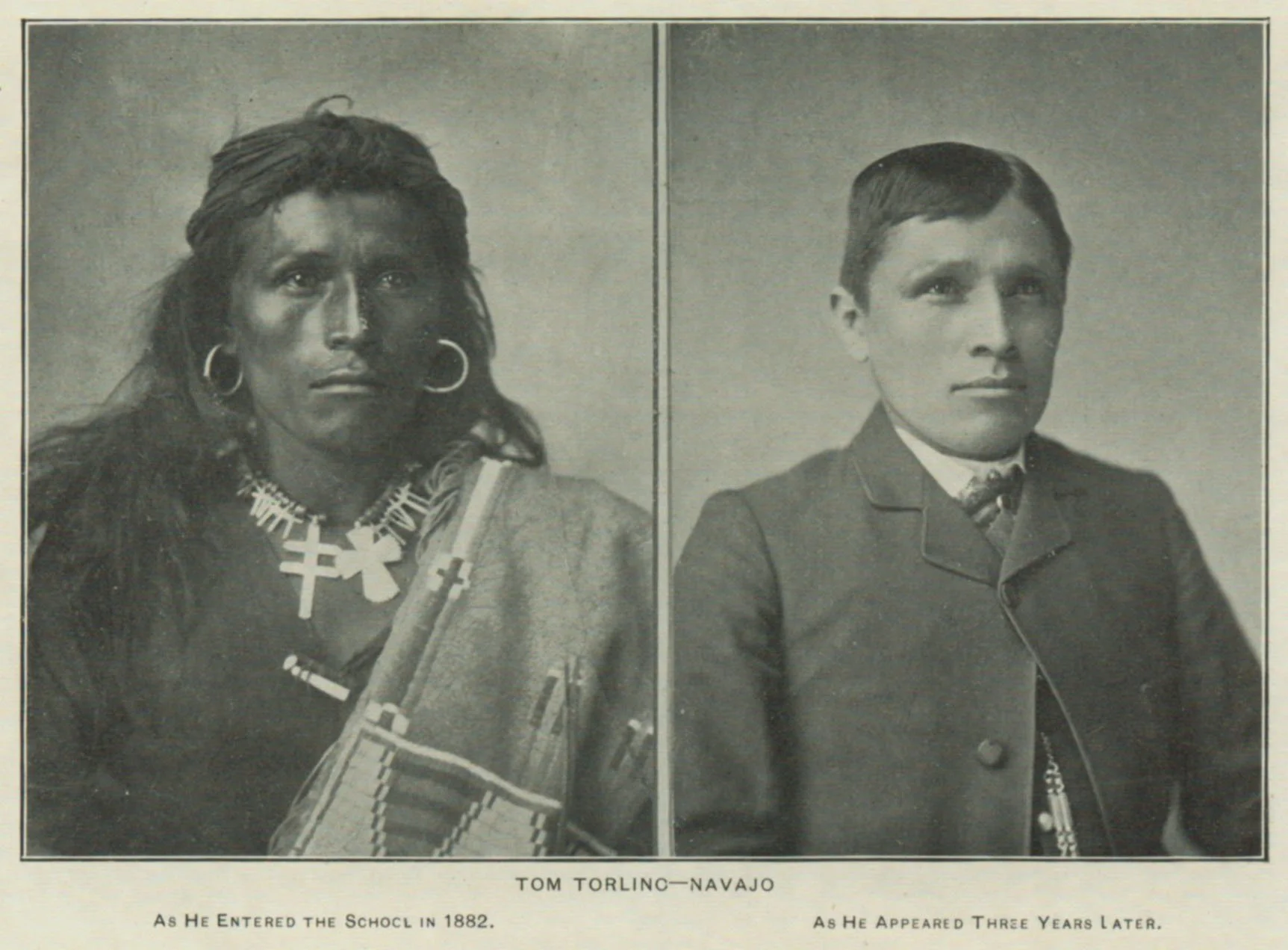
John N. Choate, Tom Torlino—Navajo, before and after portrait, 1882–1885. This image appears in John N. Choate’s Souvenir of the Carlisle Indian School pamphlet (Carlisle, PA: J. N. Choate, 1902). Carlisle Indian School Digital Resource Center, Carlisle, Pennsylvania.
The Bible functions in these images as a divine justification of superiority, paternalism, and land claim. But it also does more. Where Native Americans possessed something colonists desired but could not possess, such as older and deeper ties to and knowledge of the land, the Bible served as a counterpoint; it was their own claim to antiquity and divine knowledge. Paradoxically, the Bible simultaneously provided frameworks for understanding and treating Native American peoples, cultures, and lands in ways that supported colonial aims through a text that was equally authorized by its ancient, archaic nature as it was by its quintessential Britishness and modernness. I suggest that there is a similar dynamic in the use of the Bible and the Native American in these images; in both we can see the incorporation of something respectably older and attractively foreign, but in a way that comes to forget their foreignness and claims to greater antiquity. The Bible is incorporated, superseded by European culture, and then becomes a tool by which to carry out the same process with Indigenous peoples. In both cases, the identity of “modern” could not exist without the continual juxtaposition against that which is deemed its opposite.
Conclusion
The colonial use of Paul’s vision is strikingly ironic. The Jewish apostle, who had an uneasy relationship with the Roman Empire, responds to the divine vision by crossing over into Europe, visiting established Roman colonies, and navigating further into the heart of imperial power. Now Europe responds to this very same call by crossing over into the New World and establishing European colonies. The seal of the Massachusetts Bay Colony is not the only example of the use of the “Macedonian call” in the colonization and evangelization of North America. Protestant and Catholic leaders in the United States used the passage regularly to fundraise and lobby in order to expand Indian missions and education, and to argue for the benefits of allotment policy. This passage’s flexibility made it an ideal instrument in inspiring Christians across denominations to the mission of Christianity and civilization.
Yet as far as such modern uses of Acts 16:9 go, the seal of the Massachusetts Bay Colony serves as a particularly concise visual genealogy of modernity, filled with the paradoxes and tensions that are required to define and depict modernity: Latin encircling King James English; the indigenous name Massachusetts subsumed by Nova Anglia; and the Native man, always simultaneously noble and savage, inviting and threatening. It encapsulates the contradictions at the heart of the modern Euro-American settler’s psyche, which as Philip Deloria would remind us, are still operative today. And this dynamic exists even as the explicit genealogies of modernity in many of these seals have been replaced with more secular and less offensive corporate logos, successfully concealing the Native American that was and still is used to define modernity in the West.