Religious Demagogues and Grifter Capitalism from “Sweet Daddy” Grace to Donald Trump
When he first sought the presidency in 2015, Donald Trump chose conservative evangelical Christians as his base of support. Over the past decade, he has cultivated these voters’ belief that God has appointed him to steer the nation in a more “Christian” direction.
Mobilizing what I have elsewhere characterized as “typological plasticity,” Trump’s supporters align him with an array of overlapping biblical figures. When one wants to excuse Trump’s obvious transgressions, the best strategy is to liken him to King David, Israel’s second and greatest king, who passionately served God but also committed murder and adultery. To emphasize Trump’s magnanimity, Trump’s allies and admirers, including Israeli Prime Minister Benjamin Netanyahu, compare him to the Persian King Cyrus, chosen by God to restore the Jewish people from exile. Many Make American Great Again (MAGA) voters proclaim “Jesus is my savior. Trump is my president,” suggesting that Trump has been divinely appointed to lead the nation. Such voters often claim that God shielded Trump from assassination in Butler, Pennsylvania, reflecting his loosely messianic status.
No level of fraud or self-dealing seems to deter conservative evangelicals from these parallels. Perhaps the best example of Trump laundering graft through Christian iconography is his selling “God Bless the USA” Bibles for $60 each. Trump may be uniquely brazen, but we can trace these intertwining strands of religious demagoguery and grifter capitalism far earlier in U.S. history.
During the Gilded Age, industrialists amassed enormous fortunes by suppressing workers’ power and exploiting the lack of government regulations. Masters of vertical integration, these robber barons eventually provoked the creation of anti-trust laws. Corporate consolidation, income inequality, and the flood of money into politics have led many scholars to call the 2020s a Second Gilded Age. Trump’s particular brand of kleptocracy has only intensified the concentration of wealth in the tech oligarchy.
Charismatic religious figures, of course, trace back to the ancient world. Yet, the U.S. has its own distinctive flavor of cult leaders from Joseph Smith to David Koresh to L. Ron Hubbard, who battled the IRS to gain tax-exempt status for Scientology.
Long before Trump sycophants cried “Daddy’s Home,” Bishop Charles “Sweet Daddy” Grace expertly blended cult leadership with personal enrichment. Beginning with his first house of prayer in Charlotte in 1926, Bishop Grace planted outposts of his United House of Prayer for All People across the nation over the next three decades. Performing a highly charismatic brand of Pentecostalism, Grace attracted many Black followers who yearned for miracles, prosperity, and self-worth. Preaching the ostensibly biblical concept of “one man leadership,” Bishop Grace exerted total control over his movement.
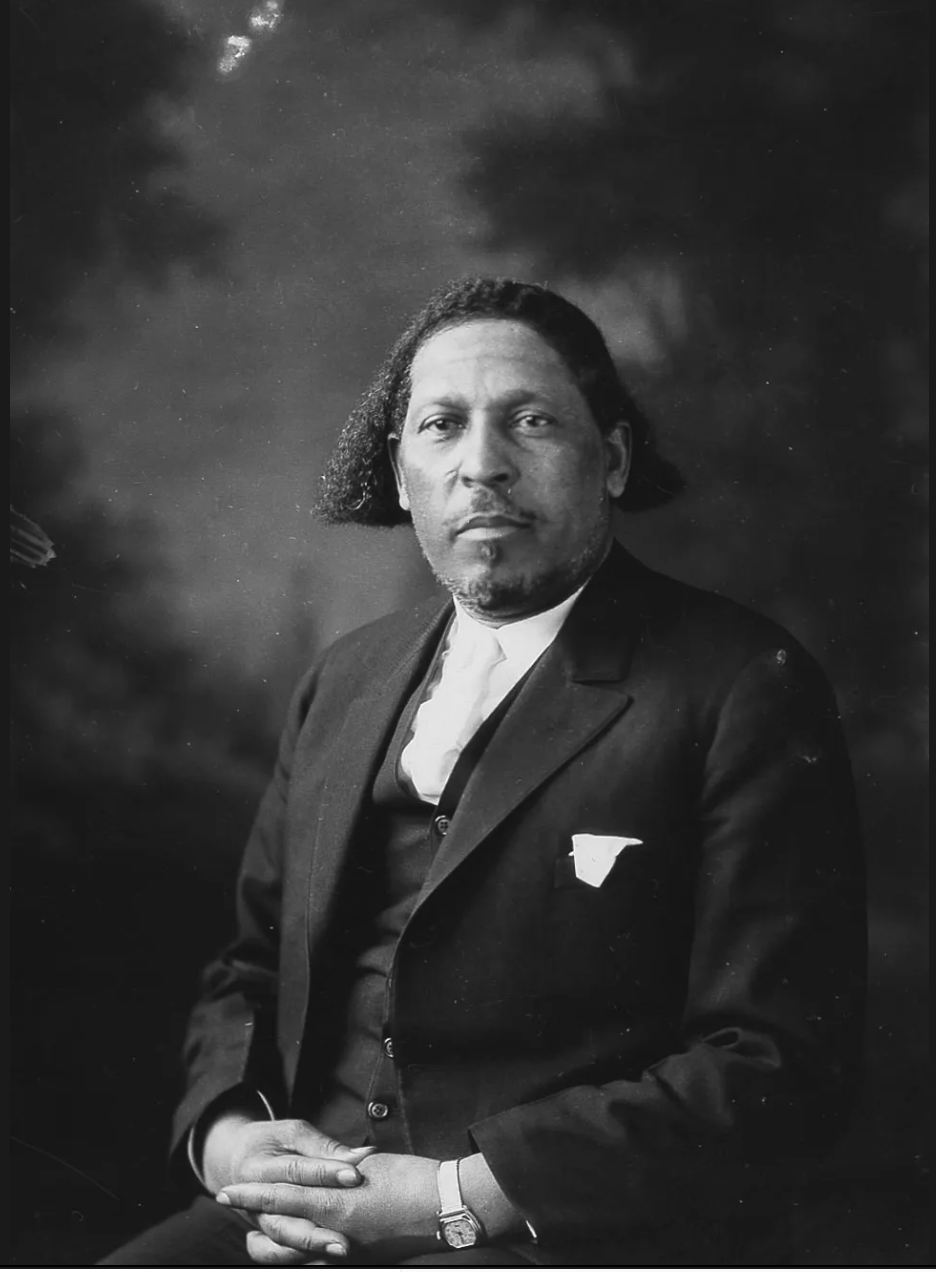
Bishop Grace, circa 1910
Much like Trump, with his signature rallies and frenetic commoditization of his influence, “Sweet Daddy” Grace excelled at live performance and marketing. From revival meetings to mass baptisms, Bishop Grace had a flair for crowd work. Elaborate and invigorating services kept people returning night after night. That loyalty and the belief that Grace was chosen by God, enabled him to accumulate a fortune. He not only expected his followers to donate money, but he also merchandized as well as any influencer, offering his own brand of snack foods, cosmetics, and hygiene products, all supposedly imbued with healing properties.
Two films of the past 15 years, The Book of Eli (2010) and Mad Max: Fury Road (2015), dramatize this confluence of grifter capitalism and religious demagoguery in the years immediately prior to Trump’s real-life rise to power.
In The Book of Eli, petty tyrant Carnegie (Gary Oldman), sardonically named after steel tycoon and philanthropist Andrew Carnegie, aspires to expand the town he rules into an empire. The film immediately establishes his dictatorial aspirations in the very first shot of him at his desk, showing him reading a book about Mussolini. With his knowledge of hidden springs, he controls access to clean water.
The villain of Mad Max: Fury Road, Immortan Joe (Hugh Keays-Byrne), is Carnegie's high-octane successor, concocting a warrior-death cult blending the Norse belief in Valhalla—the hall of fallen warriors—with automotive iconography to inspire his army of radiation-damaged War Boys to feats of suicidal violence. In the wasteland of Fury Road, Gas Town, Bullet Farm, and Immortan Joe’s Citadel hold monopolies on crucial goods—fuel, ammunition, and water, respectively.
Although both Carnegie and Immortan Joe control scarce resources, they perceive that this is not enough to maintain their power. They recognize the importance of religious ideology in controlling the masses in the same way that Trump appeals to Christian Nationalism to support his regime.
Much as Trump awkwardly grasped a bible during a photo op, Carnegie spends almost the entire film desperately hunting a copy of the bible because he believes merely reciting its words will confer totemic power on his decrees. He sends mercenaries into the wasteland to retrieve any books they find.
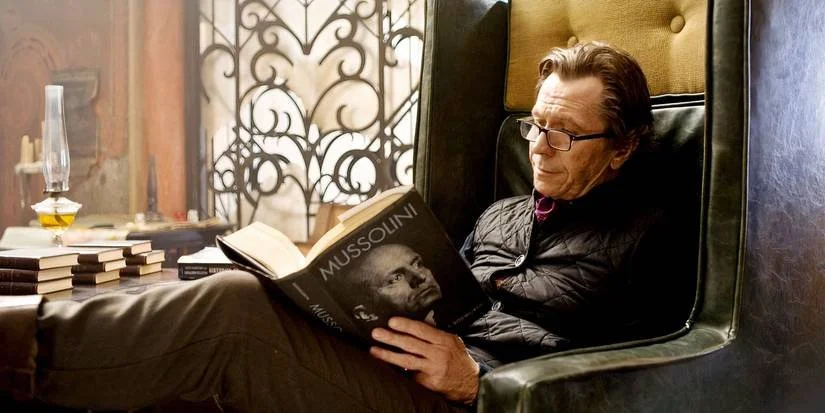
Carnegie (Gary Oldman) reading about Mussolini in The Book of Eli (2010)
Carnegie disguises his lust for power in religious terms: “Just stayin’ alive is an act of faith. Runnin’ this town’s an even bigger act of faith.” He enjoins Eli (Denzel Washington) to surrender the bible he carries, insinuating that he wants to make the world a better place:
“Imagine how different, how righteous this little world could be if we had the right words for our faith. If people would understand why they’re here and what they’re doing, they wouldn’t need any of the uglier motivations.”
Carnegie implicitly acknowledges that he lacks the charisma to control people without the magical language of the bible: “And I don’t have the right words to help them, but the book does.” Whereas the Protestant concept of sola scriptura teaches that the bible alone is the final authority for church teaching, Carnegie believes that the bare words of the bible are so persuasive that merely hearing them elicits automatic obedience.
When Carnegie’s right-hand man expresses skepticism at the priority that Carnegie places on a mere book, Carnegie screams:
“It’s not a fuckin’ book! It’s a weapon. A weapon aimed right at the hearts and minds of the weak and the desperate. It will give us control of them. If we want to rule more than one small, fuckin’ town, we have to have it. People will come from all over. They’ll do exactly what I tell ’em, if the words are from the book.”
Carnegie never specifies exactly what it is about biblical language–cadence? imagery?—that gives it such talismanic power. Unlike other religious demagogues, however, Carnegie does not have a meta-narrative of his own to offer. Trump, likewise, does not offer a coherent worldview so much as he has coopted elements of conservative evangelicalism and Christian Nationalism.
Immortan Joe makes Carnegie look like an amateur. Rather than bare words, Joe offers a whole symbolic system. Blending the Norse idea of Valhalla with imagery of chrome and octane, Joe’s religion fulfills his followers’ psychic needs. Much as the harvest festivals of ancient religions invest agricultural practices with spiritual significance, Joe transforms the motorized vehicles necessary for survival into potent symbols. With resources scarce and many afflicted with tumors because of exposure to radiation, death is all too common and all too meaningless in Fury Road’s post-apocalyptic landscape.
The Immortan’s mixture of Norse visions of gaining immortality through heroic sacrifice with the terminology of the internal combustion engine offers the War Boys the chance for a glorious death.
He promises the War Boys that they will “ride with me eternal on the highways of Valhalla.” Early in the film, the war boy, Nux (Nicholas Hoult), fervently believes that he is destined for Valhalla, saying, “I am awaited.” When each driver takes up his detachable steering wheel from the pile where they are kept, like Vikings grabbing swords and axes, he says, “By my deeds I honor him. V8.” Before attempting insane feats of danger, the War Boys spray their mouths with chrome paint. Throughout the film, Nux chants the slogans that comprise the religion of Joe’s warrior-death cult, “I live. I die. I live again.” The War Boys’ fervent belief in a blessed afterlife makes them more compliant to Joe’s will. They are ready to risk their lives for Joe because they believe, as Nux says, that “By his hand, we’ll be lifted up.” Joe promises Nux that if he sacrifices himself in battle he will “ride eternal, shiny and chrome.”
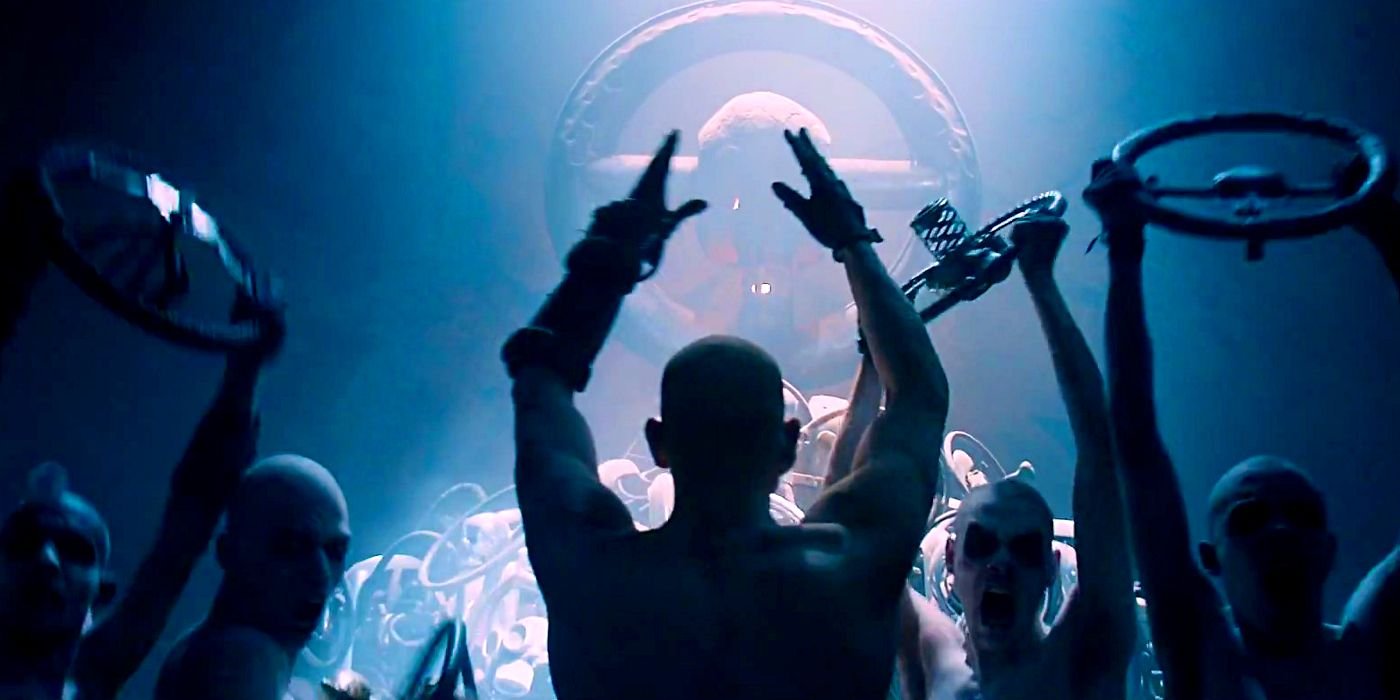
Drivers pick up their steering wheels in Mad Max: Fury Road (2015)
Like other religious demagogues, Joe claims to be his people’s only connection to the divine: “I am your redeemer; it is by my hand that you will rise from the ashes of this world.” He convinces them that he is their best hope for the future, even as he withholds food and water from them. Joe’s rhetoric is always accompanied by profound ritual imagery. He brands his slave with the emblem of the cult—a skull in a circle with flames at the top. A similar image is carved into Joe’s mountain fortress. In a symbolic gesture of his beneficence, Joe releases the flood gates that dump water down on the masses—and quickly shuts them again. Like a pastor warning his flock away from riches or alcohol, Joe says, “Do not, my friends, become addicted to water. It will take hold of you and you will resent its absence.” Joe’s exhortation, of course, is self-serving: he wants to keep the masses content with what they receive and subservient to him.
Much like Immortan Joe builds a mythology of triumph through sacrifice to secure the War Boys’ devotion, Trump projects a symbolic narrative in which his followers directly participate to earn his favor. As the Immortan declares, “I am your redeemer,” so Trump infamously accepted the GOP nomination in 2016 by proclaiming “I alone can fix it.” Although he has evaded legal responsibility, Trump did nothing to stop—and, as many have argued, even spurred—his crazed followers’ assault on the Capitol during January 6th, 2021. The vandalization and defacement of Nancy Pelosi’s office and the elaborate garb of the “QAnon Shaman” and other rioters is as ritualistic as the behavior of Immortan Joe’s War Boys.
One of the distinctive features of modernity is the collapse of traditional structures of meaning and the scramble to replace them with something new—art, secular citizenship, global capitalism, eclectic spirituality, etc. Perhaps one reason for “Sweet Daddy” Grace and Donald Trump’s massive success is that by fusing religious rhetoric with financial opportunity they present an irresistible lure for audiences starving for meaning and unmoored by economic forces beyond their control. Cinematic depictions of characters, such as Carnegie and Immortan Joe, accentuate how controlling access to both meaning and resources empowers demagogues to dominate their followers. If “Sweet Daddy” Grace’s career is the embryonic version of Trump’s endeavor to bend virtually the entire global order to his own profit, then Carnegie and Immortan Joe are post-apocalyptic mutations of this same hybrid of religious demagoguery and grifter capitalism.