The arcane figure of the katechon has featured in Christian imagination since New Testament times, but lately in the twentieth and twenty-first centuries, it has achieved a strange, alluring, secular-apocalyptic status. People who would normally have little or no truck with the writings of the Apostle Paul are suddenly fixated on the second letter to the Thessalonians as an acutely relevant political oracle.
Here are the key verses:
[W]e ask you, brothers, not to be easily disconcerted or alarmed by any spirit or message or letter seeming to be from us, alleging that the Day of the Lord has already come. Let no one deceive you in any way, for it will not come until the rebellion occurs and the man of lawlessness—the son of destruction—is revealed. He will oppose and exalt himself above every so-called god or object of worship. So, he will seat himself in the temple of God, proclaiming himself to be God. Do you not remember that I told you these things while I was still with you? And you know what is now restraining (to katechon) him, so that he may be revealed at the proper time. For the mystery of lawlessness is already at work, but the one who now restrains (ho katechon) it will continue until he is taken out of the way. And then the lawless one will be revealed, whom the Lord Jesus will slay with the breath of His mouth and annihilate by the majesty of His arrival.… (2 Thess 2:1-8)
The katechon is a restraining power, a force, and persona (to and ho) that appears here and nowhere else. It is like a sighting of the Loch Ness monster—maybe photographed once but never seen again. In New Testament scholarship, the figure is most often dealt with via footnotes, and the overall authenticity of the letter itself is frequently rejected, so it hardly registers as Pauline thought and teaching. As a result, the antagonist figure of “the rebellion” and “the man of lawlessness” has suffered from the same kind of obscurity as the fabled Scottish creature.
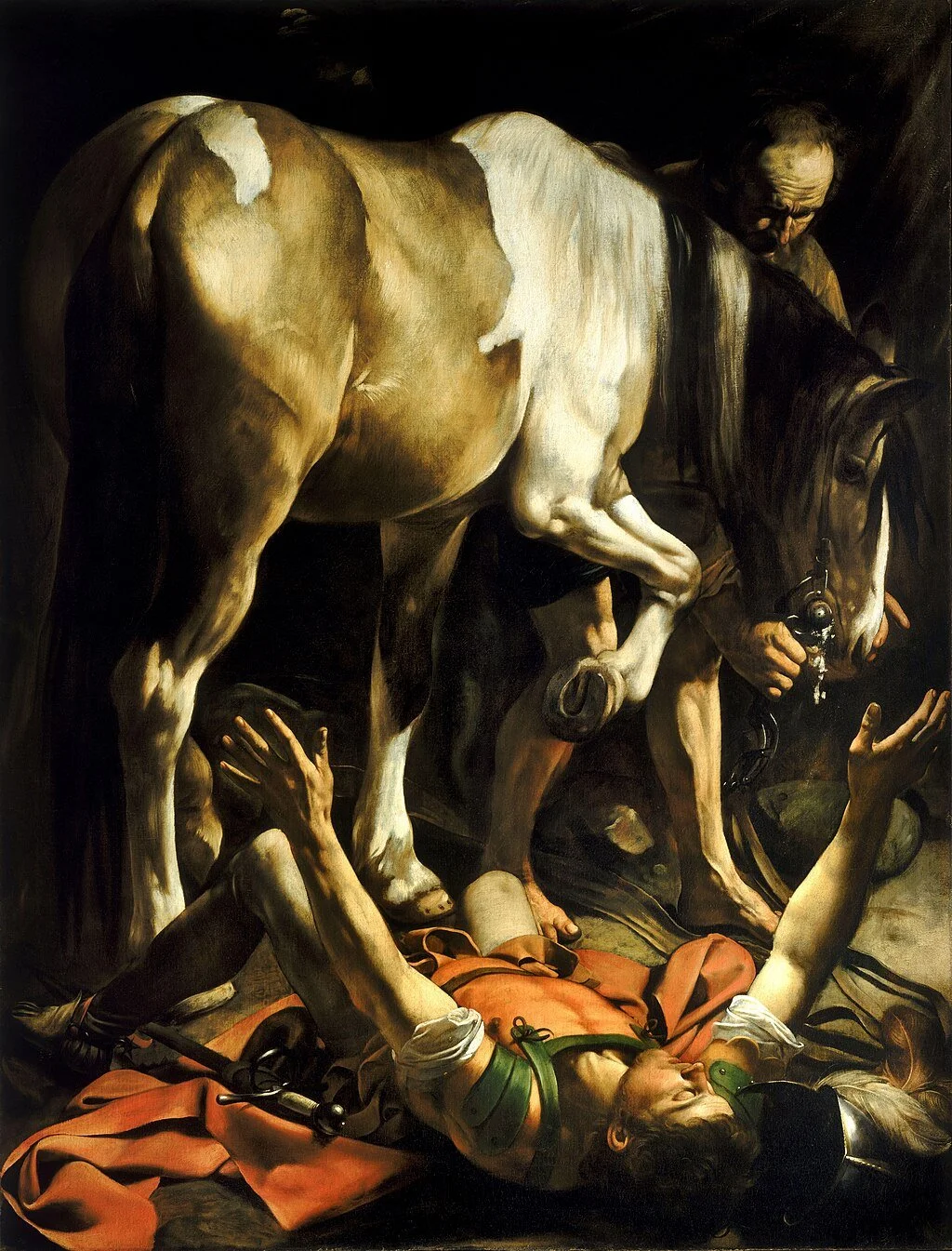
Caravaggio, Conversion on the Way to Damascus, c. 1600-1601
The latter-day upsurge of interest and quasi-mythical identity attributed to this piece of New Testament writing is largely due to the Nazi jurist Carl Schmitt. According to Jacob Taubes, Schmitt had one central intention in all his work, namely, “that chaos should not rise to the top, that the state should remain. No matter what the price.” Scarred by his experience of the collapse of the Weimar Republic in the 1920s and 1930s, the question that obsessed Schmitt was the nature and existence of a force to hold back chaos. As Taubes says, “this is what Schmitt later called the katechon, which is the restrainer [der Aufhalter] that holds down the chaos that pushes up from below.”
It is riveting that Schmitt reaches back into Christian eschatological tradition to find a concept adequate to his situation. He notes in an entry in his Glossarium of December 1947: “We have to be able to name the katechon for every epoch in the last 1948 years. The place has never been unoccupied, otherwise we would not be present anymore.” For Schmitt, the katechon is an essential element in the human political structure since Christ, something without which the world would have fallen into non-existence: “The original historical force of the figure of a katechon … remains and is capable of overcoming the otherwise occurring eschatological paralysis.” In other words, Schmitt views the katechon as the enabling condition of human society: it is the force that actually holds back the terminating event of the Last Judgement, thereby making history possible. The katechon, then, is nothing like a prehistoric creature: it is much more like an opportunistic new species that finds its place in the very specific gap created by the eschatological energy that Christianity introduced in its first centuries. But while the katechon purportedly functions as a stabilizing force for human societies, it threatens to run riot, forestalling the end times indefinitely. What is the theological value, if any, of such a creature?
The whole thing quickly becomes dark and troublesome. The katechon is an inferred function of history since Christ, whereby violent forces restrain the outbreak of chaos by assuming a self-appointed metaphysical sovereignty. Schmitt claims that its presence stretches from the Roman Empire through the German Emperors of the Middle Ages to the Third Reich (a more recent candidate for the list, according to Patriarch Kirill of Moscow, is the Russian Federation). The purpose of these noble forces is to hold back the Antichrist, identified since the Latin theologian Tertullian one-for-one with the Thessalonians’ “man of lawlessness.” And so the repetitive condition of history is crystallized as a global figure of power, a sum-of-evils Antichrist, held back by some traditional version of law-and-order established through violence.
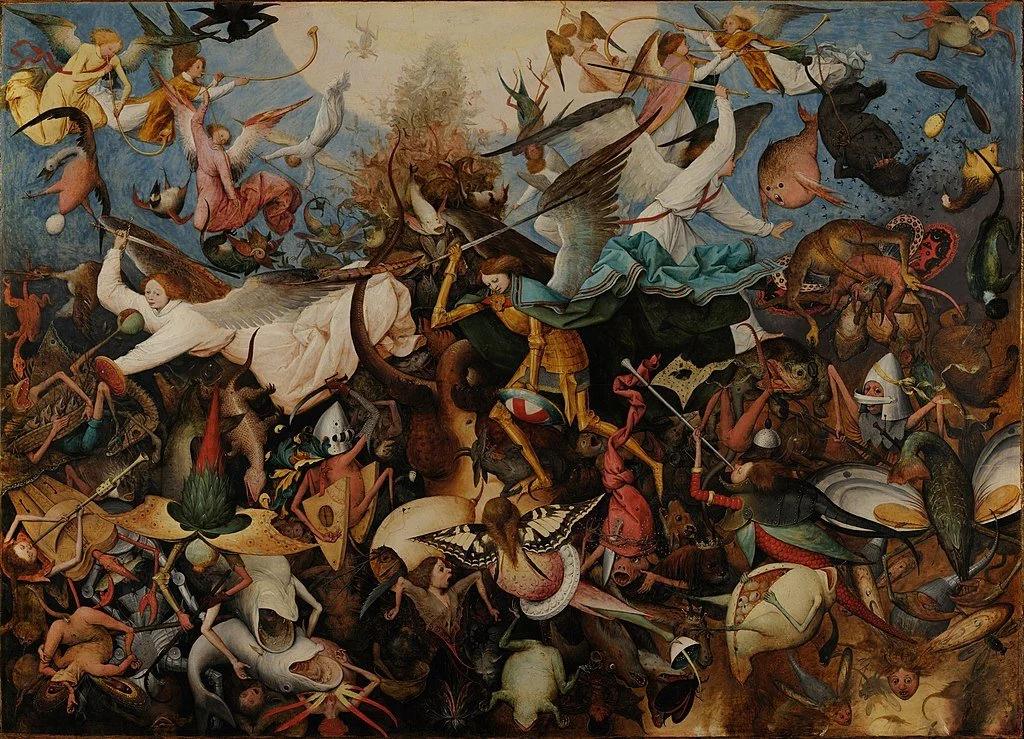
Pieter Bruegel the Elder, The Fall of the Rebel Angels, 1562
The most significant recent embrace of the katechon comes from tech-billionaire student of Girard and Trump/Vance backer, Peter Thiel. The connection with Girard makes this latest iteration doubly provocative and in need of serious examination. Girard’s thought is famously apocalyptic, but the whole dynamic of his work is a biblical deconstruction of violence and could never amount to a biblical mystification of historical violence and control. Thiel’s opinion is most often delivered in online interviews where he presents himself as a dot-com guru fresh from some underground data-mining center or from a high-powered Socratic seminar with a cosplay of laurel crowns and togas. In one such conversation with New York Times Columnist Ross Douthat, he talks about the current state of the world and its existential threats, and offers the following:
[I]f we’re going to have this frame of talking about existential risks, perhaps we should also talk about the risk of another type of a bad singularity, which I would describe as the one-world totalitarian state. Because I would say the default political solution people have, for all these existential risks, is one-world governance… The way the Antichrist would take over the world is you talk about Armageddon nonstop. You talk about existential risk nonstop… The thing that has political resonance is we need to stop science. We need to just say stop to this. In the seventeenth century I can imagine a Dr. Strangelove, Edward Teller type person taking over the world. In our world, it’s far more likely to be Greta Thunberg.
Strangely, the Antichrist here does not appear as lawlessness but as an excess of law prompted by the need to regulate human behavior in face of threats to the planet. And so a 22-year old Swede is held up as the sum of all evil. And then, necessarily in parallel, Thiel brings up the katechon in opposition to the Antichrist. In a separate interview with Tyler Cowen, he avers, “There’s always a question why the Antichrist hasn’t taken over yet, and it’s this mysterious force that holds it back, this restraining force that holds back the totalitarian one-world state.” The katechon becomes a kind of double of the Antichrist, something with obvious Girardian implications.
In the Ross Douthat conversation, Thiel expands on Schmitt’s account of the katechon and then interjects the Girardian angle:
Again, the Schmittian view is, there were all these different things that played the role of the katechon at various points in time. If you’re not supposed to immanentize the eschaton, you’re also not supposed to immanentize the katechon. If you identify too much as one thing, that can go very wrong, if you think of the katechon as the thing that restrains the one-world state or that restrains the Antichrist. Anything that’s the opposite — this is a Girardian cut — is always going to be mimetically entangled. It’s going to have this parallelism. There’s always a risk that the katechon becomes the Antichrist.
This is a critical reflection as it takes a further step, admitting that, according to mimetic theory, any structural opposition will mirror the very thing it opposes. And this is why you cannot “immanentize the katechon:” you cannot identify it in any naïve heroic fashion with this or that glorious bastion of truth and order. If you do, the katechon may easily become the very thing it stands against, as, historically, the barbarians became the Rome they hated, or, later, the Holy Roman Empire strove to out-holy and overthrow the Holy See, and, of course, vice versa. This is a very Girardian complication of the katechon. So, then, what remains of its nature and function? Thiel seems to want to keep the idea open while distancing it from any particular realization. But if the katechon is not immanent, does that mean it is transcendent—a metaphysical category or divine function parceled out mysteriously to successive historical incarnations? Again, the temptation here to openly canonize some political force is far too dangerous and suspect, and Thiel is certainly aware of that.
Thiel is well known as founder and investor in various data collection, surveillance, and profiling technologies used by police forces and national militaries across the world—some with names that echo the mythology of J.R.R. Tolkien’s Lord of the Rings, including Palantir, Anduril, and Mithril. Palantir, Thiel’s flagship data company, boasts contracts with the CIA, ICE, the US military, and other national militaries, providing them with cutting-edge tracking, patterning, and targeting capabilities. Its name refers to a “seeing stone” in Tolkien’s narrative world that enables the possessor to perceive things from a great distance and even to access visions of things in the mind of others looking into similar stones. The parallel with internet-use surveillance is obvious, but the employment of a name out of a contemporary epic mythology suggests a kind of postmodern-style mythos with a knowing wink, one that projects a smug screen of validation even as it clearly fabricates its validity. Is this the “non-immanence” Thiel is talking about: a self-consciously fictional transcendence that is perfectly happy with its own fiction? This maps philosophically with Thiel’s embrace of Leo Strauss’s concept of esoteric writing—a deliberate form of communication that affirms at a deeper level something different to what is argued on the surface—realpolitik under mythic vindication or even possibly vice versa. (See Thiel’s “The Straussian Moment” in Politics and Apocalypse.)
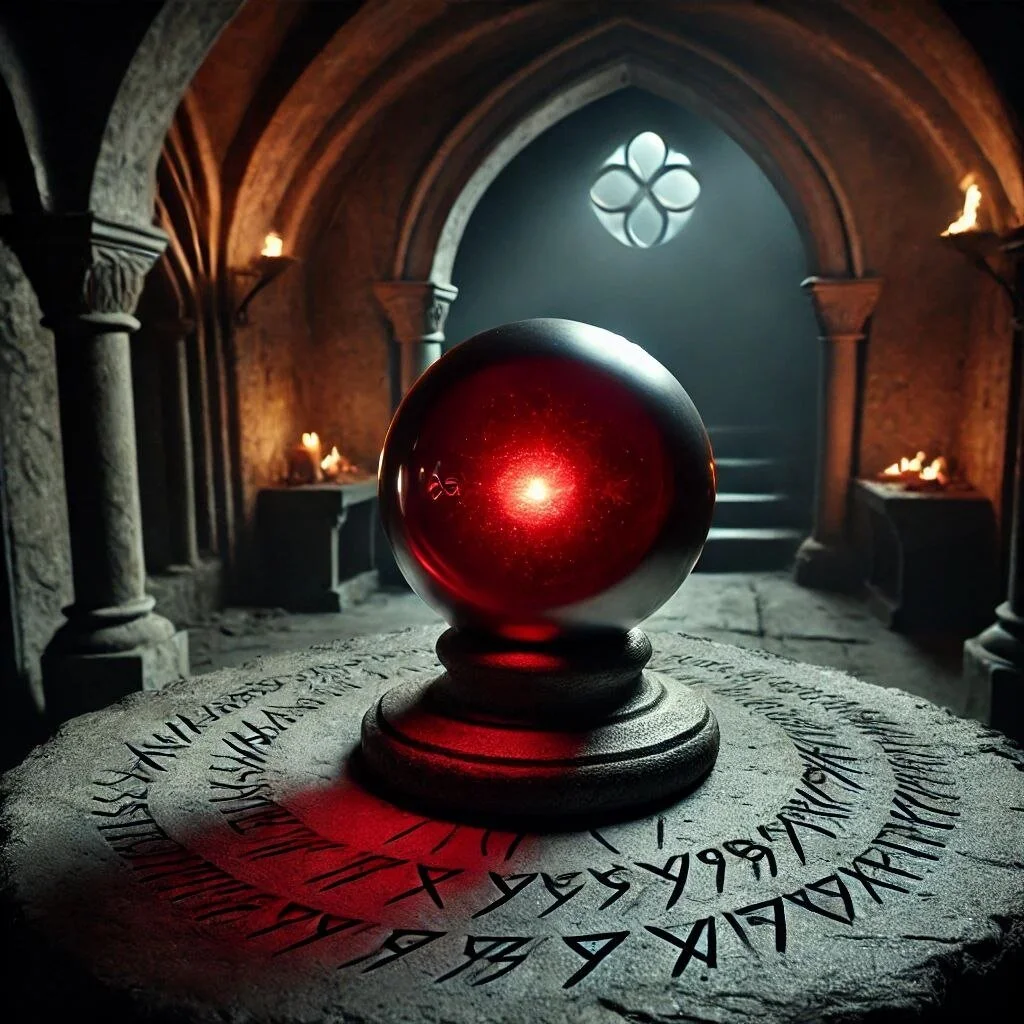
AI-generated image of a Palantir as described by Tolkien. CC 4.0.
Douthat in his interview came pretty close to identifying simultaneously both the katechontic role and the deep ambivalence of Palantir—even after Thiel had acknowledged the Girardian problem of oppositional structures. Douthat asked the following:
[Y]ou're an investor in AI. You're deeply invested in Palantir, in military technology, in technologies of surveillance, in technologies of warfare and so on, right? And it just seems to me that when you tell me a story about the Antichrist coming to power and using the fear of technological change to sort of impose order on the world, I feel like that Antichrist would maybe be using the tools that you were building, right? ...wouldn't the Antichrist be like, great, you know, we're not going to have any more technological progress, but I really like what Palantir has done so far, right? I mean, isn't that a concern? Wouldn't the irony of history be that the man publicly worrying about the Antichrist accidentally hastens his or her arrival?
Thiel answered rather lamely, “I obviously don’t think that that’s what I’m doing.” Which I think begs the question of what he is in fact doing and leads inexorably to a profound questioning of the use and meaning of the katechon after 2,000 years. In my follow-up essay, I will pursue this line of questioning.