On Not Counting on the Katechon, Part II
If we are to respond theologically to the idea of the katechon, much better than its Schmittian resuscitation, it would be to subvert it with the rest of the Pauline corpus—a Paul contra Paul so to speak. Rather than receive these texts as bearing semi-inerrantist magisterial meaning, it would be more accurate to read them as part of a critical progression in Paul’s thought. I would suggest that this letter is authentic precisely because of its primitive apocalyptic character, but it should be carefully contextualized precisely because Paul never returned to this theme again. As Douglas Campbell has argued, the letter makes a whole lot of sense against the background of what is known as the Gaian crisis, happening in the years 40 AD to 41 AD. In short, Gaius Caesar Germanicus (aka Caligula) conceived the insane plan to erect a statue of himself as Jupiter in the Jerusalem Temple and dispatched 30,000 troops to make it happen. The scheme sent enormous shockwaves through Levantine Judaism, traveling like electricity across the Jewish diaspora and rapidly reaching Macedonia. In a period that was still just a decade from Jesus’s death and resurrection, it could well have seemed the indisputable signal of the final crisis from which the return of Christ would save his people.
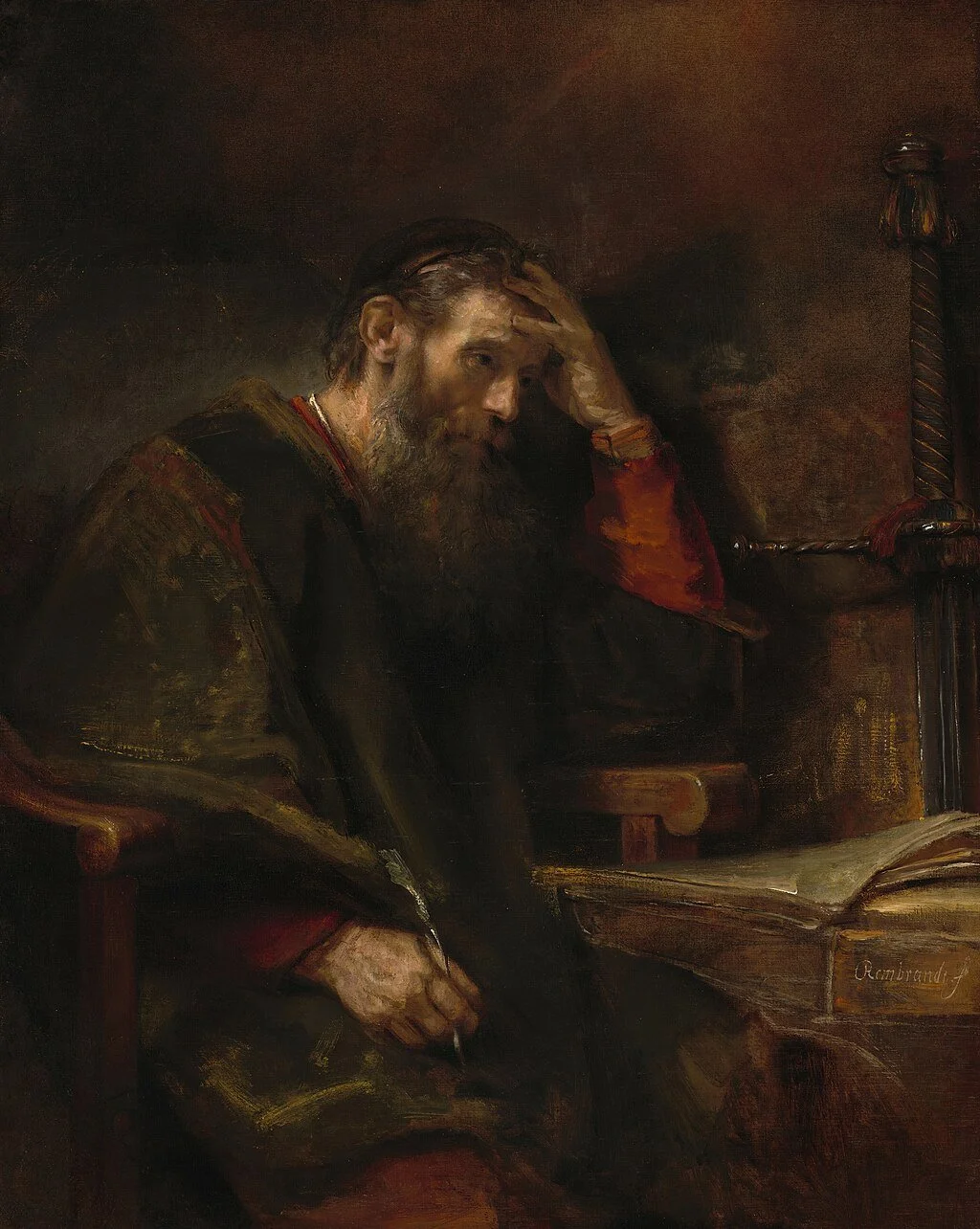
Rembrandt, The Apostle Paul, c. 1657
What “restrained” the plan was the Roman pax itself, the administration of an empire through dutiful and perhaps even conscientious officials tasked with keeping order as and where they could. Petronius, the general tasked with the unenviable job of putting a light to the tinderbox of Judaism, seems deliberately to have slow-walked the plan until Caligula came to a sudden and unlamented demise at the hands of the Imperial Guard in the year 41 AD. Paul did not specify the Roman administrative character of the restrainer, because that could easily appear like support of a possible coup against the emperor in a public letter. What he did say—“He opposes and exalts himself above every so-called god or object of worship, so that he takes his seat in the temple of God declaring himself to be God” (2 Thess. 2:4)—was more than enough to identify the notorious Caligula and his blasphemous schemes. Paul never mentioned the katechon again, because it meant little to begin with, and then, with the stretching on of the age of the Gentiles (Luke), it came to mean nothing at all.
Instead, in later writings, Paul sees Christ “seated at (God’s) right hand in the heavenly places, far above all rule and authority and power and dominion, and above every name that is named, not only in this age but also in the age to come” (Eph. 1:20–21). This is a very different, present-tense vision of Christ’s power, at odds with the violent showdown expected in 2 Thessalonians. We have to recognize, therefore, how, as time moved forward, Paul also moved on. He shifted to an understanding of how the impact of Christ’s death and resurrection in the actual lifeworld of the peoples served to undermine all violent division and authority and replace it with the entirely different sovereignty of new (nonviolent) humanity in Christ. It’s in fact possible to say that at the point of the Thessalonian correspondence, Paul saw faith in the gospel as a kind of emergency rescue operation in the face of a coming disaster—the “airlift” of a population out of the way of an invading army. Under such circumstances, the katechon would itself function as a tactical delay of the final invasion, an effective imperial blocking of Caligula’s plan. Everything in the Thessalonian correspondence has the sense of a fevered immanentism, which could easily lead to various explanatory scenarios of exactly when and how these events would occur. In contrast, the ongoing passage of time subdued the fever, and yet, at the same time, sharpened Paul’s sense of what Christ actually did mean for the world. The Ephesian vision realizes the perdurance of the world scene and Christ’s effective authority over its every working via the earth-shattering present impact of the cross.
In which case the katechon has only ever had a contingent and preterite meaning—referring to events that came to pass and then are in the past. It has been applied self-servingly by various political actors and structures, but all of them have come and gone. Since the New Testament, the term has derived a metaphorical significance, applied by lively writers to other contingent circumstances, but never accruing theological value to the term itself. Carl Schmitt’s ideological usage reflects the fevered imagination not of first century Thessalonica but of a twentieth century faced by the juggernaut of Soviet communism. Now, with Thiel, it gains yet another lease on life as the cybernetic manipulation needed to maintain a Western pax in a splintering world of human crises.
However, this leftover metaphorical or semiotic usage has had another function, one already signaled in Paul’s words and giving it, perhaps, its authentic value. In the Thessalonians text, there is a key motif of revelation “of the lawless one” (Thess. 2:3) repeated at 2:6. In the latter verse, the figure of the katechon is mentioned with an overall purpose: “so that he (the lawless one) may be revealed when his time comes.” The very effect of a holding back is for the sake of a revelation, and this would seem very much the point we have reached in the present moment. All the past incarnations of the katechon have resulted culturally in a progressive, step-by-step demystification of the nature of violence itself, bringing to the surface its mimetic and cyclic nature. Are we not at the point where the very discussion of the katechon involves an understanding of this nature (vide Thiel) and the actual unsustainability of violent solutions? Have we not reached the point where the revelatory function of the katechon has in fact finally been accomplished? Is not Thiel’s very embrace of an esoteric discourse a testimony that the business of violence cannot be pursued out in the open, because its character as human action is fundamentally exposed and called into question? At the end of the day Thiel really is a Girardian! Again and crucially, the katechon has done its job: it has lasted only until “the son of destruction”—aka, the human modality of violence—is revealed.
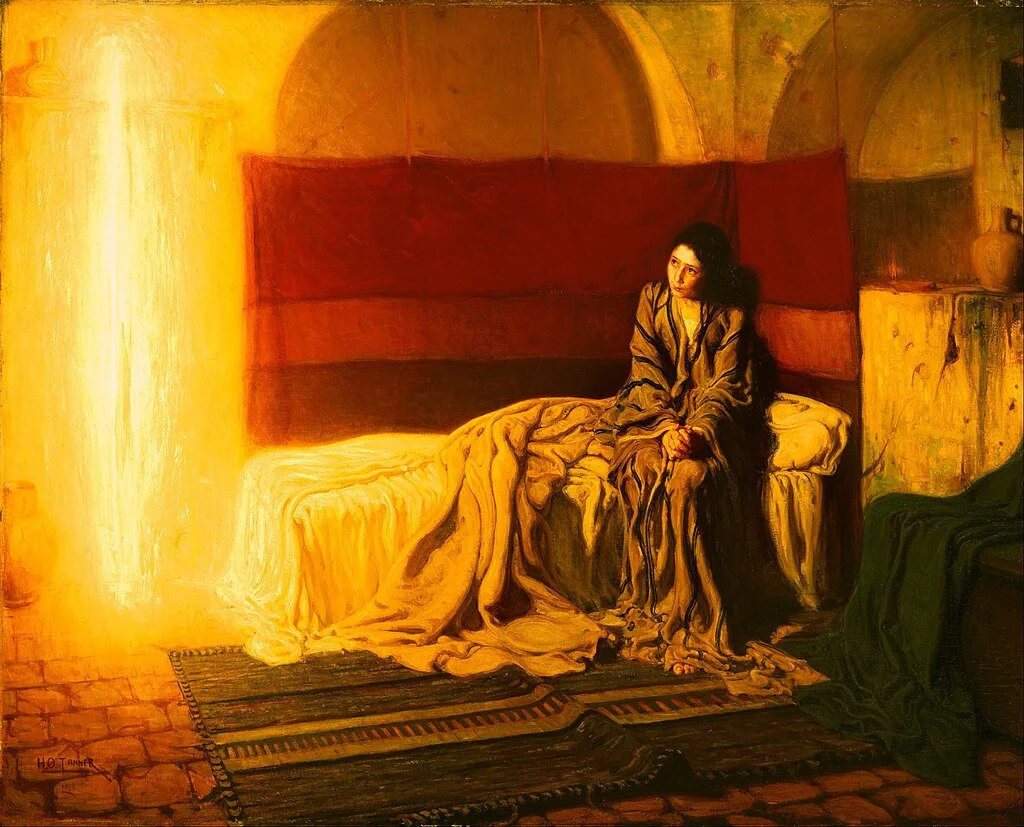
Henry Ossawa Tanner, The Annunciation, 1898
In the meantime, the gospel is something else, an urgent and present-moment inbreaking of new meaning—a semiotic apocalypse rather than a violent one. It is the present-tense transformation of reality that Paul has come to see and celebrate in 2 Cor. 5:17: “If anyone is in Christ, there is a new creation; everything old has passed away; see, everything has become new!”