What Has Halsted to Do with Rievaulx?
An essay on the past, the present, and the purpose of history
My feet positioned at Chicago’s southernmost border where Halsted Street enters the city in West Pullman, I am reminded of the Pullman Train Company’s unjust treatment of workers and their famous strike of 1894. Several miles north of here is Englewood, known for its decades of decay and population loss—characteristic of many south side neighborhoods in which Black citizens settled in the early- and mid-twentieth century. 63rd and Halsted, once second in commerce only to the Loop, is now haunted by histories of segregation and economic disinvestment. Next, Back of the Yards once housed workers of the Union Stockyards, the meat industry’s abuses rising to literary prominence in Upton Sinclair’s 1906 novel The Jungle. From there, Bridgeport, another memory of the city’s industrial history; the University of Illinois campus, which displaced thousands during its construction; Greektown; then Old Town; and now-affluent Lincoln Park. Finally at Belmont Avenue, I look down Halsted’s northernmost stretch in the historic “Boystown” (or Northalsted) nightlife district.
Halsted traverses the city’s rich fabric of social, economic, and political histories of those who have come here with their hopes for survival and desires for liberation. Yet, the corridor is a site of tension where these same hopes and desires have been consigned to ongoing ruin. Neighborhoods along Halsted face new forms of othering through gentrification that forces long-time, lower income residents into new neighborhoods where costs are more affordable—for now. This is not to let queer communities off the hook; they participate in their own ways in Chicago’s history of segregation, denying or ruining the desires of some while affirming those of others. Lately, it is becoming what Jason Orne has called a “Gay Disneyland”—that is, a space bordered off, favoring socioeconomic affluence, cis-gay men, and whiteness.
With one foot strolling along the streets of Chicago, I now lift the other and plant it in the wet, grassy fields at Rievaulx Abbey, evoking a concern for Christian theologians since Tertullian (ca.155–240) asked, “What has Athens to do with Jerusalem?” Warning of the leakage of heresy into the Christian gospel message, he questions the place of Greek philosophy in understanding divine revelation. This concern echoes throughout the centuries and even to today. Can my own experience now, we might put it, be used to better understand the Christian gospel then? Expressed in a different way, what is the role of experiences in the present for understanding the past? Anxiety about this is reasonable if we understand the historian’s task to be akin to what is often claimed as the theologian’s—that is, if uncovering the hidden truths of the past is similar to uncovering the hidden truths of divine revelation. These suggestions rely on the assumption that some metaphysical truth sits behind claims about God or the past and that it is the scholar’s task to peel back the layers to return us to an imagined metaphysical purity. This, however, limits engagement with either the past or divine revelation, solidifying disciplinary structures that are built by rejecting what fails to fit into the parameters constructed by scholars themselves.
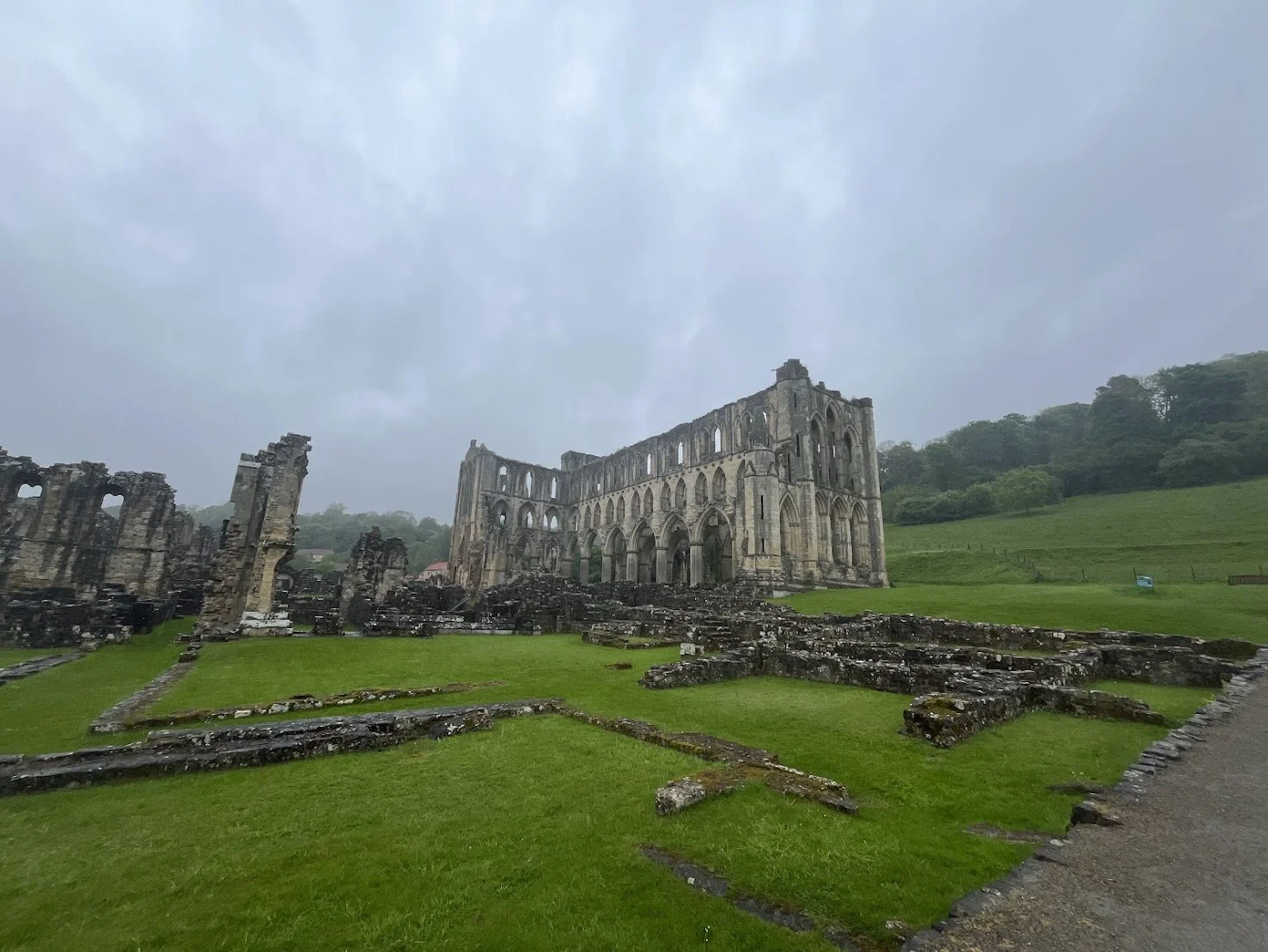
Rievaulx Abbey. Photo by author, May 2024.
There are many notable examples of past figures getting caught in these crosshairs of contemporary scholarship, but Aelred of Rievaulx (1110–1164) became a central figure in the concerns about modern political identities contaminating an otherwise pure past. He was made famous when he was forced out of the closet—after 800 years!—by scholars like John Boswell who argued in his 1980 book Christianity, Social Tolerance, and Homosexuality that there was ample historical precedent for inclusion of gays in the Roman Catholic Church. For Boswell, gay liberation in the present rests on the condition that identities like homosexuality have existed in ways uncannily similar to how these behaviors and identities are understood today. Aelred, for Boswell, is but one example of the uncanniness of cross-temporal homosexuality.
Other scholars have argued that searching for the presence of modern political identities in the past is pointless, a claim that I resist. Unless the scholar desires to maintain Aelred under some fixed identity (e.g., a spiritual exemplar), the question of his sexuality allows us to see him as more complex, layered, or queerly meshy. Still, I find myself unsatisfied with Boswell’s suggestions of cross-temporal uncanniness, and the question persists: What does the past have to do with my socio-political liberation in the present, especially when I know that Aelred was not at all concerned with who I am and with what I desire today? What has Halsted to do with Rievaulx?
I frame the question in this way because Halsted Street, a major thoroughfare that stretches across the Chicago region, has functioned for me as a symbol of my own liberation. Rievaulx, now sitting in ruin, symbolizes Aelred’s. These two locations, each with their own rich histories, are anachronistically connected by the desire for a life of freedom from the chains of some past. I recognize the risk that I take with this framework: offering the abbot liberation on my own terms, to bring him from the presumed boundaries of his monastic life to the presumed openness of Halsted. In articulating this uncanny anachronism, I now cross an ocean and step back in time (to the best of my ability) as I wander to Rievaulx Abbey.
Rievaulx sits in the middle of the UK’s North York Moors National Park in the Rye Valley. The morning after we landed at London Heathrow Airport, and after driving five hours to York, my friend and I traveled along the countryside’s winding, narrow roads, through small villages and old merchant towns. After 40 minutes, Rievaulx stood close on the horizon, a stunning ruinous grandeur situated in the Rye Valley. The sight brought tears to my eyes. The monument’s connection to Halsted was not immediately apparent, and though I expected a sudden inspiration, I was instead reduced to silence. I had anticipated some spiritual connection in the ruins, perhaps enlightenment about my dissertation research, some feeling of intimate connection to Aelred, confirmation or rejection of my suspicions about his sexual past.
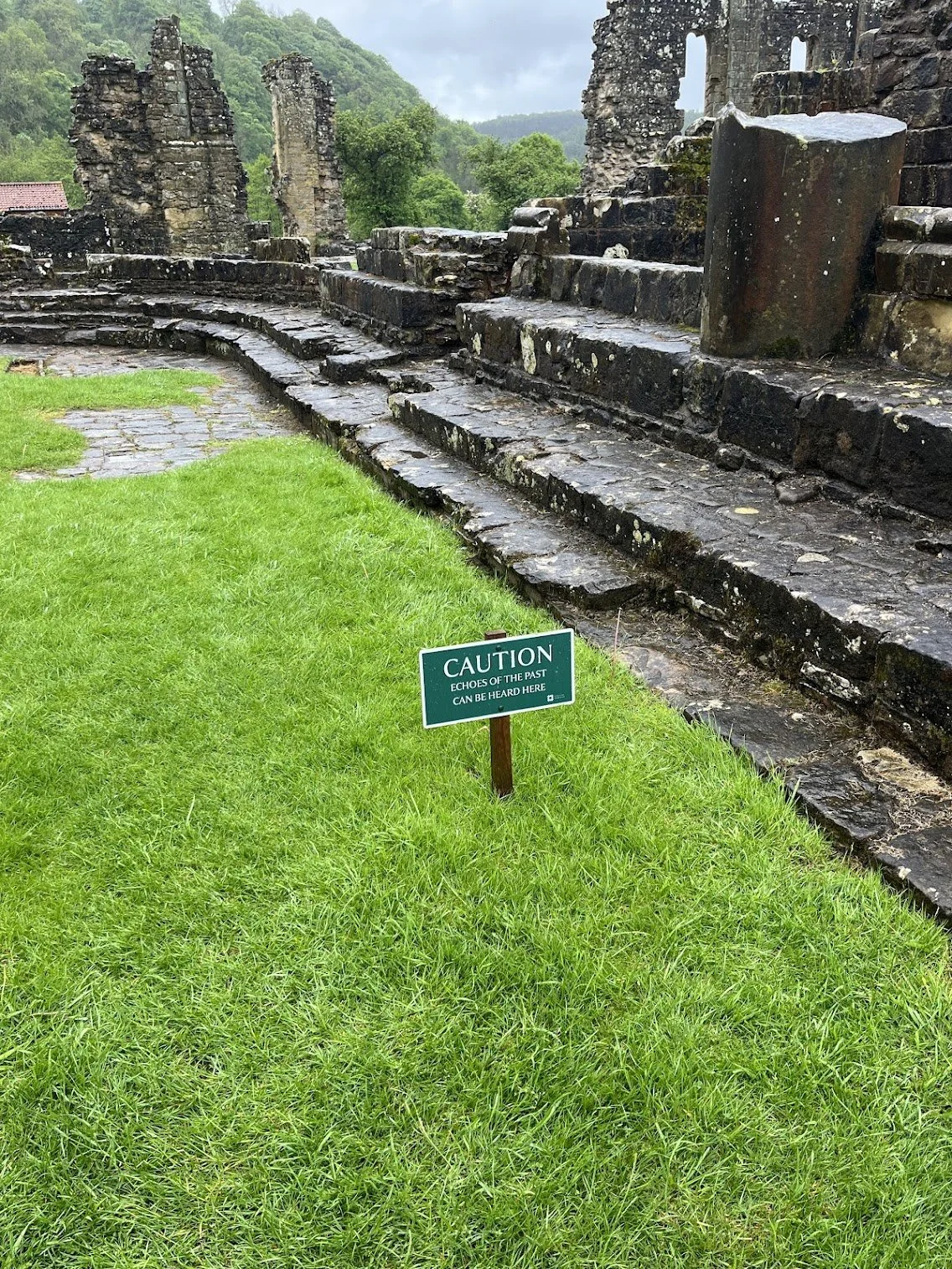
The Chapter Room at Rievaulx. Photo by author, May 2024.
No revelation came. I wandered into the nave and sanctuary of the abbey church, the ideological nexus of the historian who preserves Aelred as an exemplar of Christian spirituality. Next to this, the chapter room, where Rievaulx’s first abbot remains entombed. I then saw a clever sign cautioning visitors that echoes of the past can be heard here. I stepped into a smaller field, enclosed by four walls, a hearth still intact to my left. Embedded in the wall behind me was a plaque that read, “Abbot’s House.” The world began to cohere, though I still received no clear message from Aelred. He did not confirm what I, nor any other modern reader, want from him, and he would not. A chill worked its way down my spine, hair lifted on my arms, reminding me that what Aelred desired was sitting in ruin all around me.
My foot finally lifted from Halsted, coming to rest on an uncovered fragment of Rievaulx’s stone floor. The past cannot confirm what we say of it; there are always details left in silence, despite our best efforts; whispers that are barely legible; haunting echoes that quietly ripple through time. I had entered the ideological center of the modern queer scholar, one foot on Halsted, who reads Aelred with an eye toward his sexual behaviors—quite literally his bedroom—but I encountered the memory of a person whose freedom was within the walls of the monastery. His desires, evidenced by the immense growth that Rievaulx saw under his leadership, extended neither to what I nor anyone else today would like to say about him, but to the success and spiritual formation of his own community of monks.
Halsted pulled me back. One foot returned to the storied corridor of my liberation; the other remained planted in Rievaulx. If I use Aelred as the condition of my freedom, or if I read him according to the needs that I have today (whether queer or not), I participate in the ongoing ruin of his desires. I bend and warp him to fit narratives that work for me. I do not say this to discourage studying the past, but to recognize my epistemological limitations, my capacity to perpetuate harm, and my inability to do otherwise. What becomes of historical work if, no matter which method I use, I must ruin the desires of those who came before me? The historian’s task can be to analyze the anxious gap between past and present, the intertwining and uncanny familiarities between them, or to remind me of my capacity to bring to ruin the desires of anyone I encounter. Now with one foot on Halsted and the other at Rievaulx, I myself become the site of history’s reflection: less a search for what came before me and more a critical reflection on who I am today.
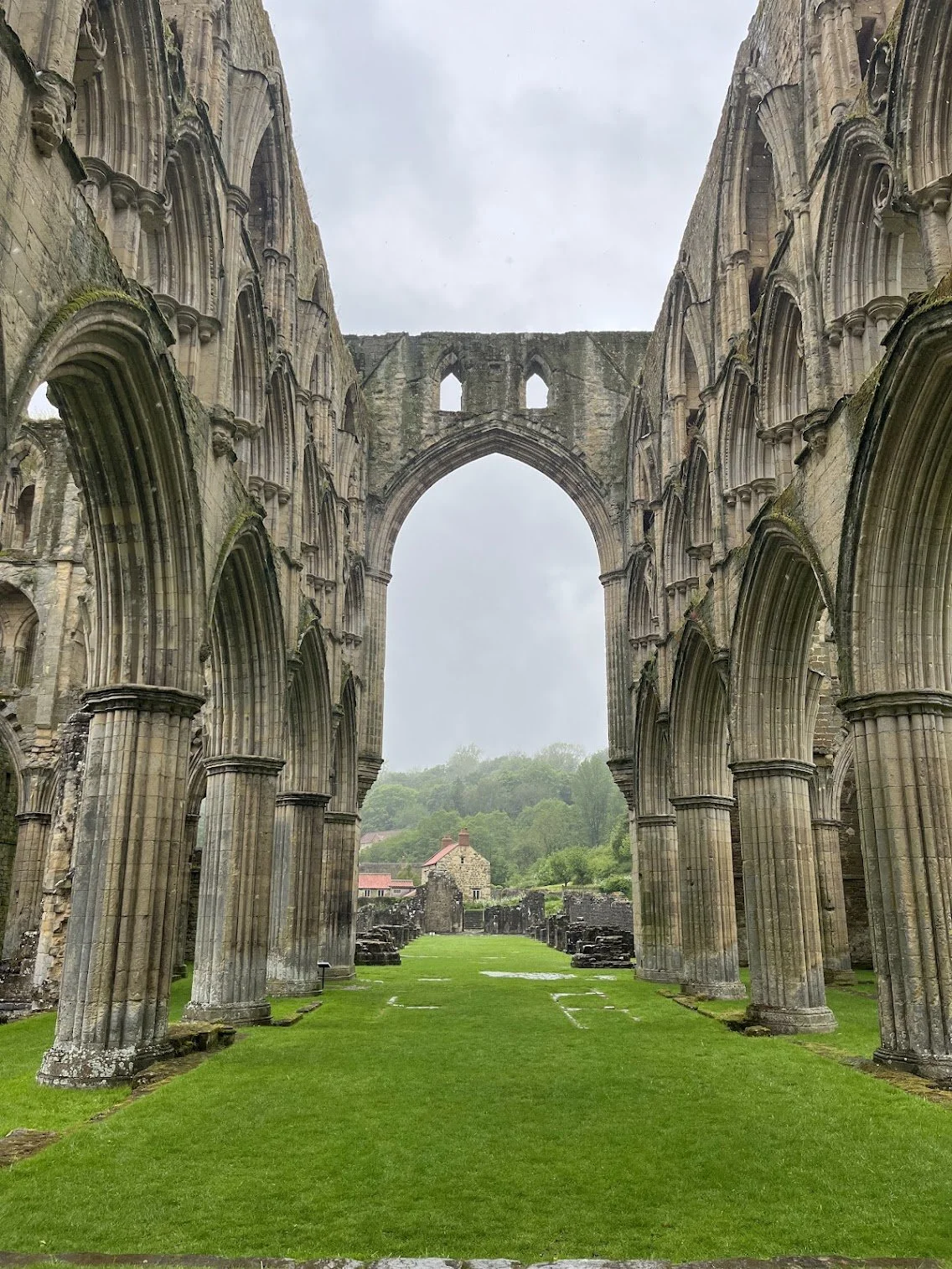
Rievaulx Abbey from within. Photo by author, May 2024.