The perpetually online world in which we live tests us all. Jonathan Haidt’s book, The Anxious Generation, for example, examines the growing disconnect between young people and the world around them. There have also been numerous academic articles on the “friendship recession” experienced by young men, explaining the complex multi-factor shift in society, work, and geography, which is leading us to become increasingly disconnected. Relying upon AI to find friendship has been met with sneers, but young people, in the absence of a genuine human connection, are finding a form of salvation within it. This is not to approve of it—AI has already been found to have indulged our most destructive fantasies, leading to some tragic consequences.
These personal experiences map onto our political lives. Old alliances are breaking at the seams as personal decision-making replaces institutional formations of community. Many post-liberals, such as Patrick Deneen in Why Liberalism Failed, believe that the atomizing effects of liberalism have resulted in the decimation of unity and solidarity, which were the traditional bulwarks against societal disintegration. Robert D. Putnam made a similar argument in Bowling Alone, which revealed the dangerous spiral of loneliness that has emerged with the disintegration of social networks and norms since the 1950s.
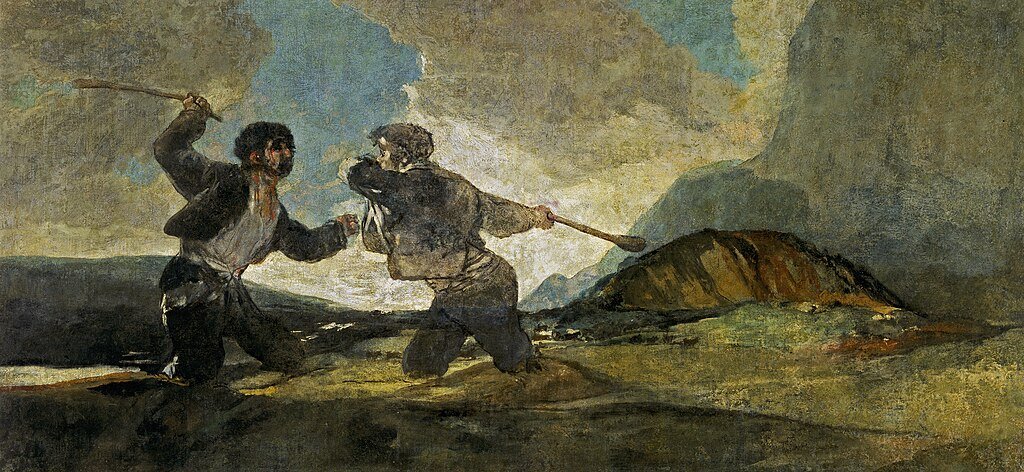
Francisco Goya, Fight with Cudgels, 1820–1823
Yet, this panic over the death of friendship is hardly new. As Francis Fukuyama noted in The Great Disruption, America in the early nineteenth century was largely churchless and drinking far more than was good for them. Within fifty years, church membership had doubled, and the temperance movement was in full swing. Safe to say we should not ignore the warning signs of an increasingly depressed, anxious, and lonely generation who spend extensive periods of their lives on technology we do not fully understand. But neither should we succumb to doom-mongering. Friendship, like any other concept, can be reimagined and reformed in the face of genuine obstacles. But all attempts at reimagining and reforming what friendship might look like in our current moment depend on understanding what friendship is in the first place.
For sure, there is no one definition of friendship. But if we want to begin to wrap our minds around such an elusive and complex topic, Aristotle is a good place to start. He believes that friendship is not entered into for pleasure nor advantage; the friend is cherished for who they are in and of themselves. It is their essence, not their effect, that we are drawn to. Yet this definition feels somewhat personal. Of course, you may well be thinking that friendship is inherently personal, and it is. However, friendship also remains a deeply political concept. The very fears over the decline of social bonds, AI, and the growth of loneliness closely intersect with our political fears over the rise of authoritarianism, the alt-right, and figures such as Andrew Tate.
Friendship has also come under pressure from politics. We cannot ignore the number of articles published on how to challenge and/or ignore relatives' contentious political views around the dinner table. The notion that “the personal is political,” a phrase taken from the title of a paper by the feminist writer Carol Hansich, emphasizes the relationship between politics and our relationships, the way politics can foster solidarity or conflict with those around us. As David Corey suggests in the passage below, the breadth of politics now infiltrates our social lives in ways that it did not before. Today, politics, and our attachments to political positions, have become a marker of our worthiness to live, love, and interact with each other.
[M]istaking political battle for politics itself causes severe harm to human fulfilment. Some people dismiss this harm on the grounds that politics has simply always been as nasty as it is now. In their defence they cite the extreme vitriol exchanged between Thomas Jefferson and John Adams in the election of 1800. But they are wrong. While the vitriol was indeed extreme, what they miss is that the massive increase in the scope of government since 1800 means that all domains of social life are now conscripted into political warfare: education becomes political; church becomes political; museums and orchestras become political. Everything is valued, or not, depending on its potential contribution to victory.

Carl Schmitt, 1932
In this scenario, and given the increasingly intensified personalization of politics, enter the theorist Carl Schmitt. Schmitt’s politics have been used as a tool to understand today’s vagaries of friendship. To say he is controversial is an understatement—Schmitt’s association with the Nazi Party and his post-war refusal to engage with de-Nazification ensured not only his banishment from the academy but also wider ostracization. As the scholar Jan Muller has noted, Schmitt remains a dangerous figure who should be approached with extreme caution. Yet, writers, staffers, and political theorists remain attracted to this virulent antisemite for his caustic attempts to understand politics in the modern world.
Schmitt’s blunt assessment of friendship was a negative one and was premised upon existential fear of violence. Known as the ‘friend–enemy’ dichotomy, Schmitt’s theory proposed that all of politics was divided between enemies and friends (i.e., groups who pose a physical threat and those who do not). By “threat,” Schmitt meant a public threat rather than a private one. In Theory of the Partisan, Schmitt built upon the friend–enemy concept he had most famously delivered in Political Theology and Concept of the Political. Whereas in Concept of the Political, Schmitt writes that enmity can take the form of ideology, in Theory of the Partisan, Schmitt defined friendship spatially rather than ideologically. In other words, a friend, for Schmitt, would be someone who lives in the same city, rather than someone who is a fellow member of, say, the Communist Party. Indeed, Schmitt even critiques activists such as Lenin for attempting to globalize the friend–enemy distinction (e.g., the bourgeoisie and the proletariat).
The friend and the enemy, therefore, are not supposed to be personal, like they are in Mean Girls. They are something much bigger than ourselves. As Schmitt points out, it is citizens, and in some cases the sovereign, who decide who is a friend and an enemy. Just think of George Bush telling the world, “You are either with us, or you are with the terrorists.” It is no coincidence that the re-emergence of Schmitt’s theorizing occurred during the War on Terror, as the U.S. began to disembowel the liberal order it had helped create and foster for more than seven decades.
Schmitt’s focus on enmity goes beyond any single ideology and lies at the foundation of Schmitt’s beliefs about politics. This is why both those on the left and those on the right have utilized Schmitt’s work over the years. For example, the political theorist Chantal Mouffe’s use of Schmitt is founded upon a belief in the utility of agonism. Politics, according to this notion, is necessarily driven by competition between different groups. If we try to ignore competitors in politics or try to reason them away, then we cannot fundamentally understand our differences. Instead, confronting them and recognizing those differences creates the space for a more honest and transformative politics.

Person on laptop, CC 4.0, image by Brian Twitty
Despite the enduring appeal and usefulness of Schmitt’s friend–enemy dichotomy, there are problems with it. For one, Schmitt’s conception of friendship is rooted in territory. But we live in a post-territorial world. The internet now allows friendships and enmity to move easily beyond the boundaries of states and nations into social media and other virtual forums. Given that friendship and enmity transcend geographical borders, Schmitt’s hope that the state can be an arbiter of such dynamics seems increasingly untenable.
Friends and enemies not being tied to the state can be witnessed by the birth of transnational groups, such as Al-Qaeda and ISIS. Tied not to borders but to the internet, such groups were able to indoctrinate, lure, and mold terrorists. Such groups are not tied to territory but to ideology. Even though scholars, such as Benedict Anderson, discuss the production of “imagined communities” through periodical culture, which was constrained by the material limits of newspaper circulation, our “imagined communities” now exist online and in the air, lacking any limitation due to their formation through digital cultures.
Now, we also bear witness to podcasts and right-wing groups forming connections beyond any border. The development of Orbanism as a model for the US post-liberals has helped cultivate a community that knows each other by the names of their podcasts and personas online. Trolling and vilifying “the other” have become the norm in this toxic political community on the right. This is not merely the erosion of barriers; globalization long before the arrival of social media produced an increasingly interconnected world. Instead, it is perhaps the beginning of a much darker, post-spatial political relationship that cycles viewers between different podcasts in the hope of capturing audiences.
Identity is being molded and formed outside of geographical boundaries. Genuine attempts by nations and regional organizations, such as the European Union, have been made to limit the spread. However, to assert it is merely a matter of knowledge and information misses the deeper issue. The question of ideology and identity is inherently important to politics. The new formations of political groups supersede older calls to nationalism, resulting in the fragmentation of older notions of community and identity. Everything is up for grabs now.
Schmitt’s interpretation of politics as fundamentally being a fight between friends and enemies may well, at its core, be correct. Yet, Schmitt’s attempt to tie this claim to space is a failure that cannot be ignored. Ideology transgresses boundaries, and we live, despite many people’s pretenses otherwise, in a deeply ideological world. We may also question if Schmitt truly made sense in his own time. After all, this is a man who proclaimed it necessary to limit the level of enmity yet failed to break out of the cycle of ideology himself. His falling for the Third Reich and his defense of Hitler highlights not only Schmitt’s personal failures but also his wider political danger. In the twenty-first century, when we bear witness to evermore anger, Schmitt’s own divisive racism and hatred should be a timely reminder of the futility of the politics of the friend and the enemy.