Though we are not Catholic ourselves, my family and I have attended a local parish for years, drawn by the warmth of the community and the welcoming way the liturgy invited us into worship. Like everyone else, we sing the hymns and join the responses, guided along by the slides projected high on the Epistle side of the sanctuary that display lyrics and text for each Sunday’s Mass. But at this particular church, the slides frequently pair text with images of artworks lifted from a long sweep of Christian history. Added to the mix is a generous dose of the sentimentalized renderings of Jesus so prevalent in contemporary devotional media. Images aren’t confined to a single moment, but shown throughout the Mass: the gathering song, Kyrie, Responsorial Psalm, Gospel Acclamation, Offertory, Communion, and closing song. In this respect, our church is clearly atypical in its visual freedom. The use of slides has long been a subject of debate concerning what is liturgically appropriate, yet today the projection of lyrics is far more common in Catholic churches than the projection of images. The format is simple and consistent, with lyrics in large white italicized text on black paired with their illustrations. I used to enjoy the challenge of identifying famous artworks when they were shown, making it a private game I played to test the limits of my art-historical knowledge. But after watching these slideshows for weeks, eventually months, the effect began to change. Their overall dissonance was becoming impossible to overlook.
This jumble of clashing images made me wonder how much of the Church’s visual inheritance we’ve forgotten. I began to imagine how powerful these presentations would be if they were arranged with greater coherence and purpose. And I realized how this seemingly harmless aid to participation was formatively consequential. How a rapid procession of disconnected images will at best confuse attentive viewers, and at worst trivialize sacred truths, undermining spiritual formation. Though I don’t doubt the sincerity of the staff member who prepares these slides, when a church takes seriously the history and theology embedded in Christian art, its riches can be deployed with greater care to guide the congregation in seeing, imagining, and believing. Most Catholics know that the Church has a visual tradition, but fewer realize that it is not just beautiful—it is a language. And like any language, when we stop speaking it fluently, meaning begins to slip away.
From Gregory the Great’s endorsement of images for teaching, through the Council of Trent’s codification of their devotional use, to Baroque and Gothic Revival commissions and twentieth-century projects by figures such as Couturier and Regamey, the Church has continually taken images seriously as a means of conveying theology. With this in mind, and given my longstanding interest in how images condition our understanding of reality, it seems inevitable that the slideshow’s visual sprawl would lead to questions about what the ready availability of digital images is teaching—and reflecting—theologically. So, where do we look for practicable models of visual theology? I searched for answers in the Church’s own history, reminded that the making of images has often unfolded as a reciprocal process, shaped by the needs of worship and the Church’s theological, pastoral, and ecclesiastical aims.
✳ ✳ ✳
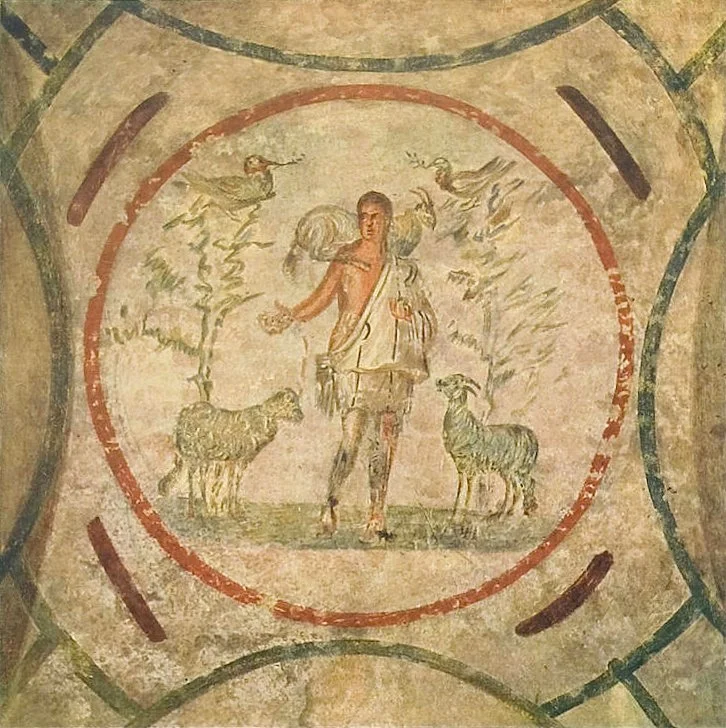
Third century Fresco of Jesus as the Good Shepherd
Consider the image of Christ in the early days of Christianity, when paintings of the Good Shepherd appeared in the catacombs of Rome. These commemorative images were meant to encourage hope and inspire courage—critical in a period when state oppression loomed large in the daily lives of the faithful. Emphasizing Christ’s care and salvific power, the image of the Good Shepherd affirmed Christian identity amid persecution and marginalization. It didn’t simply depict Christ but taught Christians how to see themselves: as a people bound together by care, trust, and belonging. The image did the work of unifying identity under political and social pressures.
As Christianity moved from the margins of society into the structures of empire, images no longer needed only to console the faithful. They now had to claim authority. Thus, as Christianity came out of hiding and overcame persecution to gain imperial favor under Constantine, images of Christ shifted. In the Late Antique to Early Byzantine period, spanning the fourth to sixth centuries, Christ emerged in art as the commanding Pantocrator, often enthroned, and in shimmering imperial mosaics, portrayed as cosmic ruler and ultimate judge. These images embodied a theology aligned with empire. They trained the faithful to see Christ as Lord over history, mirroring the Church’s new public power.
Centuries after Christ’s sovereignty had become firmly established in image and doctrine, the Church began to turn its gaze toward the mystery of how that sovereign God had lived, suffered, and died as a human being. Theologians in late medieval Europe increasingly emphasized Christ’s humanity, and artists painted and sculpted narratives inviting viewers to imaginatively participate in salvation history. The Church promoted images of Christ’s human suffering as a means of cultivating compassion and penitence. By the time of the early Renaissance, naturalism had become the dominant visual language of Western Christian art. This served a clear theological purpose: by stressing Christ’s lived, embodied humanity, artists prompted the faithful to see something of themselves in his exemplary life. This emphasis aligned with the Church’s pastoral concern at the time to shape Christian conduct through visual models of lived holiness, frequently personified by the great saints.
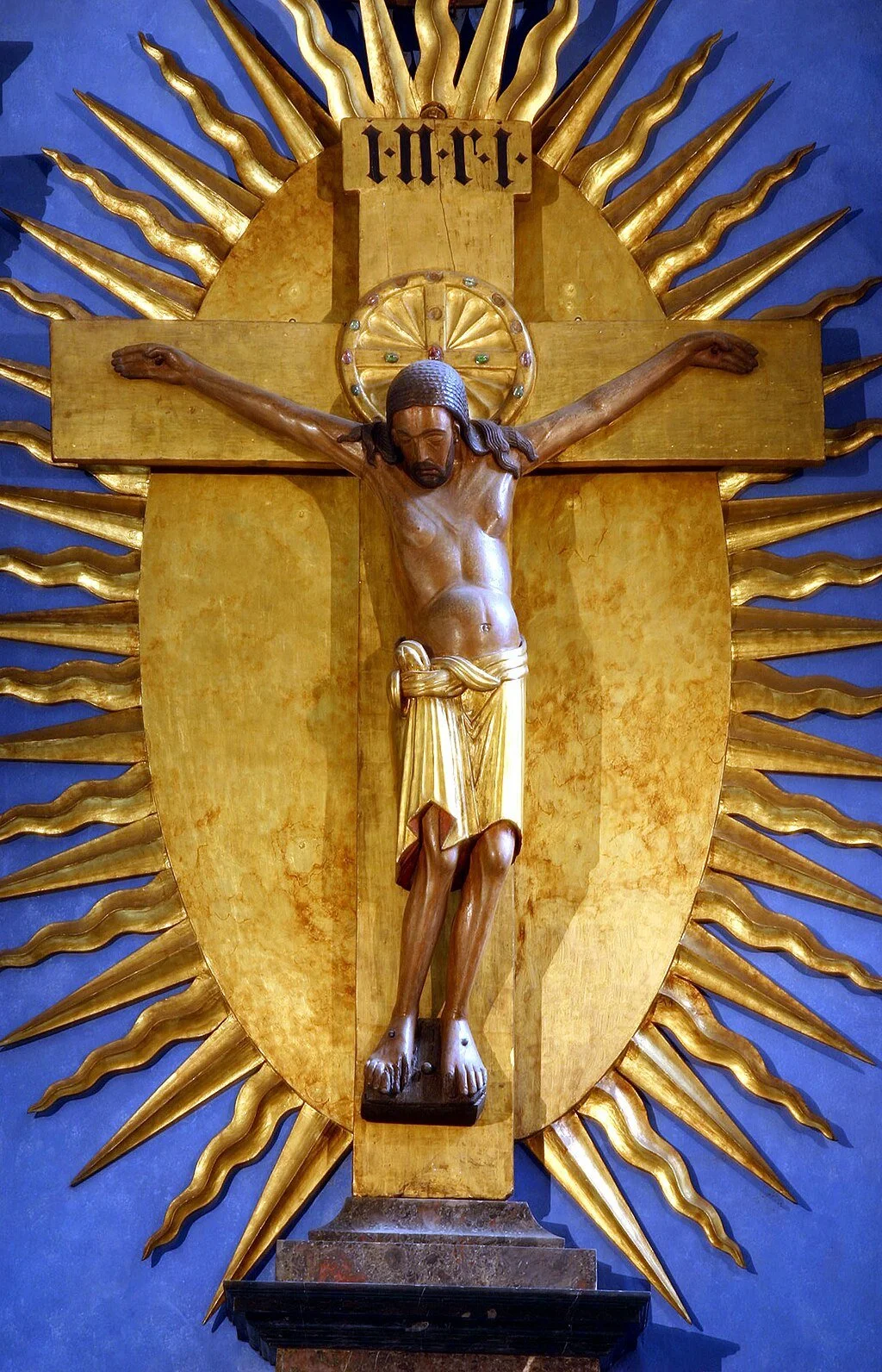
Gero Crucifix, c. 970
Medieval artists often expressed Christ’s human nature through raw physicality. The Gero Crucifix (c. 970; above) and the Crucifix by Cimabue at Santa Croce (c. 1265) are two examples of the shift from the earlier Christus Triumphans (victorious, open-eyed Christ) to images of a dead or dying body—slumped, bleeding, eyes closed. In images of this type, the weight of Christ’s body pulls downward, expressing mortality and pain. In pieta or German and Bohemian Vesperbild imagery, Christ’s corpse is often emaciated, twisted, and heavy. Meanwhile, Mary’s interaction with the body foregrounds maternal grief and the intimacy of touch. Giotto’s fresco cycle in the Arena Chapel in Padua (c. 1305), which depicts the Life of the Virgin and the Life of Christ, expresses the grief of Mary and Christ’s human vulnerability through the artist’s revolutionary naturalism. But it also includes his earthly birth in the Nativity. The infant Christ’s dependence and embeddedness in ordinary life is poignantly expressed in Gentile da Fabriano’s Adoration of the Magi (1423), where amid gold and luxury, Christ is still a small, naked infant on Mary’s lap. An interest in psychological depth and naturalism found a parallel in Franciscan spirituality, whose affective models of prayer emphasized feeling, influenced scriptural interpretation, and encouraged imaginative engagement with images. Alongside St. Francis, the affective piety of St. Augustine, Anselm of Canterbury, and Bernard of Clairvaux informed Renaissance commissions that embraced humanistic principles.
After the Reformation, confronted by a fractured and contested religious landscape, the Church turned to images that seized the senses, reawakened devotion, and reaffirmed Catholic doctrine. In the sixteenth and early seventeenth century, the Church’s Counter-Reformation priorities found their most powerful expression in Baroque art’s ability to educate and persuade simultaneously. These priorities became visible in the quite different yet equally compelling approaches of artists, such as Caravaggio, Bernini, Gentileschi, and Annibale Carracci. The heightened drama of Baroque art generated new visual languages that centered on—in addition to the lives of saints—scenes of martyrdom, depictions of miracles and intercession, and intensely emotional moments of revelation and conversion.
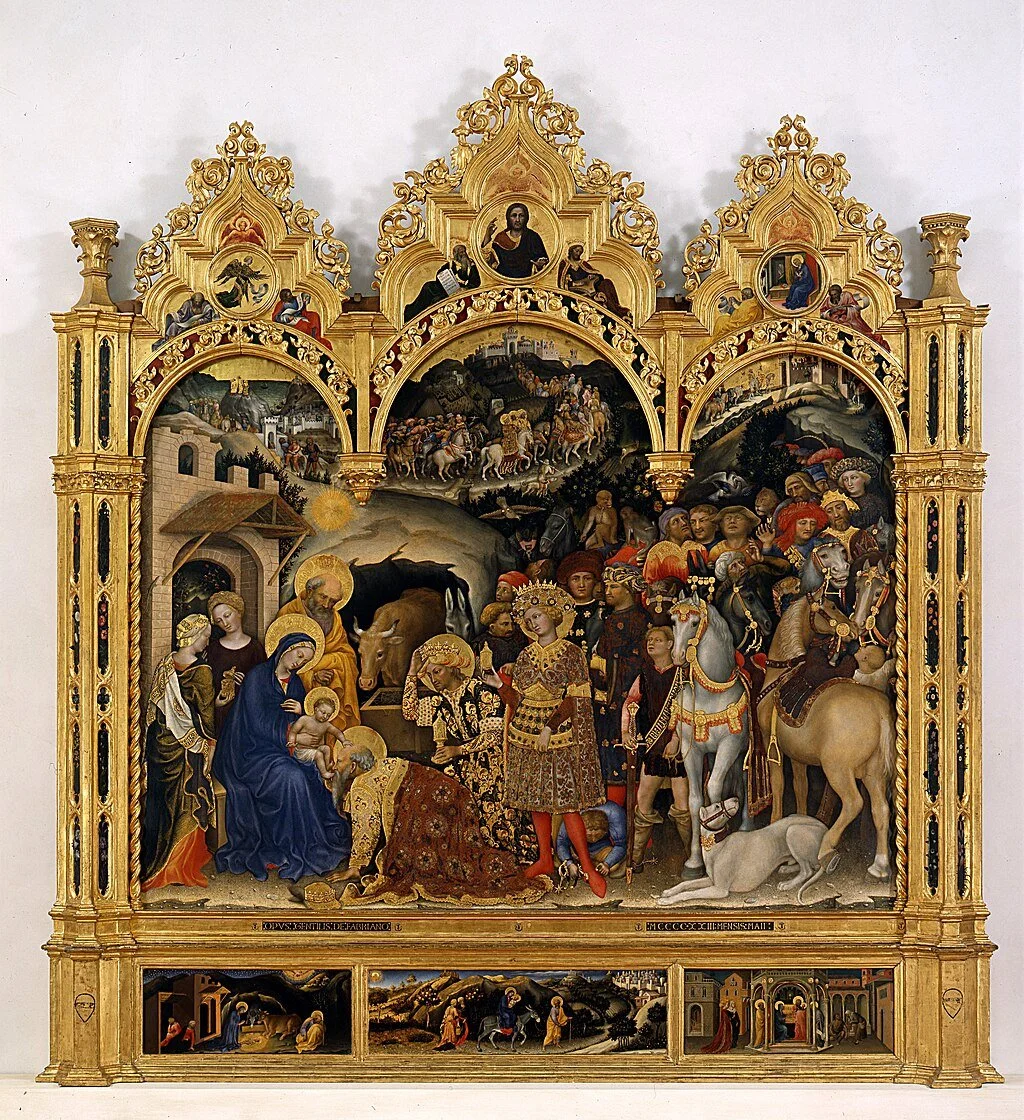
Gentile da Fabriano’s Adoration of the Magi, 1423
Here I’ve traced a movement that begins with messages of survival, identity, and hope, crystallizes around authority and order, evolves to emphasize the Incarnation and participation, and later intensifies its concern with emotional engagement and religious fervor. Of course, many more examples could be drawn from other periods, cultures, and individual artists, but my point is not to be exhaustive. Rather, it’s to show that images have long operated as sites of spiritual formation, not just reinforcements of something sung, recited, spoken, or announced. Religious visual language will at times emphasize transcendence and mystery and at other times, intimacy, suffering, instruction, or devotion. These shifting aesthetics reflect differing attitudes and priorities over time, reminding us that images do not merely illustrate belief but actively participate in shaping how faith is perceived, felt, and lived. Historically, the production of sacred art was impacted by challenges very different from those churches face today: artists worked under scrutiny within strict material and technical limits—and for specific liturgical spaces where images were encountered slowly and communally. In our current age of image saturation, the challenges are vastly different.
I’ve always been grateful for the benefits of living in a digital culture, one of which is our easy access to the great art of the past. Much of this art makes up the Church’s history. But our virtual landscape is one of excess, and the desire to learn our history can easily send us tumbling down a steep slope into an endless stream of drawings, paintings, and sculptures depicting biblical scenes culled from a vast array of sources, produced with unprecedented ease and circulating continually, disconnected from catechesis, place, ritual, and the specific communities they were designed to serve. Reproductions of art make up one small current within a sprawling digital ecosystem, sustained by the same flows of attention and circulation that feed countless other images. It’s an ecosystem governed by speed, novelty, and algorithmic preference. Where in the past, challenges for both artists and churches included scarcity, durability, and doctrinal clarity, today’s churches are challenged by excess, novelty, distraction, and the difficulty of sustaining contemplation. How does a sacred image rise above the noise? How can it function as an enduring, spiritually formative encounter as opposed to fleeting visual content?
These questions do not admit of easy answers, but they have led me to think more about how the Church might engage digital images more intentionally—a possibility I return to in the second half of this essay.