This article is the second essay in our July-August 2026 forum on Personalism and the Catholic Worker.
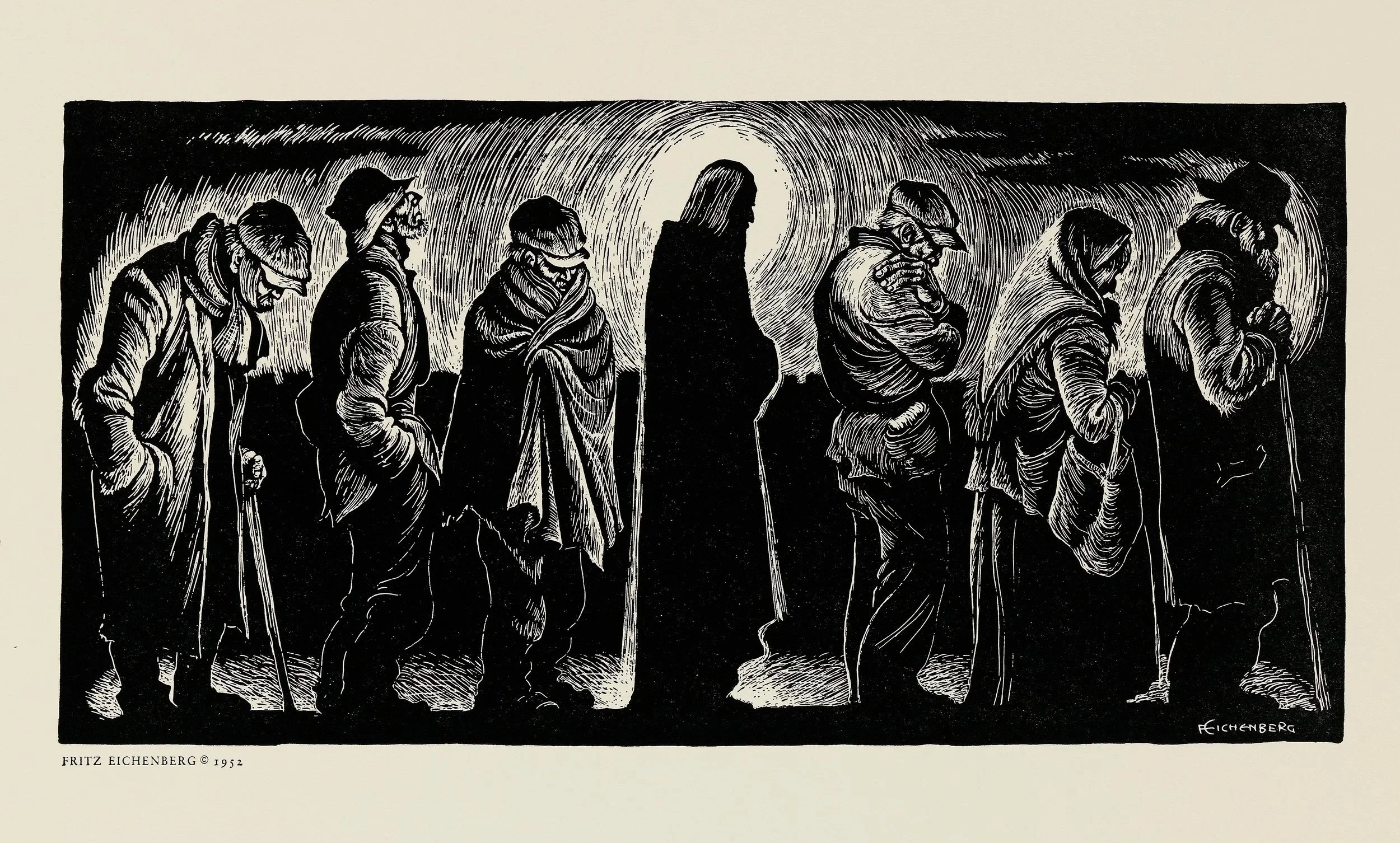
Fritz Eichenberg, The Christ of the Breadlines; Portfolio of Illustrations by Fritz Eichenberg published in the Catholic Worker from 1949 to 1982 - Number ii, 1950, Print on medium, slightly textured, cream paper, 13 x 16 15/16 in., Gift of Elizabeth O'Grady and Jeffrey P. Dwyer, Smith College Museum of Art, Northampton, Massachusetts, SC 2016.65.122.2
When Peter Maurin and Dorothy Day launched The Catholic Worker in 1933 in the depths of the Great Depression, they envisioned a different kind of newspaper: one that would integrate protest with spiritual formation. Their unwavering commitment to addressing the plight of the working class led to a paper that broke new ground in American religious and political life. Printed cheaply and sold for a penny, it circulated in soup kitchens and tenement apartments, in picket lines and on factory floors. Its pages a compelling mixture of essays, reports from the poor, theological reflection, and radical political critique. Guided by Maurin’s European socialist and personalist philosophy and Day’s anarchist and pacifist views, the newspaper disseminated ideas that challenged the status quo in its ongoing critique of mainstream society. From union actions and tenant evictions to state violence and political injustice, it framed the problems of ordinary people using the social teaching of the Catholic Church. Maurin’s “Easy Essays,” Day’s “On Pilgrimage” column, research pieces, and contributions from others on a range of worker issues found concrete expression in the growing Catholic Worker movement and its hospitality houses and other social services.
Into this world of voluntary poverty and prophetic dissent stepped Fritz Eichenberg, whose wood engravings gave The Catholic Worker a visual grammar to express its moral urgency. For around 40 years after his chance meeting with Day in 1949, Eichenberg would illustrate the newspaper with bold, stirring wood engraved prints featuring images that proclaimed Christ’s presence amid human suffering. A German–Jewish immigrant, he converted to Quakerism after fleeing the Third Reich with his family and the unexpected death of his wife. One of the world’s foremost wood engravers, his prolific output spanned a range of subjects that included illustrations of literary classics by figures such as Dostoevsky, Tolstoy, and Poe. His conversion drew him more deeply into religious themes, and although he didn’t share Maurin and Day’s Catholicism, Eichenberg found in their movement a place to express his own commitment to peace and Christian ethics.
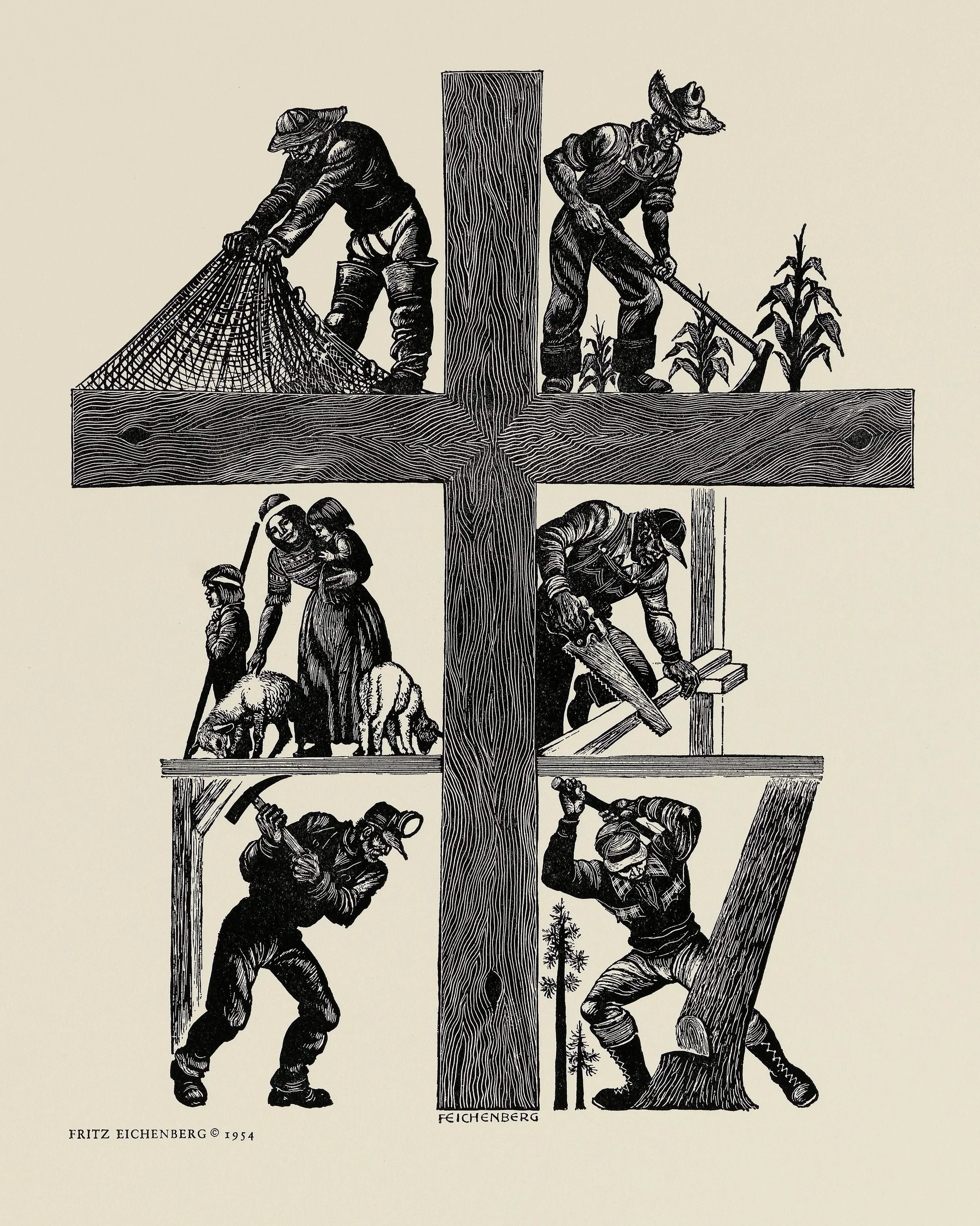
Fritz Eichenberg, The Labor Cross; Portfolio of Illustrations by Fritz Eichenberg published in the Catholic Worker from 1949 to 1982 - number iii, 1954, Print on medium, slightly textured, cream paper, 16 15/16 x 13 in., Gift of Elizabeth O'Grady and Jeffrey P. Dwyer, Smith College Museum of Art, Northampton, Massachusetts, SC 2016.65.122.3
From the factory strikes of the 1930s through the United Farm Workers mass civil disobedience in the 1970s, The Catholic Worker was enmeshed in the militant actions of the working class, engaging directly in labor advocacy. At the same time, the mainstream press was expanding commercially and working to capture a mass audience using spectacle as much as news. To enlarge their market share, major newspapers like The New York Times, The Washington Post, Chicago Daily News, and the Philadelphia Inquirer featured sensational headlines accompanied by eye-catching photographs. Lifestyle sections and entertainment coverage were designed to appeal to a consumer mentality. In its staunch independence, the ad-free, volunteer-run Catholic Worker stood against the rising tide of corporate media. In a comparable way, Eichenberg’s wood engravings defied the visual regime of commodity culture, which directed the public’s desire ever more toward consumer individualism. In an increasingly mechanized society, his work bore witness to human dignity.
The highly-skilled and labor-intensive medium of wood engraving perfectly complemented the paper’s moral mission. Eichenberg was a master at his craft, especially in the demanding white-line technique, in which images are cut into hard end-grain woods, like boxwood, to produce extraordinarily fine, meticulous lines. His forms emerge as luminous white lines against dark fields, lending his subjects a dramatic, visceral force. Quite literally against the grain, these prints resisted the dominant newspaper aesthetic. Consistent with The Catholic Worker’s own vision, Eichenberg’s work emphasized the handmade over the mechanical and the expressive over the sensational. Its symbolic density was distinct from the glossy but disposable spectacle of the mainstream press. Rather than consumption, his images invited moral reflection. Eichenberg’s work, like the movement he had joined, merged theology and praxis through its wide dissemination of the Gospel message through the framework of protest.
There’s something especially fitting about how Eichenberg’s images highlight the labor of the hand. The medium of wood engraving speaks to the tangible nature of work. Each print is a record of manual labor—of disciplined, physical effort—where the artist has cut, scraped, gouged, and worn down a block of wood until the image appears. Like most forms of drawing, it’s a medium that is direct and immediate. Wood engravings (and their cousin, the woodcut) are printed inexpensively and can be reproduced limitlessly, reaching the rich and poor equally. The use of humble materials and the commitment to patient labor in the service of God aligned Eichenberg with the ethos of The Catholic Worker, as did his refusal to commodify his work for the mainstream press.
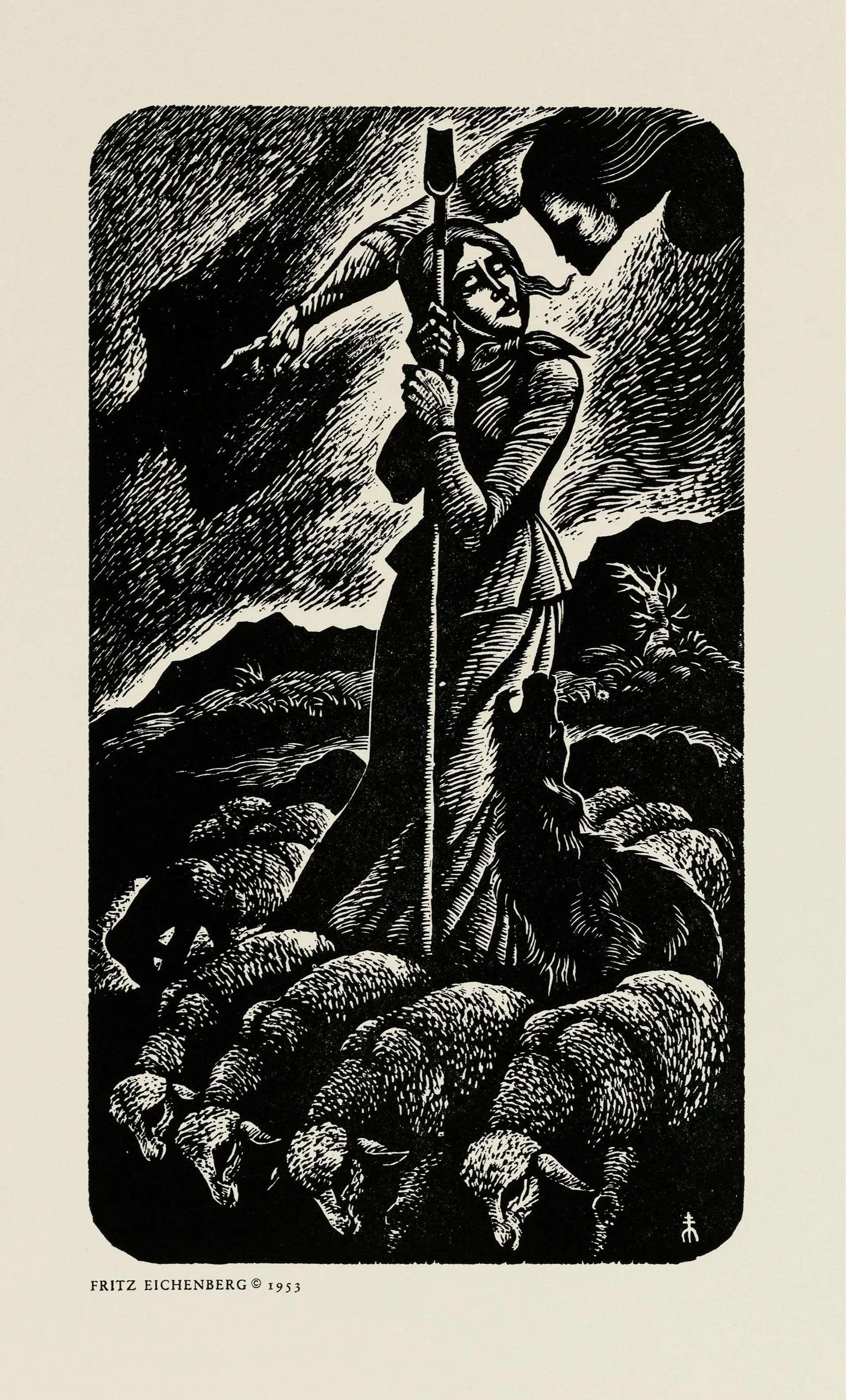
Fritz Eichenberg, Joan of Arc; Portfolio of Illustrations by Fritz Eichenberg published in the Catholic Worker from 1949 to 1982 - number xii, 1953, Print on medium, slightly textured, cream paper, 16 15/16 x 13 in., Gift of Elizabeth O'Grady and Jeffrey P. Dwyer, Smith College Museum of Art, Northampton, Massachusetts, SC 2016.65.122.12
Images such as The Christ of the Breadlines (1950), The Lord’s Supper (1951), and The Christ of the Homeless (1982) confront the brokenness of modern society through the light of Christ. In these examples, Jesus appears in the midst of ordinary life, offering his mercy and compassion to the poor, the oppressed, the homeless, and the hungry. In The Labor Cross (1954), for instance, Eichenberg connects those who work with the earth to Jesus’s life as a carpenter. The Black Crucifixion (1963) is a powerful example of how he was able to filter the period’s revolutionary spirit through traditional religious imagery. And his images of saints are imbued with personality, making them sympathetic to modern readers (e.g., 1953’s Joan of Arc and 1964’s Sermon to the Birds).
It was a vision of God’s presence in the everyday that undergirded Eichenberg’s handmade images of working hands. And it was not just the subjects of his work that are religious; the very medium and techniques of his work express his deep spiritual commitments, from the clarity of his compositions, to the way the wood block evokes the wood of the Cross. Consider also how he figures the artist as a worker and how his practice situates the artist squarely within the world of labor. His work presses us to ask questions about the art world of today: How might artists join in solidarity with other forms of labor? What role does the artist play in serving the common good? And how can artists effect real change from the ground up? Of course, art that takes up such questions doesn’t require a single style or visual language. It doesn’t need to be representational or figuratively expressive like Eichenberg’s. Art that critiques or resists systems of power, and that invites new ways of looking and thinking about our relations with others, can take virtually any form, and isn’t limited to particular subjects or genres.
Beyond rethinking the role of the artist, Eichenberg’s work and the paper’s mission more generally invite a reconsideration of the relationship between religion and politics. Catholics have a legacy of radical witness in which faith is lived out through resistance to injustice and solidarity with the oppressed, embodied by figures such as Maurin and Day, but also the brothers (and Catholic priests) Daniel and Philip Berrigan, Oscar Romero, Rutilio Grande, Ita Ford, and even Thomas Merton. Within contemporary political culture, Christianity is often imagined as a set of beliefs—and more often than not, conservative ones—that enters politics through voting blocs, and religion is driven by moral campaigns and seeks conservative legislation aimed at influencing power from the outside. But for the Catholic Left, faith became political by reorganizing life from below; through labor, hospitality, solidarity with the poor, social conscience, and praxis. It is precisely this vision that animates Fritz Eichenberg’s wood engravings: made through strenuous manual labor, depicting the toil and suffering of ordinary people, while also suffused with a spiritual gravity that refuses to separate holiness from work or suffering from dignity. In Eichenberg’s hands, art itself becomes a form of witness, showing that the Gospel is not a message to be preached over the world of labor, but something that can emerge from within it.
The Catholic Worker showed how class consciousness and spirituality can be mutually sustaining. Amid the bitter, ongoing class war that continues to plague our nation, how many would consider the efficacy of a radical Christian response? By contrast, how many Americans believe religion occupies a neutral, apolitical sphere? Who believes that faith ought to transcend, rather than confront, material injustice? Just as some treat faith primarily as a set of political positions, others assume religion should remain neutral, insulated from questions of economic and social justice. Both tendencies—reducing Christianity to ideology or divorcing it from action—underscore how rarely belief is understood as a call to concrete, transformative engagement in the world. The contributions of all those who have produced (and continue to produce) The Catholic Worker unmask the fallacy behind any effort to separate religion from effective social and political action, providing an object lesson for what it means to say, “God is in everything.” Those involved with the paper in the years Eichenberg was there, in striving to see Christ in others, had no choice but to become a resistance movement. It was the inevitable result of placing dignity over economics and calling out exploitation. To choose caring for others over merciless competition, to confront corporate abuse rather than retreat into tribal loyalties, requires both awareness and courage. Such acts exemplify the compassionate resistance our fractured society still so urgently needs.
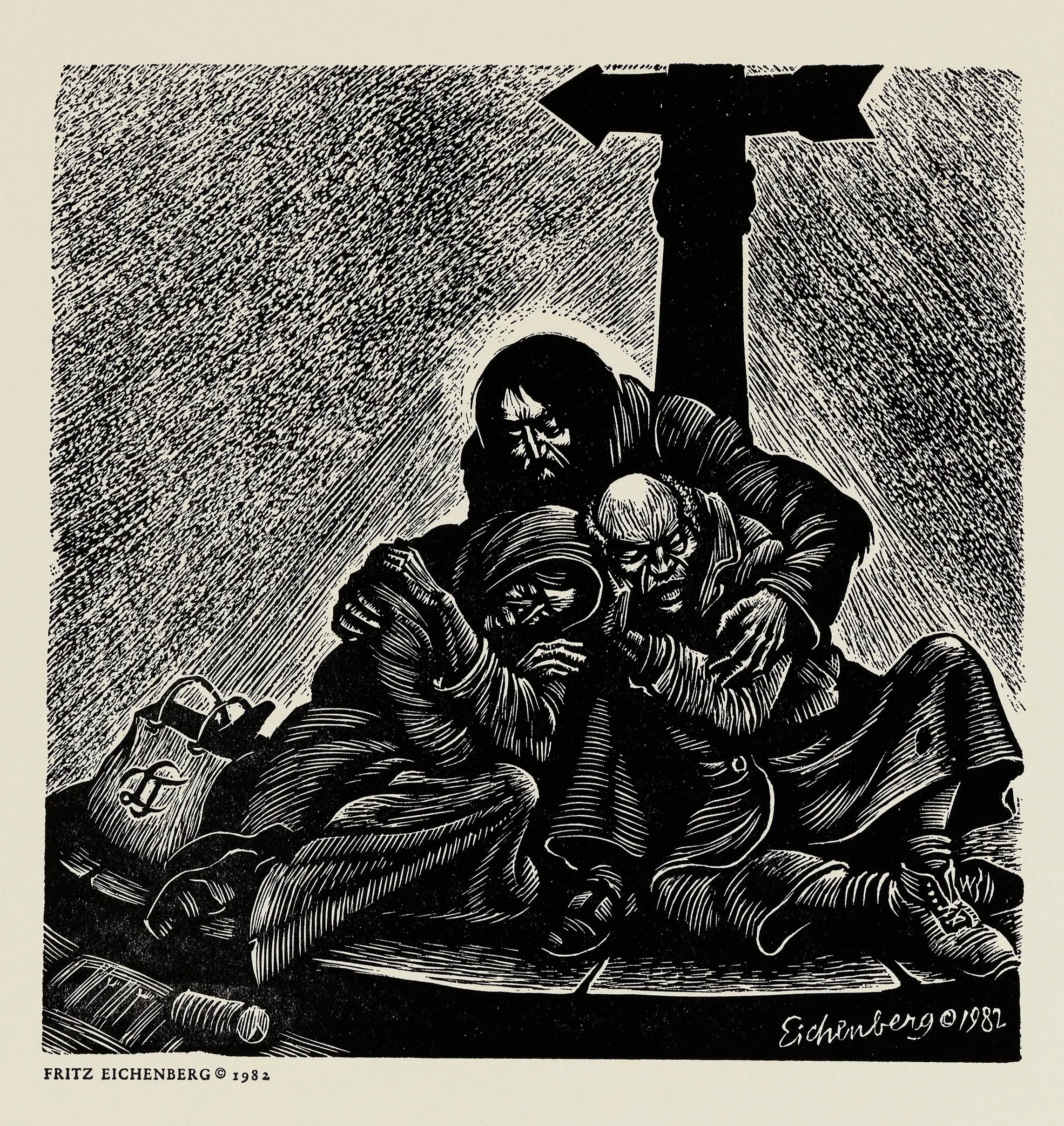
Fritz Eichenberg, The Christ of the Homeless; Portfolio of Illustrations by Fritz Eichenberg published in the Catholic Worker from 1949 to 1982 - Number x, 1982, Print on medium, slightly textured, cream paper, 16 15/16 x 13 in., Gift of Elizabeth O'Grady and Jeffrey P. Dwyer, Smith College Museum of Art, Northampton, Massachusetts, SC 2016.65.122.10