Part I of this interview can be found here.
AS:You observe early on that the main topic of the book is, in some ways, coded conservative. What’s your story for how that came to be the case, and should liberals or progressives—who, I take it, are your target audience—be concerned about this development?
AB: It’s important to realize just how recent the politicization of the question of children really is. As we wrote in an opinion piece for the New York Times, although “the family” as an idea and an institution has been coded conservative for some time, if you look at electoral politics, Democrats were not always so eager to cede the mantle of “family values” to the right. And we’re not talking just about how JFK spoke of the home as the “central unit” of American civic life. Bill Clinton attacked the Republicans for failing American families and campaigned with an “American Family Values Agenda.” So the sense that family-values talk is itself conservative is fairly recent (and even so, when it came to advocating for and defending gay marriage, many liberals and leftists appealed by necessity to the virtues of families.) The situation today is that the left will of course vigorously defend the right to abortion, access to contraception, and broader reproductive justice, but for the most part has shied away from weighing in on whether having children is a worthy project to begin with.
I think we should really worry about the left ceding this topic to the right. While there are certainly political aspects to having and raising children, it would be a tragedy if the very possibility of a human future were to become just another pawn in the culture wars. We may disagree about how to lead our lives, collectively and as individuals, but all but the most staunch of anti-natalists should be able to agree that we share a commitment to a flourishing human future. It's the details we disagree about.
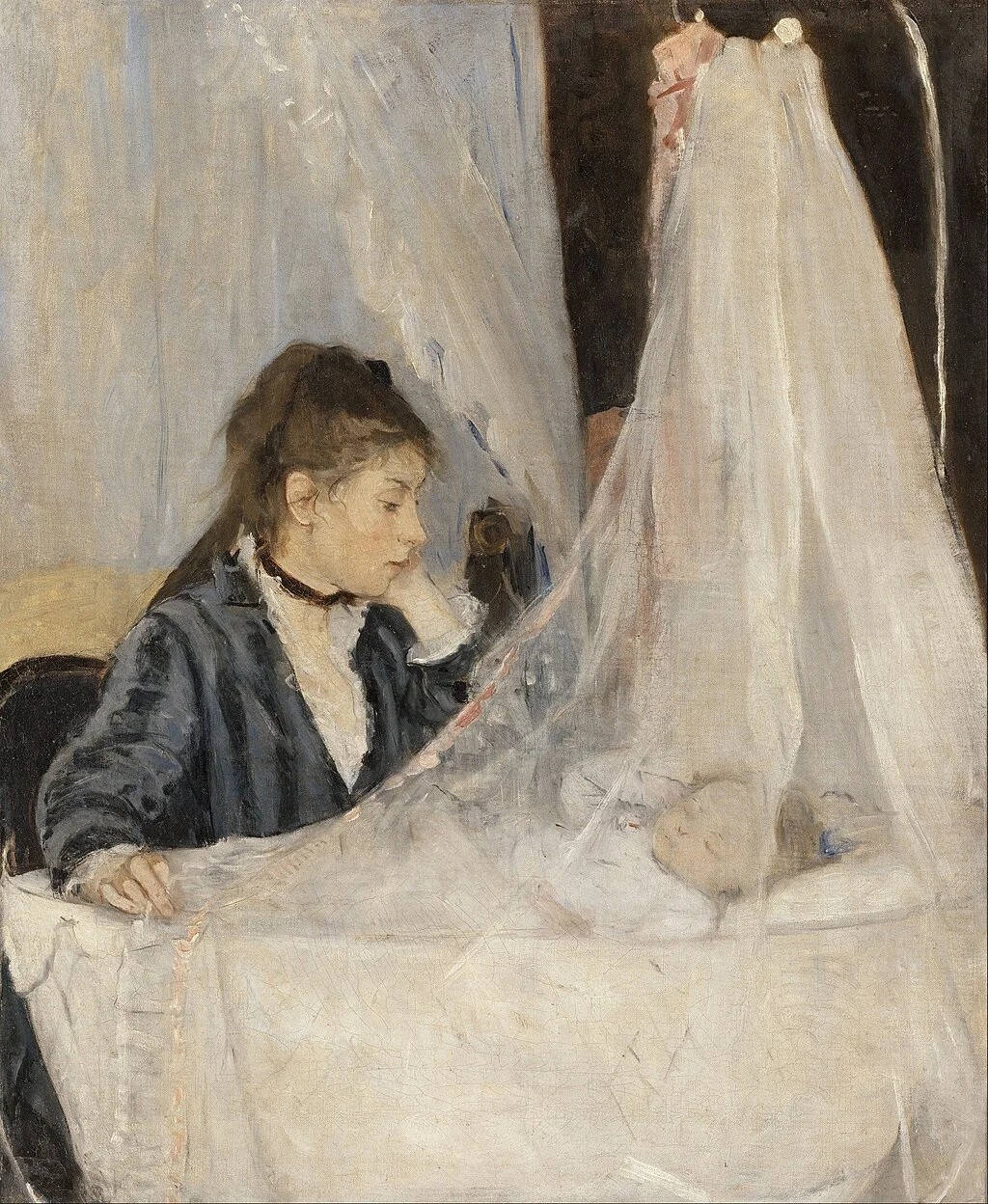
Berthe Morisot, The Cradle, 1872
AS: I was thinking about your book when listening to a recent NYT podcast—Ross Douthat’s interview of Noor Siddiqui, founder of Orchid, “a company that promises parents the ability to protect their future children through genetic testing for embryos before pregnancy.” I’m wondering if you’ve considered any of the ethical and moral questions that emerge with the arrival of such technologies? This seems to be connected in many ways to the constellation of key terms your book touches on—IVF, population ethics, and arguments about human suffering among them—but also different.
AB: Anti-natalist arguments come in two varieties. One of those is what we term the “Argument from Suffering,” and it’s the thought that human life is so full of pain and suffering that it is immoral to subject someone else—without their consent, no less—to this fate. And the moral case for genetically sorting and/or enhancing our children depends on this argument. This idea is grounded in the assumption that what a parent is responsible for in bringing a child into the world is nothing short of their entire well-being, the sum of everything good and bad that befalls them, over and above the actual causes of their suffering. This is understandable—how can we deny the pain a parent will always feel seeing their child suffer, no matter the cause—but ultimately it gets the responsibility of parents all wrong. What we’re responsible for as parents is not the sum of well-being of our children but preparing our children to meet life’s challenges, setbacks, losses and griefs as best we can. Imagine your child gets injured in a car accident because someone else was driving recklessly. Are you really in any sense responsible for this rather than the actual bad driver? This seems a little morally narcissistic to me! Or, better yet, imagine something wonderful happens to your child. They fall in love. Do they owe you gratitude?
Once you get clarity on this, the moral case for souping up your embryos becomes much murkier. Now, are most people who find the prospect of biohacking their embryos attractive motivated purely by this alleged altruism? I doubt it. But teasing apart the reasoning is clarifying because we can then grapple with the non-altruistic motives on their own terms.
If you push my argument to its natural conclusion, you might realize that it implies that there is no fate a human being can face that will render bringing them into the world immoral, and I think this is right. But it can be a moral failure to knowingly bring a child into the world and not be ready to address, in whatever way you can, the challenges they will face.
RW: I’ll add that these genetic testing start-ups pitch themselves as helping people wrest back some control over the immense uncertainty and contingency that go along with bringing a human into the world. But, as anyone who’s done IVF knows, there’s only so much you can control, in fertility as in life. You could have the most perfect-on-paper embryo, and it might not implant; the pregnancy might not make it to term. And if it does, that child will still get injured; they will still get sick; they will still experience heartbreak; they will still die. Trying to eliminate all suffering from life is a fool’s errand. And there’s something discomfiting about the assumption that the duty to shield one’s child from suffering—of any kind—begins before conception, for the ethical reasons Anastasia raises but also on a personal and practical level too. It raises the bar for entering into parenthood even more and rendering it even further out of reach for ordinary people.
AS: One of the things I really appreciate about the book was its return to what I would call “first principles.” I’m wondering, though: were you surprised that the shape of the book took you in the direction of making one of the most foundational arguments you can make—to affirm the goodness of human life?
AB: No, it was not a surprise, as this was always the germ and heart of the project, ever since its inception in the form of a short editorial for The Point’s issue on children. It’s a great question, though, because it reflects the fact that when you look at the book as a whole and see how much of it is dedicated to thinking through various hindrances to embracing the possibility of having children, the “return to first principles” can seem like just one element among many—a response to one specific challenge (the anti-natalist moral arguments). This isn’t wrong, but also in an important sense, it’s the very loss of this grasp on how to affirm the goodness of human life that makes possible or exacerbates all those other sorts of concerns. In part, opportunity cost is applied to the question of children because the goodness of human life is no longer taken for granted; people orient their romantic lives independently of their procreative aspirations because the goodness of human life is no longer taken for granted. If you think human life is good, and we should have a flourishing future, then that in itself can put in perspective the many challenges that we face when contemplating how pursuing having children would change how we lead our lives at present.
AS: One of the surprises about my own experience of parenthood in the 14 months since my son’s birth is just the way that my work—and life—has taken on more meaning because it feels not my own in some more substantial way (in fact, on many days not much seems to be my own!). And while I’ve had less freedom, the forms of freedom that I do have seem to be better. I’m making better choices because there are fewer of them; the experiences of freedom are more intense because they’re less frequent and more savored. Is the tension between the liberal and intersubjective less a tension and more like a mutual need, the texture of human life?
AB: Well, this is a wonderful question, I love the way you framed it and the idea that the tension between freedom as independence and an embrace of intersubjective dependence is essential to human life. The way I think about it is that the freedom that is truly befitting human beings is not the idea of freedom as complete independence, as if our highest aspiration is to have no meaningful ties, commitments, places where we belong. And I think that the freedom that befits human beings is one that is ultimately enabled by the right kind of relations between human beings, whether familial, romantic, social, or political. To give the simplest example, to be all we can be we require care and instruction, and those are diametrically opposed to the idea of freedom as complete independence.
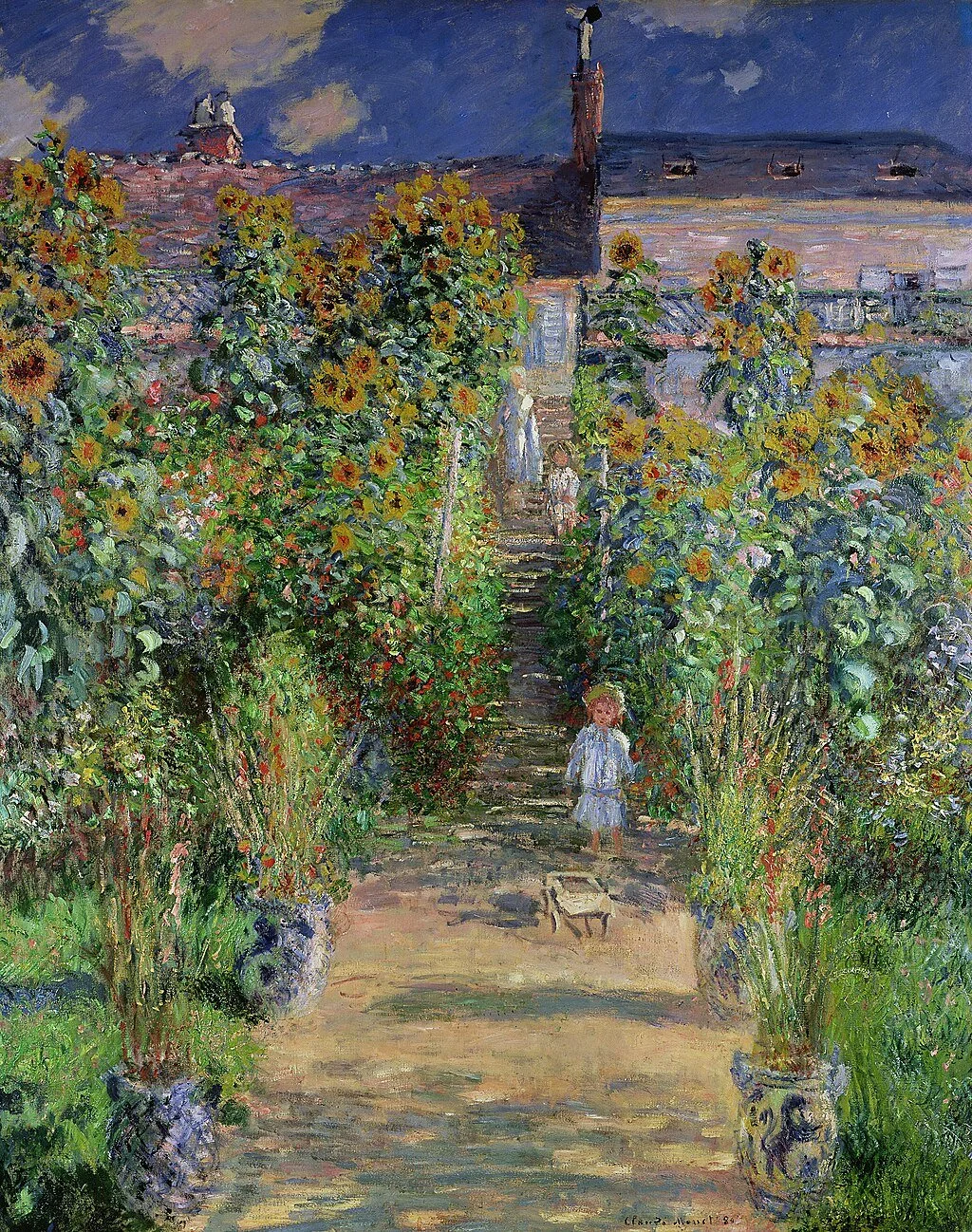
Claude Monet, The Artist’s Garden at Vétheuil, 1881
AS:It’s been a while since you wrote the reflective, personal essays that serve as introduction and conclusion to the book. Anastasia, I especially loved the anecdote about the old painter you overheard talking about his son and his concern for his son, not as a retirement plan, but as his reason for being: “What do I get up for in the morning…what do I live for if not for these worries?” And Rachel, I was moved by the way your family—particularly your relationship with your mother—figures into the analysis. Is there anything either of you would add to those reflections now, a year and a half on?
AB: The biggest thing I would add, and this is an idea I was fortunate enough to encounter fairly quickly after publication, is that you can argue, as I do, that parenthood might not be instantaneously transformative and that you don’t have to fear not caring about everything you cared about before or becoming unrecognizable to yourself. And yet, be open to the possibility of a kind of slow and gradual development of who you are over a long period of time. Whether we have children or not, we all evolve over decades. When my children are grown I might not be the same person I was when I had them, as I wouldn’t have been the same person at that point in time had I remained without them.
RW: In the introduction, I wrote about how the model of family I grew up with—though I had very loving parents and our home situation was always stable—wasn’t necessarily one I could confidently say I wanted to reproduce, nor did I have a good sense of what it would mean to create my own alternative. One of the most unexpected joys of becoming a mom has been that it brought me closer to my mother and father. I’ve come to appreciate their efforts and sacrifices in a new light. As we raise my son together, as a family, I’ve had to learn how to be a daughter all over again.
AS: And do you have any projects on the horizon that our readers might want to learn more about?
AB: Closely related to the book, one question we got a few times on the book promotion trail, especially from young people, was what, if any, duties children owe to their parents, in a secular context. Another is the question of whether the framework we develop can help us make interventions in debates about birth rates. We outline a response to the argument from evil—the idea that human beings are so selfish and rapacious that it’d be better if there weren’t any—and argue that if you can affirm goodness in your own life, however partial or compromised, you are in a position to see that it would be good were human life to persist into the future. But persistence can take many forms and at present we are facing a world that is likely to start shrinking, and fast, very soon. This raises the question of whether or not there’s anything ethically to lament in a shrinking population, abstracting from the logical conclusion of exponential shrinkage being ultimate extinction. My intuition is that while there is much to lament in people being unable to make a confident decision about whether or not to have children, it’s wrong to think about the absolute numbers as something we can ethically evaluate. It is not better to have ten human beings rather than five. And in fact, approaching the question of our future by thinking about how the brute number of people can be better or worse for welfare or utility—because more conducive to a social welfare scheme, or technological innovation, or whatever—risks reducing human beings themselves to just another material resource.
RW: A little orthogonal to our writing projects but still worth mentioning is our work with the Program for Public Thinking at the University of Chicago, in connection with The Point. We host events, workshops, and lectures on the University of Chicago campus, and this summer Anastasia will be co-teaching a fully funded two-week course for college students on the Good Life. Public Thinking aims to cultivate the next generation of writers and thinkers, helping them to develop the habits of mind and skills required to do thoughtful cultural criticism. It’s our hope that one outcome of the program will be that more intellectually serious interventions into the public conversation—of the sort we have attempted in this book—will be written and see the light of day.
AS: Many thanks for your time and energy! I am so deeply grateful.
AB & RW: The pleasure is all ours.
Anthony Shoplik is the Executive Editor at Genealogies of Modernity and a PhD Candidate in the English Department at Loyola University Chicago.
Anastasia Berg is an assistant professor of philosophy at the University of California, Irvine. She is an editor of The Point, and her writing has appeared in the New York Times, The Atlantic, the Times Literary Supplement, the Los Angeles Review of Books, the Chronicle Review, and elsewhere.
Rachel Wiseman is the managing editor of The Point. Her writing has appeared in the New York Times, The Atlantic, The Point, and the Chronicle of Higher Education.