An Ethics of Gesture in “It Was Just an Accident”
The twenty-first century, so far, could be defined as the era in which ubiquitous computation has truly collapsed the distinction between map and territory. This subordination of everything—the totality of the human, and non-human, lifeworld—to rational calculation is known as instrumentalization: a logic in which the complete colonization of space leads to the construal of every possible activity as a project, subjugated to the fulfillment of an end. Interrupting this logic is, therefore, a modern plight. An ethic that is averse to instrumentality animates the thought of contemporary Italian philosopher Giorgio Agamben and can be seen in Iranian director Jafar Panahi’s It Was Just an Accident, released in 2025. Through both formal and narrative components, Panahi lays the dynamics of this tension bare, displaying a gesture that short-circuits instrumentalization.
Art never exists in a vacuum. Contextual factors, such as time, place, and circumstance, always infiltrate the creative enterprise, contorting or even restricting the content of representational media. When facing production codes and the like, directors, like other visual artists, often experiment with the formal elements of their medium in order to express something that the content itself cannot abide. Formal experimentation elevates a work from the mundane to the critical. Of course, once experimental techniques are judged successful, they become popular. The avant-garde passes into kitsch, and the technique’s radicality is neutered as it is adopted by practitioners who merely want to borrow from the semantic cache of “experimental” without suffering from the pressures that originated it.
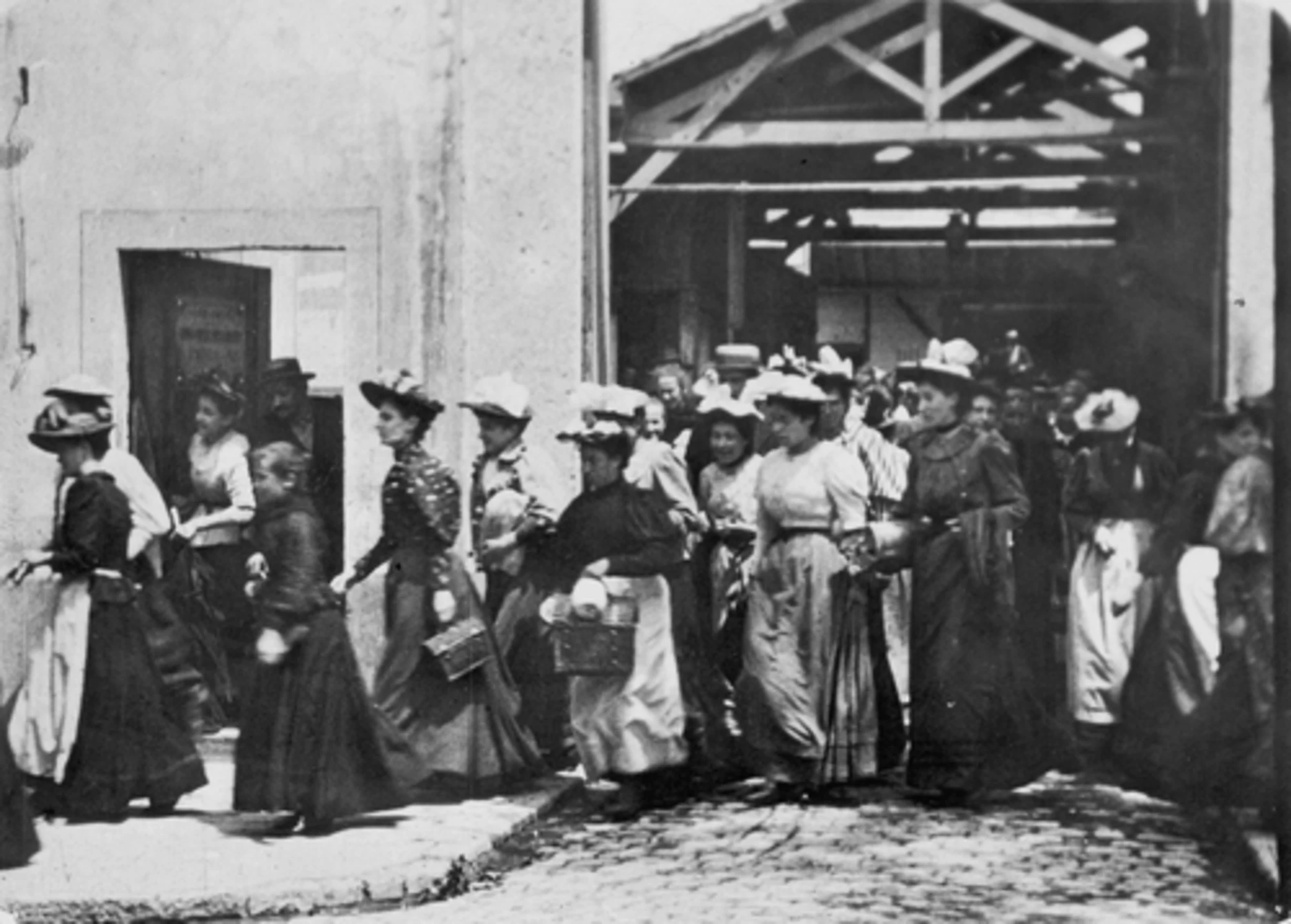
Louis Lumière, La Sortie de l'usine Lumière à Lyon, 1895
The oner, or long-take, is such a technique. A continuous, uninterrupted shot—dubbed seamless because it does not contain any of the usual cuts that we associate with conventional editing practices in narrative film—was born out of the necessity to capture a scene quickly. Fundamentally, a oner is the product of experimentation in response to restrictions: technical constraints, insufficient budget, limited means of access to a particular shooting location, or worst of all, politically motivated persecution (with the threat of prosecution) for filming at all.
Such was the predicament that dissident director Jafar Panahi faced in Iran while filming It Was Just an Accident. As the film opens, for nearly five minutes the camera itself does not move. Placed on the hood of the car as Eghbal (Ebrahim Aziz) drives his family down a deserted road late at night, the camera does not react until Eghbal unintentionally hits a wild dog, stopping the vehicle before exiting to remove the dog from the street. The camera then tracks his movements without ever changing the angle of the shot: Eghbal is, consequently, out of frame during some of the action. This incident forms one part of the titular accident that drives the film’s narrative. Car trouble ensues, and Eghbal happens upon an auto shop wherein he is unknowingly recognized by a mechanic, Vahid (Vahid Mobasseri), as having been an intelligence officer whose cruelty during interrogation and imprisonment left Vahid permanently scarred. Vahid proceeds to follow Eghbal home, kidnaps him, and then prepares to execute him. The tension of the film results from Vahid’s uncertainty about Eghbal’s true identity, since the latter denies the accusation of having ever been an agent of the state. Over the course of the following day, Vahid must seek out former captives and associates in the hope of establishing a positive identification, so that killing Eghbal will constitute justified retribution. Vahid’s odyssey throughout the film is a kind of memory work, an active process of recollection in which Vahid must confront the historical reality of an injustice suffered, and how to resolve the affliction and move forward ethically, in a state with no judicial recourse.
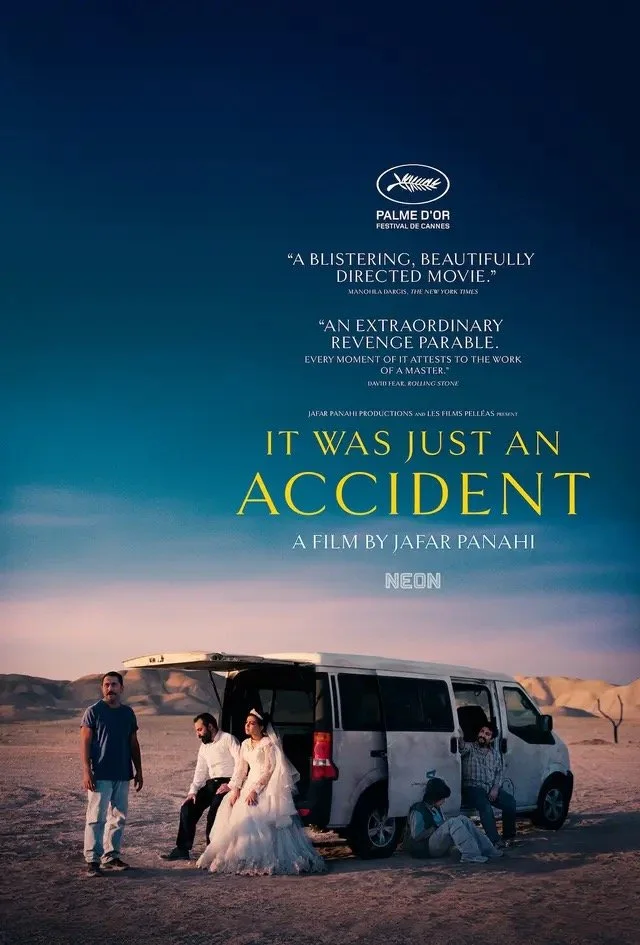
Official poster for It Was Just an Accident (2025). Jafar Panahi Productions / NEON
Ethics and aesthetics converge here to produce a political gesture: violence is an instrumental means to achieve a particular end, and cinema is a commercial product for entertainment. The logic of both is interrupted by Panahi, and in the process, a crucial concept proposed by Agamben is put on full display.
Agamben’s thinking on matters of ethics is informed by a classical distinction introduced by Aristotle. In the Nicomachean Ethics, Aristotle writes: “For production [poiesis] has an end other than itself, but action [praxis] does not: good action is itself an end” (VI.5 1140b6-7). Both production and action adhere to the values of intention and purpose. Production follows a linear path from intention to desired outcome, while good action, like a line that curves back on itself to form a circle, is carried out for its own sake. For Agamben, the characteristic feature of modern society is governance in accordance with a technologically orchestrated means-end logic that permeates every aspect of life. From Fordism to statistical rendering, from optimization protocols to efficiency mandates, everything runs in service of streamlining an appropriate use of means in order to accomplish a preordained end. The only way to interrupt this logic, for Agamben, is to act without a goal, to endure within the activity of action by suspending the motivating elements of intention and purpose. A thinker deeply committed to the idea of historical rupture, Agamben views a resuscitation of Aristotelian praxis as inapposite within prevailing material conditions; it is therefore inviable as an ethic—an ulterior construction is necessary. Not an end in itself, then, but an affair of pure means. Means restrict ends, like pathways through a dense forest; but ends determine means, like the unalterable destiny of an unavoidable destination. Means are the tools by which ends are enacted, the subordinate function, the only real variable in the ethical equation. These must be wrested away from their instrumental service in order to create alternative uses. To resist instrumentality, you cannot free ends from means, you must release means from ends. An appropriation of Immanuel Kant’s infamous definition of aesthetic judgment: a “purposiveness without purpose.” Agamben’s term for this kind of ethical endurance is gesture.

Gilles de la Tourette, Études cliniques et physiologiques sur la marche: la marche dans les maladies du système nerveux, étudiée par la méthode des empreintes, 1886
Paradoxically, a gesture, in Agamben’s formulation, is a vital suspension of activity (or praxis) that opens up new possibilities for creation (poiesis), returning to the oner. Cinema is the medium of moving images, and images are instants, or slices of time ripped from the continuum of life as it is really experienced. When these discrete images are reassembled and reanimated cinematically, the continuum of life is observed at one remove, and the spectator is confronted with life as an object of experience. The vulgar Marxist would call this reification. But, for Agamben, this principle of reanimation is what separates cinema from the other fine arts. When continuity editing is interrupted by subtracting the familiar cuts from a scene in a film, the spectator takes on an awareness of the film as mediating between these two realms of life, the filmic and the experiential. The act of mediation itself is brought forward. Formal experimentation in cinema, in other words, is itself gestural for Agamben. The oner technically enacts the gestural insofar as it foregrounds pure filmic mediation—recording and observing—without the weight of a productive aim.
The penultimate scene of Panahi’s film is another oner. Vahid and his compatriot, Shiva (Mariam Afshari), herself a former victim of both physical and structural violence perpetrated by the IRI, have a blindfolded Eghbal tied to a tree as they attempt to compel his confession. The camera is static throughout the entire thirteen-minute sequence, mirroring the height of Eghbal as he sits with his back to the tree, while Vahid and Shiva move in and out of frame, verbally berating him. The oner draws attention not just to itself, but to the fact of the continuum reproduced on screen. Through ecstatic pleading, Vahid and Shiva seek a confession that will not, that constitutively cannot, bring about any sort of resolution, existing as they do in the shadow of a regime whose tyranny remains pervasive and unaccountable. Their decision, ultimately, not to kill Eghbal is ineffective in the precise sense in which the oner is: by interrupting the means-end logic of instrumentality, both the film and the gesture open up a possibility for difference, to see and to be differently. An act of resistance in the face of a totalizing logic that is neither subversive nor apathetic, but entirely reflexive and interruptive.
In a Christian context, the act of mediation derives from the ultimate intimacy of the Trinity and extends to the profane through Christ’s role as the Word becomes flesh. Caritas. It is not wholly inaccurate to read Agamben’s sense of gesture as a secularized (although, profaned would be more technically precise) conception of pure charity, without program or ulterior design, but a mere—and for that very reason, preeminent—deactivation of the law through grace. For Agamben, however, love as gesture cannot be a duty carried out as a pliant response to the command of sovereign authority, or else it loses its potential to lay the very act of mediation bare, and risks falling back into the stream of instrumentalization. The oner makes no claim upon the viewer’s attention, the gesture holds out no expectation for a desired outcome, and love has no demand. Deactivation, ineffectiveness, and mediation are the sources of an ethos worthy of the name.