Monstrosity and Modernity
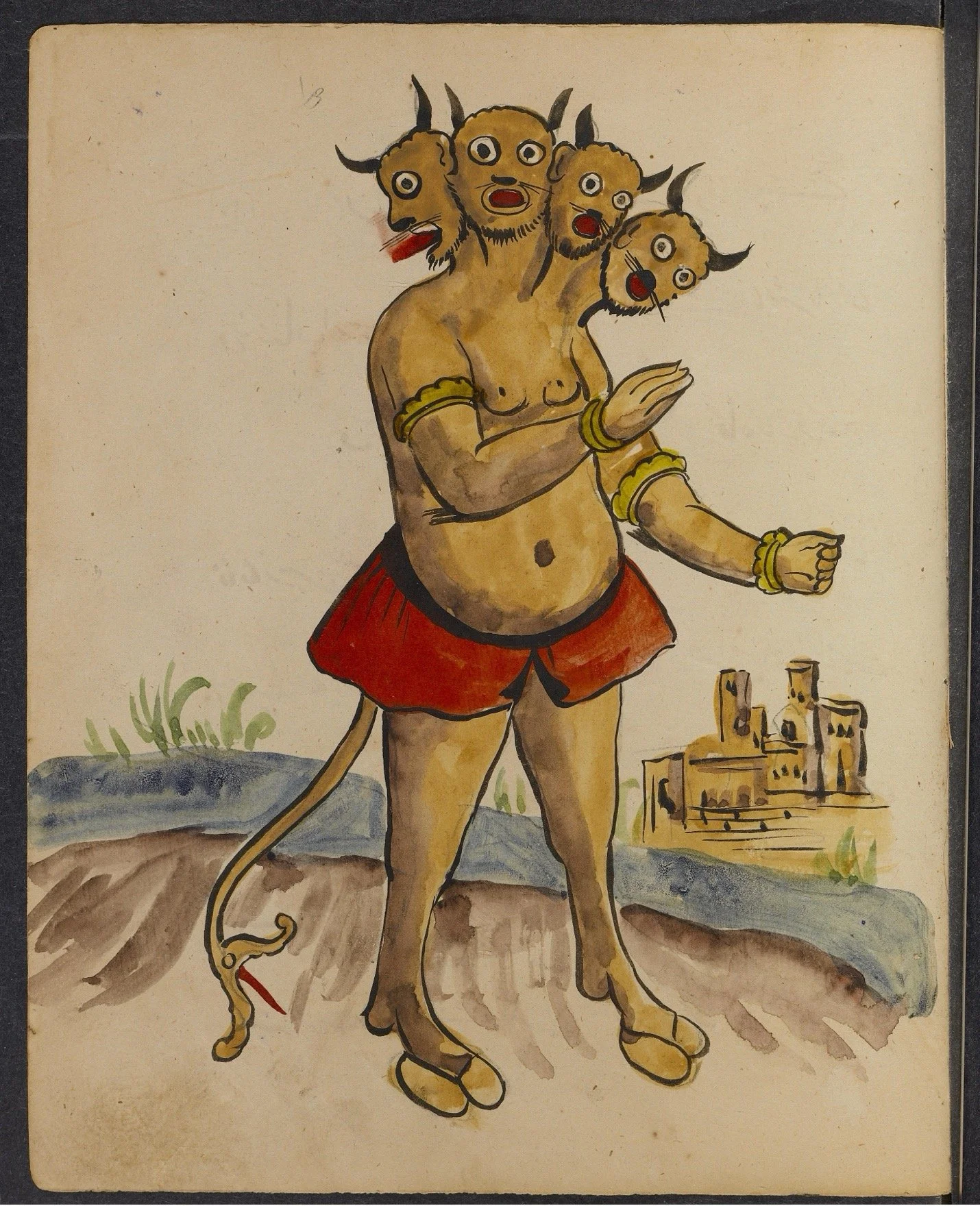
An illustration from an early twentieth-century Persian copy of Kitab-i Aja’ib’i Makhluqat (Wonders of the Created)
When talking about monsters and monstrosities, a certain delimitation is necessary from the outset because of the monstrosity of the category itself, into which a very large number of phenomena can be smuggled. I will thus keep the discussion to three types.
The first type is what I will call, à la Michel Foucault, “human monsters.” Conjoined twins, hermaphrodites, and bestial humans (that is, humans with animal features, like Joseph Merrick, a.k.a. “Elephant Man”) are prime examples. The reason such individuals were seen as monsters from antiquity through well into the twentieth century is their conflation of realms—human and animal realms, for example—and their confounding of civil and religious law alike. How many times should a conjoined twin be baptized? Would hermaphrodites inherit as men or women? Will a pig-man have human rights?
The second type of monstrosities includes marvelous and extraordinary occurrences, such as a virgin maiden in the seventeenth-century Ottoman Empire who, after being swallowed by an elephant and then spit out after some hours, gave birth to a baby elephant, or Mary Toft who in England in 1726 apparently gave birth to seventeen rabbits through the power of her imagination alone, or the emergence of the pope-ass from the muddy detritus of the Tiber River after flooding in 1495.
The third type is what might be termed the supernatural, including vampires, ghosts, resurrected corpses and skeletons, possessions, demons, and spirits. Such phenomena are often classified under the rubric of monstrosity because they violate the fundamental categories of secular human experience: the dead and the living, the past and the present, the animate and the inanimate, and so on.
What is common to all three forms of monstrosity? Historically, human monsters were often perceived as God’s or nature’s creative work, which the human mind could not necessarily comprehend. As such, they were treated, especially in the Islamic tradition, with caution and care. They were also seen as divine omens or warnings, announcing God’s wrath upon earth or even the apocalypse, resulting directly from collective, institutional, or individual sinfulness and corruption. As Arnold Davidson suggests, the horror associated with monsters is not only the horror felt at the sight of them but also the horror that issues from the monstrous circumstances that beget them: the corruption of the church, a pregnant woman dreaming of or imagining animals or demons, and copulation against nature (say, between a human being and an elephant). Yet, most importantly, there is one overarching theme that connects the three. Monsters upset the secular humanist’s taken-for-granted distinction between divine, human, and animal realms, or, perhaps more accurately, between supernatural, cultural, and natural spheres.
I am interested here in what has happened to monsters in the wake of modernity. The study of monsters is quite limited in its ability to aid us in pursuing such a question. This owes first to its transhistorical orientation and second to the prevailing secularity not only in this field but also across the humanities as a whole. In what is widely regarded as the foundational text of “monster studies,” Jeffrey Jerome Cohen takes monsters to be reflections of cultural anxieties and fears. The emergence of a monster is always linked to the borders, boundaries, categories, and limits of the society that produces it. A society creates certain kinds of monsters because its racial, gender, and religious makeup is threatened, so, in response, it “monsterizes” (dehumanizes) what it deems to be a threat to gatekeep or reestablish its borders. The monster is thus assigned the permanent role of the other, the limit, or the constitutive outside. In more nuanced, historically inclined works, which I think might be titled “contextualist,” monsters are seriously engaged, but overwhelmingly, as folkloric elements and myths inherited and surviving from the past, which usually gain greater momentum and traction in moments of social, political, and economic crises. At times, this approach is content to offer insights into a specific folkloric and cultural tradition; at other times, its thick descriptions (e.g., vampire lore in seventeenth-century Wallachia) give way to philosophical anthropology (e.g., mythmaking/storytelling is human nature).
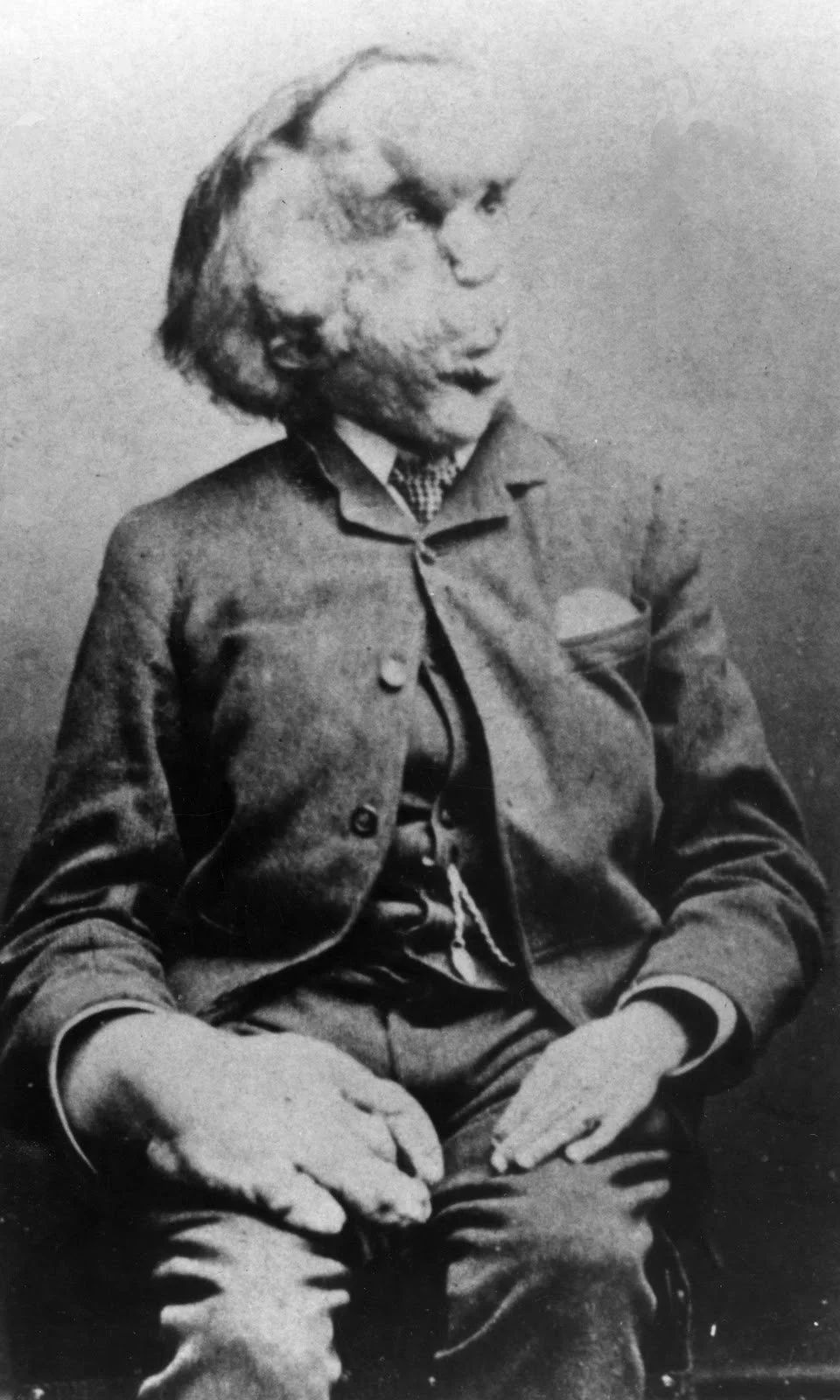
Photograph of Joseph Merrick, c. 1889
The last kind of approach to monsters is what I call “historicist.” I use the term to refer to inquiries into the historical conditions of possibility of the object of analysis with an eye to the alterity of the past. Examples include Foucauldian genealogies, new historicism in literary studies, certain versions of postcolonial theory, and historical ontology/epistemology in science studies. In addressing the relationship between modernity and monstrosity, historicism offers us a series of compelling accounts. The historicist work is likely to argue that modernity brought about the domestication, naturalization, and disenchantment of monsters, often in the form of a critique. For example, as Georges Canguilhem suggests, human monsters were stripped of their divine and natural confusions with the emergence of sciences like teratology and, later, embryology and anatomy. Monstrosities could now be explained as congenital deformities and maldevelopment or arrested development in fetal formation. The occurrence of monsters is thus alleged to be much rarer now, because preventive measures can be taken and/or parents might decide not to bring the fetus into the world. Furthermore, with modern scientific and technological means, one can even experiment with monsters by producing them in laboratories.
The modern distinction between imagination and reality also eliminates monsters that were previously thought to come into being through the imagination’s outward, visible effects on the body. Dennis Todd argues that Mary Toft’s hoax of giving birth to seventeen rabbits created such a stir because, at the time, it was widely believed that a pregnant woman’s imagination could affect her body and fetus. This distinction also enabled the process of fictionalizing monsters in the Gothic novel, in which the reader/consumer assumes monsters’ unreality. In Formations of the Secular, Talal Asad notes that the notion that modernity is an experience of “disenchantment” is “arguably, a product of nineteenth-century romanticism, partly linked to the growing habit of reading imaginative literature—being enclosed within and by it—so that images of a ‘pre-modern’ past acquire in retrospect a quality of enchantment.” Thus, modernity/disenchantment gave monsters a sense of premodern superstition and turned them into a pastime of reading fiction.
Likewise, the emergence of psychological sciences, including psychoanalytic discourse, linked monsters (especially the supernatural type) to childhood traumas and uncanny experiences, carried into adulthood through the unconscious and remaining repressed until their return. This dynamic was also mapped onto societies and peoples, and the ones that preoccupied themselves too much with monstrosities were considered stuck in the childhood phase of civilization. Modernity thus claims superiority over earlier ages in terms of its alleged elimination of monsters and monstrosities through science, disenchantment, secularism, rationality, and progress. Historicism, then, is a critique or problematization of this claim to superiority.
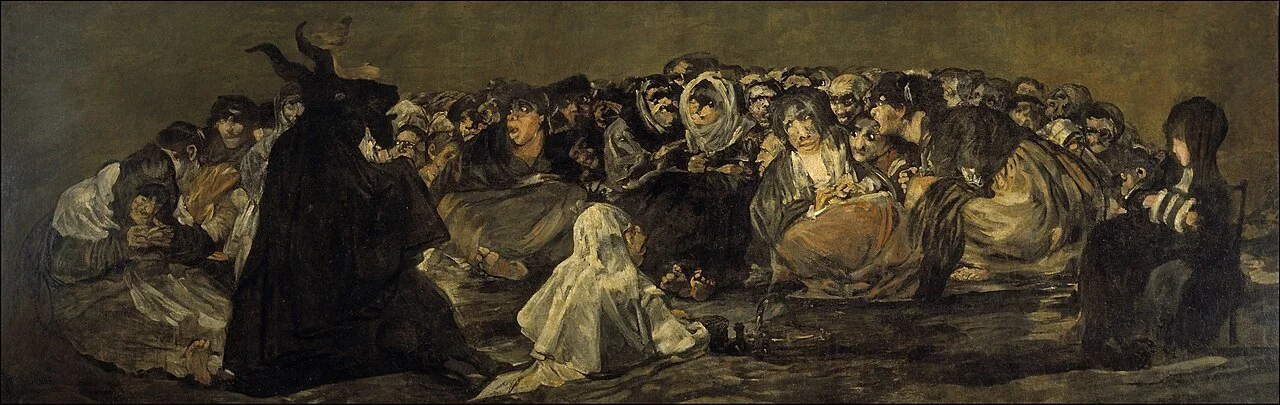
Francisco Goya, Witches' Sabbath (The Great He-Goat), c. 1821–1823
Let us recap. The monster studies approach treats monsters merely as cultural signifiers. Monsters always reflect something other than themselves or their “bodies.” To put it rather bluntly: if someone claims to have an encounter with the undead, it must be a symptom of social and cultural, if not individual, crisis because there is no such thing as the undead. The contextualist approach situates monsters as folkloric elements and myths within their contexts rather than making claims about monstrosity as such. In contextualist work, whether ethnography or microhistory, monsters appear as elements of a belief system. The first approach is transhistorical: monsters were cultural others in antiquity and remain so in modernity. In other words, modernity and/or historical change is not a question. The contextualist may, in principle, attend to the question, but their analysis is essentially myopic and synchronic, focused on a particular sociocultural context. Furthermore, both approaches are fundamentally secular in that they cannot deal with the existence of vampires beyond cultural signifiers or metaphors like bloodsucking capital, nor the possibility of a human monster emerging out of a divine creativity, omen, or wrath. Historicism seems to be the only one that responds to the question of monsters in modernity. In a nutshell, its response is that modernity erased monstrosity. Yet it reiterates modernity’s self-identification as a radical break, though in a negative/critical light: the premodern was populated by monsters, while the modern stripped itself of them—a stripping viewed not as a progress or triumph of reason but rather as an experience of estrangement or an act of (colonial) eradication. Such a take often ends up proposing two incommensurable historical ontologies, epistemes, or cultural worlds, eventually sounding like an elegy for a long-gone monstrous world.
Have we ever been modern? Bruno Latour answers the question with a “never” by showing that the modern distinction between nature and culture has never actually taken hold. Yet this seems trickier in our case because, after all, how can we “show” monsters, chimeras of “supernatureculture,” to borrow Mayanthi Fernando’s coinage? But at least we can recognize that the nature/culture divide, which is the condition of possibility for the human at the center of the world, misses an element. Maybe we need to tackle a tripartite divide between culture, nature, and supernature. By refusing to be shown, monsters show that our critiques should target not only the process that turned nature into a mute object at the disposal of the human, but also the correlative process that reduced divine and supernatural forces to superstitions of the past. Then, perhaps, monsters can show, but, as Jacques Derrida has it, cannot be shown: “A monstrosity can only be ‘mis-known’… misunderstood. Monsters cannot be announced. One cannot say: ‘Here are our monsters,’ without immediately turning monsters into pets.”