Love Letters from the 51st State
A certain kind of American madness characterizes the Upper Peninsula (U.P.) of Michigan. You see it all over the U.P.’s history. Its early missionaries had to ride ice floes to get from one place to another. Its parishioners burned down their local cathedral out of devotion to an unjustly reassigned beloved pastor (the bishop brought him back after the arson). It’s an area with multiple websites, Facebook groups, and subreddits dedicated simply to maps that omit the very fact that it exists. Perhaps it’s not surprising that such a place would foster so much loyalty from those who live there, its U.P.-ers/Yoopers, whose pride in being the 3% of Michigan’s population who live on a peninsula almost 30% of the state’s size shines especially in the perennial calls to secede from lower Michigan and form America’s fifty-first state: Superior.
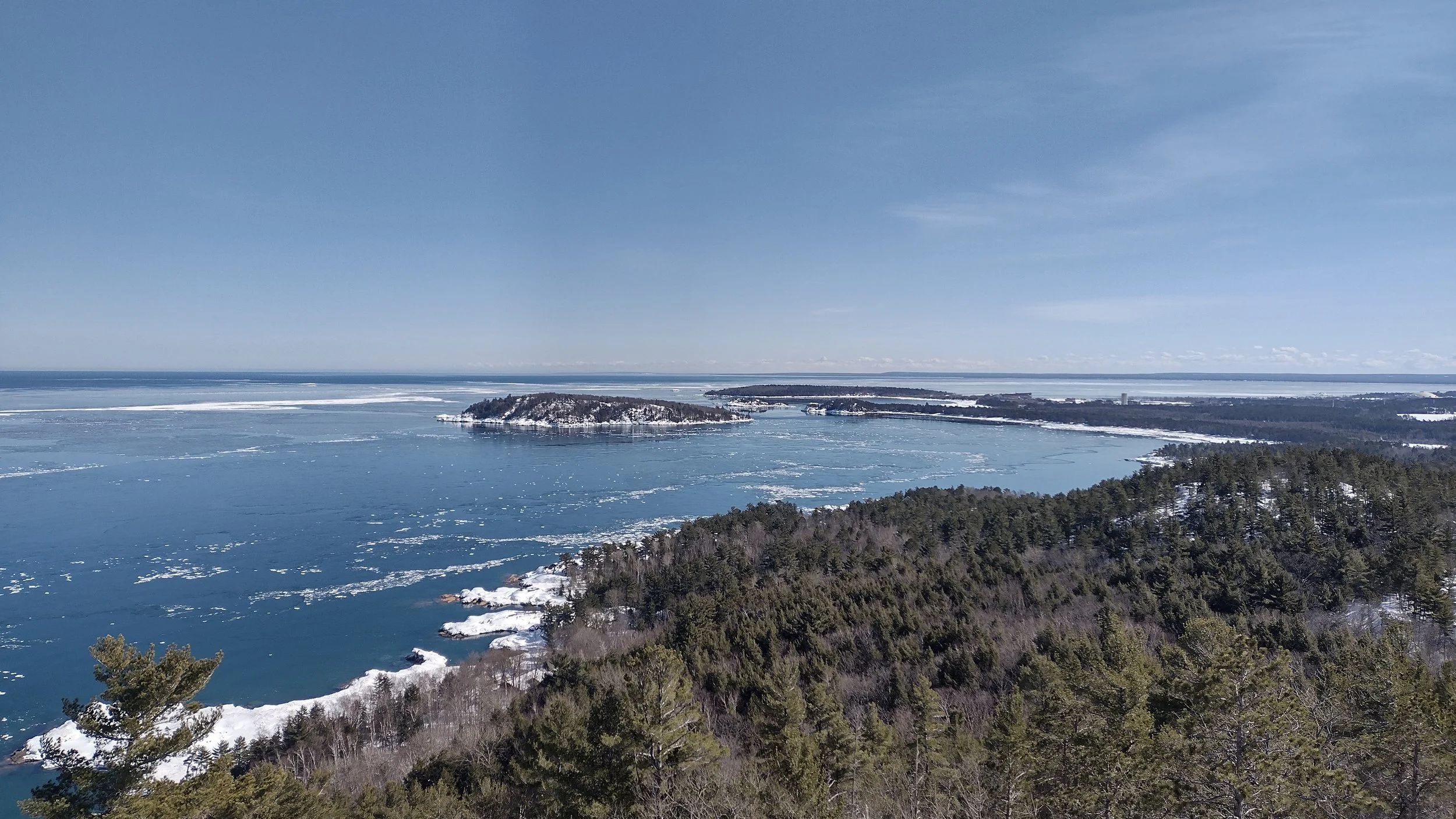
View from Sugarloaf Mountain in Marquette, MI. Photo by author.
That idea seems insane, until you actually go there. Then it all makes sense. The Upper Peninsula is a place that simply doesn’t fit in with any other state. Maybe it’s the trees, the quiet, the breeze off the lakes, the endless miles of lakeshore, the clarity of the water, or the wild turkeys in the parking lots, but there’s something about the U.P. that makes you feel like you can breathe again, or rather, let out a breath you didn’t even realize you were holding in. It feels like being on the frontier—except that you can appreciate the U.P.’s beauty without feeling like it’s always trying to kill you. It’s the kind of place that could drive you mad with love.
Some medieval and Renaissance scholars have posited the idea of “porous individuality,” one of the ways pre-moderns understood their place in the universe: “the porous self is the self open to the influence of God, cosmic or astral influences, spirits, angels, or demons.” Historians mostly deal with this view of the human subject as it relates to “diabolical possession alone,” but as philosopher Josef Pieper notes in his essays on Plato and divine madness, the divine can break into our lives at any moment and carries with it an awesomeness that trivializes demonic power. Even the least materialist of ancient philosophers believed that there were physical places the gods marked out as sacred, lands beyond the scope of individual temples or shrines in which the boundaries between the natural and supernatural became thin. The UP is one of these “thin” places, a place of snowshoe priests and stigmatists.
Many have tried to represent accurately this spiritual dimension of the Upper Peninsula. Indeed, the giants of American literature seemed quite taken with the U.P.: Hemingway’s “Big Two-Hearted River” takes place in Seney, a half hour away from the Pictured Rocks, where Longfellow set his Song of Hiawatha (though only he and Gordon Lightfoot still unironically call Lake Superior Gitche Gumee). James Gatz of North Dakota eked out a living as “a clam-digger and a salmon-fisher” outside Ironwood before a millionaire’s arrival propelled him towards becoming Jay Gatsby. But these literary giants only ever toured the U.P., using it as a setting. Other depictions of the U.P. and its environs are plentiful but metaphysically lacking, a grab bag of hard-boiled mysteries, small-town romances, a book that inspired a legendary Jimmy Stewart performance, and young adult lit whose high-school detective protagonist is a “biracial, unenrolled tribal member” who “never quite fit in.”
There’s only one artist I know of who’s been able to capture how and why the U.P. can open one up to divine madness: Jim Harrison. Harrison wasn’t a native Yooper, but he spent significant time on the peninsula, fishing in the same Fox River as Hemingway. Though he won a Guggenheim Fellowship, a Saturn Award, a Mark Twain Award, was a personal friend of Anthony Bourdain, and had a few movie adaptations made of his 1979 “Legends of the Fall,” Harrison never broke into mainstream success domestically. He did achieve literary fame for his poetry, novels, and epicurean lifestyle in France, the last of which he commemorated in a New Yorker piece about a 37-course lunch he ate in Burgundy.
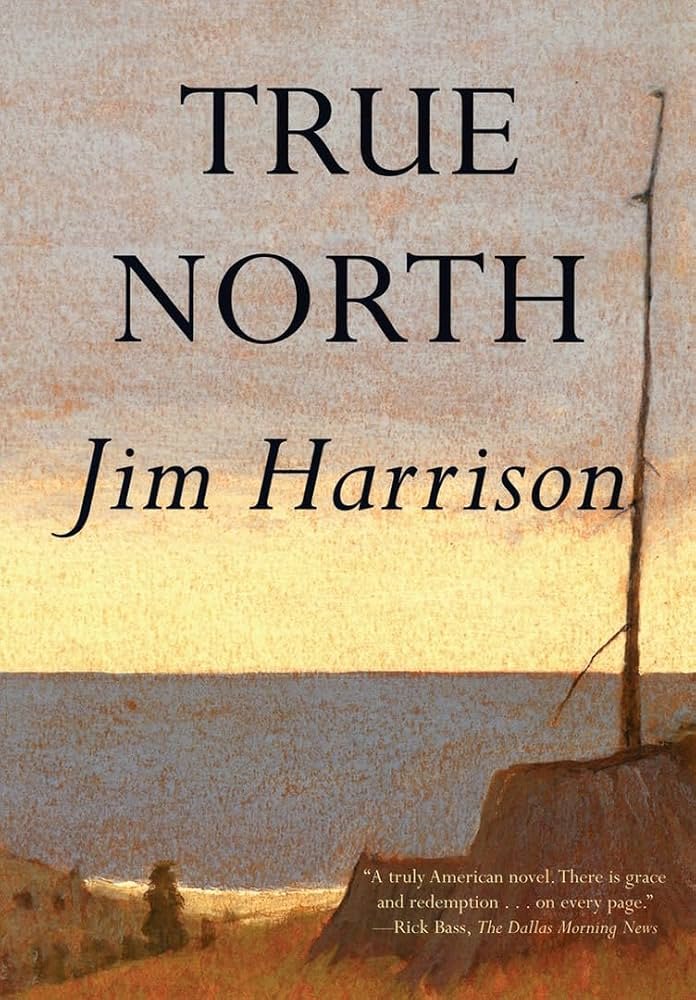
Cover of Harrison’s novel.
But in America, his “biggest selling book” was his 2004 True North, a decades-spanning epic set mostly in and around the U.P.’s largest city, Marquette, with some detours. Indeed, the novel starts in medias res in Mexico, with a Cormac McCarthy-esque prologue: “Father was wailing. I deduced from the morning sun and moving flotsam that we were drifting southward with the force of an unknown current.... Both his hands had been severed at the wrist and the stumps had been tightly bound with duct tape.” Not quite the opening you’d expect, especially when you turn the page to find yourself thrust into the autobiography of David Burkett IV, ex-theology student and scion of a family of lumber barons. The Burketts are slowly decaying in the city their ancestors built at the expense of the environment and native and immigrant workers.
Harrison traces how over the course of more than twenty years Burkett’s disgust for his family, especially the evil his father incarnates, manifests in an obsessive attempt to historicize its evil—a practice reflective of “critical genealogy.” Burkett wants to write the definitive treatise on the social, environmental, and human damage his relatives have imposed on the Upper Peninsula and its people, in part because he worries that this evil is bound up with his own being. Burkett’s father, David Burkett III, casts a long shadow over his son’s life and is the primary motivator behind this genealogical quest. David Jr. fears his father’s life will become his own fate, as David Sr. falls headlong into alcoholism and sex addiction, vices which his son feels tempted towards.
But Harrison is too good of a writer to belabor the mimetic elements behind this inherited name, remarking as early as the first page of the first chapter that “this naming process is of no particular interest except to illustrate how fathers wish to further dominate the lives of their sons from the elemental beginnings.” Burkett knows his father plays an outsized role in determining the arc of his life—his entire task is a long retort against David Sr. But when there is so much evil in your bloodline, so much evil in your immediate family, that it feels like a substantial presence in history looming over your entire life like a Damocletian sword, David’s refusal to give up his task becomes almost logical. He must solve the problem of his ancestors, or he will never be able to live.
David finds the gravity of his family’s ecological sins especially irresistible. He must contemplate them endlessly even as he repudiates them. As he remarks, years into his genealogical study of his lineage’s evils, “I came upon a sentence in a treatise that reported, ‘In 1923 Michigan realized it had to deal with ten million acres of stumps.’ I threw the book against the far wall of the den…what the fuck could this sentence possibly mean? ‘The west had to deal with the absence of seventy-five million buffalo,’ would be another version.” Tracing out the area on foot where his family’s lumber company would have worked, Burkett finds a tragic “stump shrine” in the U.P.’s woods, a remnant of his family’s deforestation, “the grandest collection of white pine stumps that I had ever seen. They were simply immense, with several so large that three men with hands joined couldn't have encircled them.” Among them is “the great mother of stumps, straddling the gulley like a ten-ton spider supported by roots so massive I couldn't get my arms around them. I scrambled around to the other side and there was an opening large enough to crawl in…I was enthralled, and there was a distinct feeling similar to when I had been baptized. I thought that this was as close as I could come to finding a church for myself in our time.”
Harrison’s own pantheism and nature worship shape Burkett’s encounters with religion, which skew decisively gnostic. Forwarded The Gnostic Gospels by his uncle, Burkett encounters “a form of Christianity where the church was not allowed to become a remote and dictatorial parent.” He finds a Jesus who preaches apparently mind-blowing truisms like “if you bring forth what is within you, what you bring forth will save you. If you do not bring forth what is within you, what you do not bring forth will destroy you,” and spiritual practitioners who recommend one “abandon the search for God and creation and other matters of a similar sort. Look for him by taking yourself as the starting point…if you carefully investigate these matters, you will find him in yourself.” Burkett finds this theology the most compelling he will ever encounter, the most real version of Jesus he ever sees.
This is Harrison at his most frustrating. He accurately sees something about the U.P. that even masters like Fitzgerald and Hemingway consign to scene setting. Likewise, David is right to connect his father’s interpersonal evils with his family’s environmental destruction, both of which reduce creation to utility. But Harrison is wrong to have Burkett self-flagellate for seeing the problem of his family’s evil so myopically—especially when he expects us to empathize with Burkett’s gnostic solution, which relies on an equally myopic view of good. For Harrison, God is in the stumps of the U.P., literally, but also and especially in ourselves. The universe divides into good and evil forces, with the earth tending towards the former and human beings tending towards the latter, only able to become good through raw willpower. Some never do and their genealogies become infected, requiring a complete repudiation of the cancerous past to begin again. The difference between the two David Burketts becomes one of will rather than anything else, the will to see the U.P. as a place that possesses a certain kind of transcendent glory or one that can be used as a means to an end. (In neither case are nature and human beings truly part of the same creation; for Senior and the David Burketts before him, nature is for his own comfort, whereas for Junior it is a sacred thing that must remain untouched.) What is the ultimate source of healing and grace? The power that we white-knuckle out of ourselves through our own self-actualized, Pelagian efforts, inspired by the words of the gnostic guru Jesus Christ.
True North critiques David Sr. for failing to see that the white pine tree stumps are the closest thing that could ever exist to a true church—except for the simple fact, which both David, Jr. and Harrison miss, that a stump is not a church. It’s a stump. To confuse one for another is to lose what a tree is—with all its unique and particular beauty disclosed through its being a tree—and to obscure the capacity of the tree to tell us something about its Creator in a way that only it can. That does not mean that the tree is in itself divine. The natural points to the supernatural without being the supernatural. To miss that point is to lose sight of the actual meaning of the tree in front of you, which demands a different loving response than a church does or than human beings do or than God does. True North’s pantheistic religious vision refuses to let nature be what it is, because nature must be God rather than simply reflective of him.
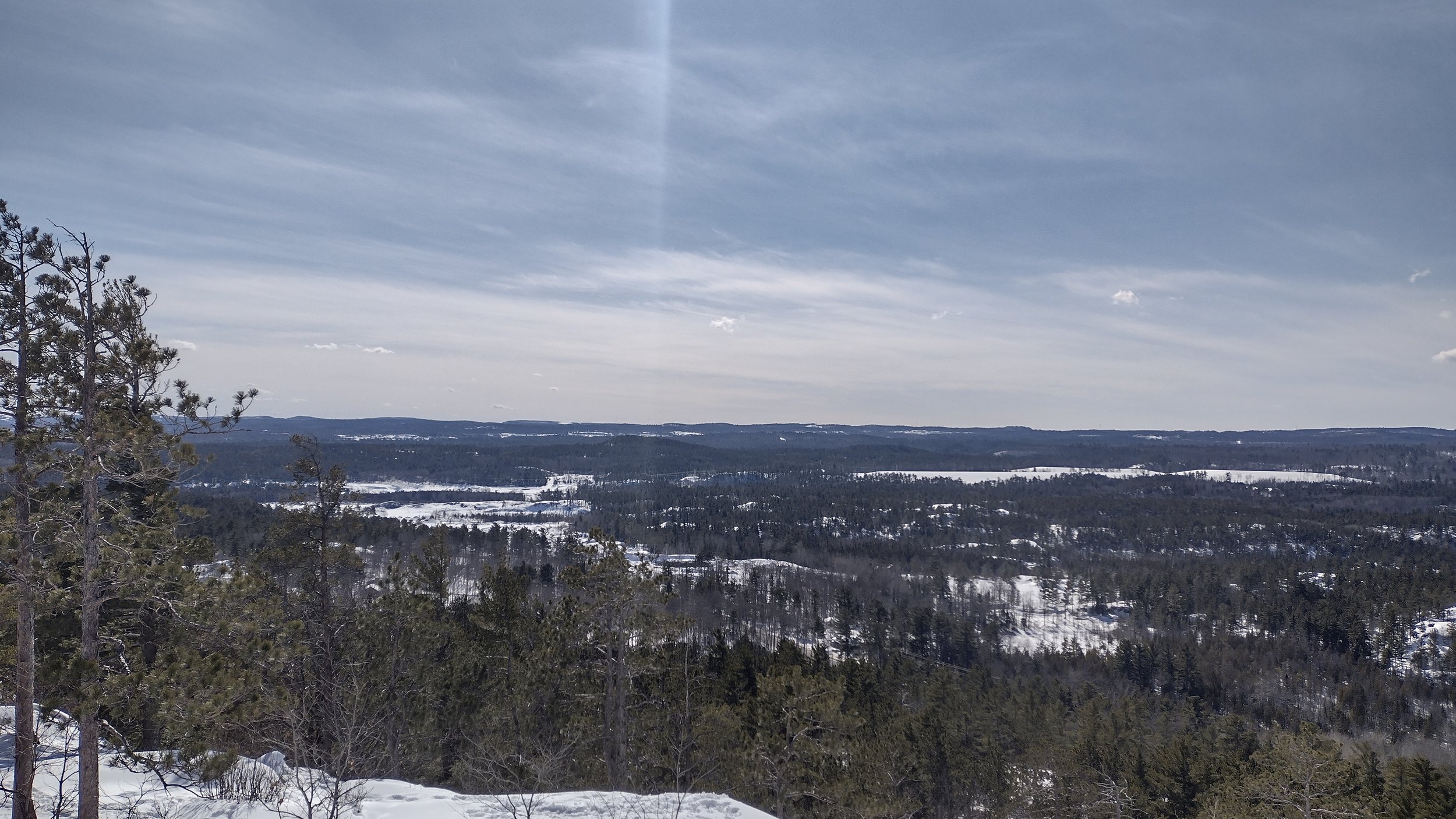
Another view from Sugarloaf Mountain. Photo by author.
Still, I think Harrison is onto something. The U.P. possesses some quality that, in a particular and privileged way among America’s territories, points on a natural level to the supernatural. So, this is your invitation: book a trip to Marquette or Escanaba or Sault Ste. Marie, rent a car, and drive—into the wilderness, into town, whatever—until inspiration strikes. Perhaps you will see what Jim Harrison and David Burkett saw, but just a little bit more clearly: that this is not a place that is God, but it is a place where God’s glory resides, in an unparalleled way, in nature. It is the most valuable kind of American frontier: a slice of the weirdness of Heaven.